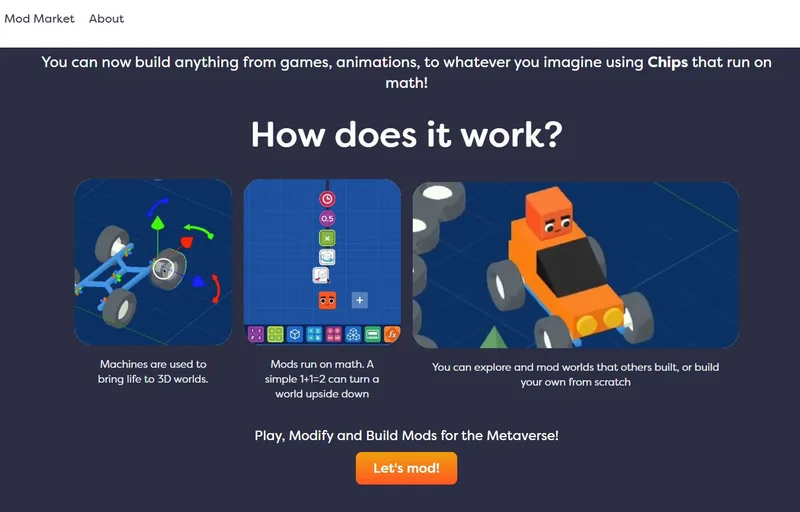
Polyup (now Let’s MOD) is the rare educational tool that doesn't feel like a digital worksheet. It’s a computational playground that treats math like a language you can use to build things, rather than a set of rules to follow.
If your kid is already into Minecraft or Scratch, this is the logical next step. It’s free, it’s smart, and it actually builds the kind of algorithmic thinking that matters in the real world. No ads, no fluff, just pure logic.
Age Fit
Best for ages 8 to 18. It is specifically designed for the K-12 spectrum, but the logic puzzles are sophisticated enough that even an adult might find the high-level 'machines' a decent brain teaser.
WISE Breakdown
Wholesome
92
It is a pure, education-first environment that trades cheap dopamine hits for the genuine satisfaction of solving a puzzle. The tone is encouraging without being patronizing.
Imaginative
88
Unlike standard math drills, this is a sandbox. Kids aren't just answering questions; they're 'modding' the logic of the world to see what happens.
Safe
85
Web-based and free with no aggressive monetization. The only variable is the user-generated content (sharing 'machines'), but the medium—mathematical expressions—is inherently low-risk for toxicity.
Enriching
95
It bridges the gap between 'doing math' and 'computational thinking.' It scales from basic addition to high school calculus, making it a long-term utility rather than a one-off game.
Parent Info
✓
Why It Might Be Great
Computational thinking is the star here, teaching kids how to build algorithms rather than just memorizing formulas.
It is a complete sandbox, meaning kids can experiment, fail, and iterate without the pressure of a ticking clock or a grade.
The massive age range (grades 3-12) means it grows with your kid, from simple operations to complex calculus.
It is highly accessible and runs on basically anything with a browser, including those school-issued Chromebooks.
⚠
What to Watch For
The site recently rebranded to Let’s MOD, so don't get confused if the URL or logo looks different than older school flyers.
The learning curve can be steep; if your kid isn't a natural tinkerer, they might need a 'machine' (puzzle) to get them started before they're ready to build their own.
Because it's open-ended, some kids might treat it like a toy and just mess around without actually engaging with the math unless there's a goal set.
Conversation Starters
"Can you show me a 'machine' you built and explain how the logic works?"
"If you changed one step in that algorithm, what do you think would happen to the result?"
"Why do you think they call it 'modding' instead of just 'math'?"
"Is it easier to solve someone else's puzzle or build your own from scratch?"