Our reviews and ratings are 100% unbiased. Screenwise is a Bookshop.org affiliate and an Amazon Associate, so if you buy a book through one of our links, we may earn a commission. Bookshop.org purchases also support independent bookstores.
Screenwise Verdict
Brooke Hartman's follow-up picture book hits the sweet spot for early elementary readers who love weird, high-stakes nature facts. By pitting adorable character designs against legitimate danger stats, the book turns evolutionary biology into an easy page-turner.
With 17 animals covered, Sourcebooks Explore keeps the formatting concise and readable. It balances cartoon comedy with real habitat info and conservation context, making it a great pick for kids who usually pass on traditional non-fiction.
Age Fit
Targeted directly at kids ages 6 to 9 (grades 1–4). Perfect for early readers who love weird nature facts or funny non-fiction.
WISE Breakdown
Wholesome
85
Uses lighthearted humor and playful cartoon art to introduce real animal behavior and survival mechanisms without graphic or disturbing elements.
Imaginative
82
Sparks scientific curiosity about the natural world, adaptation, and how appearances in nature can be deceiving.
Safe
90
It is a non-fiction picture book for early readers. Themes involve venom and hunting, but presented strictly through playful illustrations and educational facts.
Enriching
88
Delivers genuine biological facts, habitat specs, and conservation context for 17 species, making science accessible and engaging.
Parent Info
✓
Why It Might Be Great
Real biology wrapped in comedic contrast: Pairs sweet, fluffy faces with factual breakdowns of venom, stings, and hunting tactics across 17 animal species.
Built for reluctant readers: High-interest subjects and bite-sized text blocks keep first through fourth graders turning pages without feeling overwhelmed.
Grounded science: Includes actual habitat information, scientific naming, and conservation statuses alongside the wacky premise.
Expressive art: María García's cartoon illustrations keep the focus on humor rather than realistic predator gore.
⚠
What to Watch For
Predictable predator topics: Highly sensitive kids who dislike the idea of animal bites, poison, or prey hunting might prefer standard nature books.
Conversation Starters
"Which animal on these pages surprised you the most with its secret defense mechanism?"
"Why do you think some dangerous animals evolved to look harmless or cute instead of scary?"
"If you had to design a defense mechanism for a small creature, what would you give it?"
Deep Dive
Science facts disguised as a comedy book
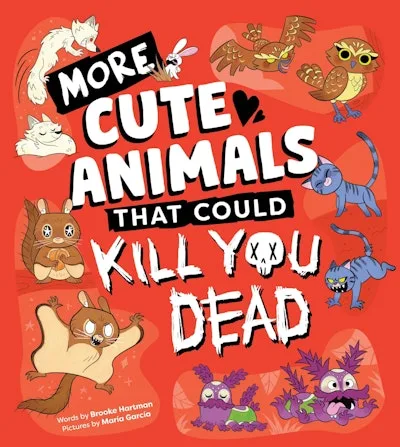
Books that hook reluctant readers usually need a strong gimmick, and pairing plush-looking animals with terrifying survival tactics is a proven winner. More Cute Animals That Could Kill You Dead expands on the premise of the original series entry, bringing 17 new species into the spotlight.
Instead of sensationalizing danger for cheap shocks, author Brooke Hartman keeps the content anchored in actual zoology. Kids get real breakdowns of species habitats, scientific classifications, and conservation statuses. Illustrator María García uses a bright, exaggerated cartoon style that keeps the mood light—you are looking at funny expressions and theatrical danger rather than graphic wildlife scenes.
How to read it with your kid
This is an ideal candidate for side-by-side reading with a 6- or 7-year-old, or independent browsing for an 8- or 9-year-old. The bite-sized text sidebars mean a kid can jump around to whatever creature catches their eye rather than reading sequentially. If you have a child who frequently asks for National Geographic Kids Weird But True or similar trivia collections, this hits that exact same impulse with a unified comedic narrative.