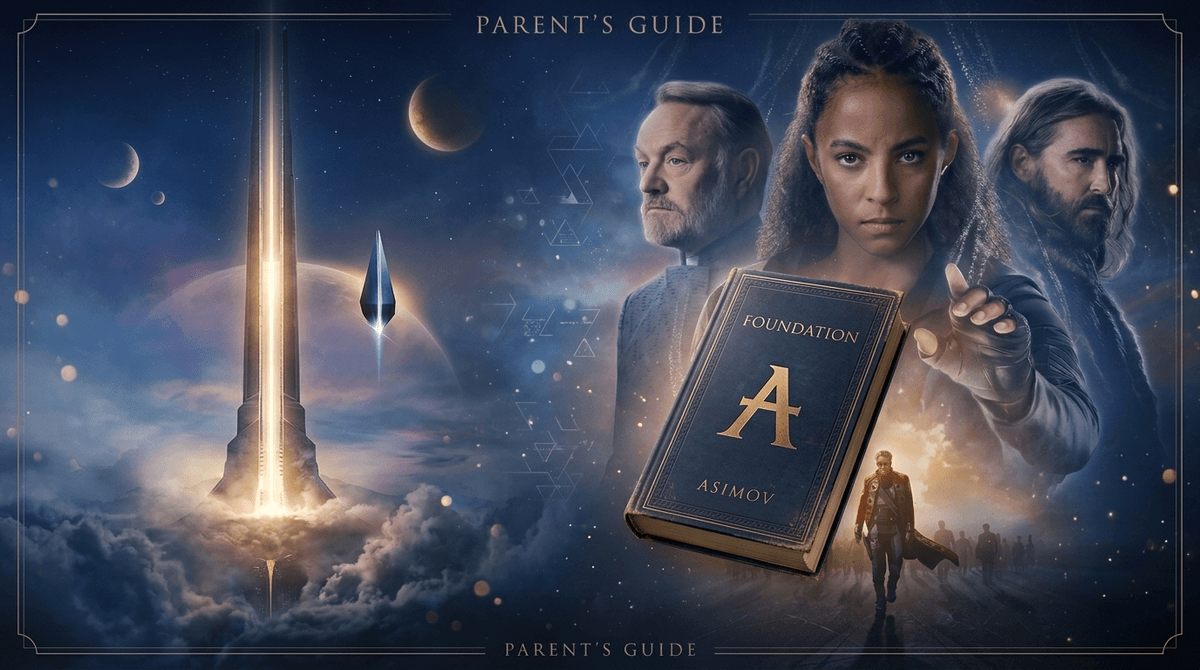
The ultimate cerebral space opera
Long before Star Wars put battle fleets on movie screens, Isaac Asimov proposed a radically different vision of galactic conflict: victory through sociology. Foundation collects five interconnected stories that track the collapse of a 12,000-year-old Galactic Empire and the tiny, isolated group of scholars tasked with shortening the coming dark age from 30,000 years down to a single millennium.
The central concept, psychohistory, uses mathematics to predict the behavior of massive populations. Hari Seldon cannot predict what an individual will do tomorrow, but he can predict how trillions of people will react to economic pressure over centuries. That shift from individual heroism to systemic leverage makes Foundation unique among classic sci-fi entry points.
Pacing and style for modern kids
Parents should know that Foundation reads very differently from contemporary middle-grade or young adult fiction. There are no teenage protagonists, no personal origin stories, and very little visceral action. Instead, each section drops the reader into a new historical epoch, introduces a new cast of diplomats or politicians, and sets up a political puzzle that must be solved before the planet is overrun.
Kids accustomed to quick chapter hooks and continuous character arcs might find the jumpy generation-hopping format jarring at first. However, for young readers who enjoy strategy board games, world-building, or historical analysis, this structure is genuinely satisfying. It treats the reader like an adult who can follow economic and political trade-offs.
How to get a young reader into it
If your kid is hesitant about older prose, consider starting with the audiobook. Listening to the sharp, theatrical dialogue brings out the drama of the political standoffs without letting the mid-century sentence structure slow down their reading momentum.