

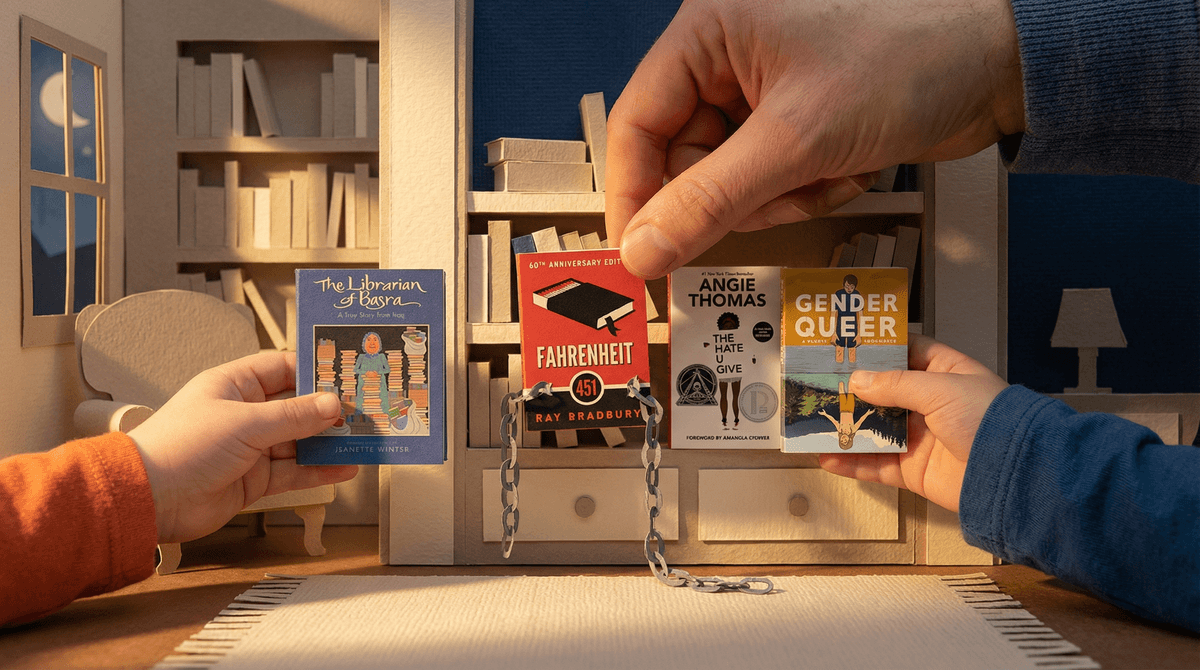
Here's the thing: book banning is having a massive moment right now, and kids are noticing. Whether it's their school library quietly removing titles, news coverage of heated school board meetings, or just hearing adults argue about what books belong in classrooms, censorship has become impossible to ignore.
Books about book banning are stories that tackle censorship head-on—sometimes through dystopian fiction where books are literally illegal, sometimes through realistic narratives about communities fighting over what kids should read, and sometimes through nonfiction that explains the history and stakes of these battles. Think Fahrenheit 451, but also contemporary YA novels where a character's favorite book gets challenged, or memoirs from authors whose own work has been banned.
And honestly? This might be one of the most important conversations you can have with your kids right now—not because you need to pick a side and indoctrinate them, but because understanding why people ban books teaches critical thinking in a way that few other topics can.
The American Library Association tracked over 1,200 challenges to library materials in 2022 alone, and that number has only grown. Books featuring LGBTQ+ characters, stories about racism, and memoirs about sexual assault are being pulled from shelves at rates we haven't seen in decades.
Your kids are growing up in this environment. They're hearing about it, whether you're talking about it or not. And here's what's wild: the controversy itself often becomes the best teaching moment.
When a book gets banned, kids want to know why. They want to understand who gets to decide what they read. They start asking questions about power, representation, and whose stories matter. These are exactly the conversations that build media literacy and critical thinking skills.
Ages 8-12: Starting the Conversation
The Day the Crayons Quit - Okay, hear me out. This picture book about crayons going on strike is actually a perfect entry point for talking about different perspectives and why everyone deserves to be heard. It's not explicitly about censorship, but it's about voices being silenced.
Maus by Art Spiegelman - Yes, it's a graphic novel about the Holocaust. Yes, it's been banned in some schools. For mature 5th-6th graders, this is an incredible way to talk about why some people want to hide difficult history.
The Librarian of Basra - A true story about a librarian in Iraq who saved books during war. Great for discussing why books matter and who tries to destroy them.
Ages 12-15: Getting Real
Speak by Laurie Halse Anderson - Frequently challenged for its depiction of sexual assault. This is the book to read if you want to talk about why people ban books that make them uncomfortable—and why those might be the most important books.
The Hate U Give by Angie Thomas - Challenged for "anti-police" content. Perfect for discussing how books about racism get labeled as "divisive" and what that really means.
Fahrenheit 451 by Ray Bradbury - The classic. Firemen burn books in a future where reading is illegal. Still hits hard, especially when your teen realizes it's not that far-fetched.
Ages 15+: The Deep Dive
The Handmaid's Tale by Margaret Atwood - Frequently banned, ironically proving its own point about controlling information. Dense but worth it for older teens.
Gender Queer by Maia Kobabe - The most challenged book in America for multiple years running. A memoir about gender identity that's been pulled from libraries nationwide. For mature teens ready to discuss why LGBTQ+ stories face disproportionate censorship.
All Boys Aren't Blue by George M. Johnson - A memoir about growing up Black and queer. Another heavily challenged book that older teens should know exists and understand why it's controversial.
Don't make it weird. Seriously. The conversation doesn't need to be a formal sit-down. Try this instead:
Start with curiosity: "I saw this book got removed from a school library in Texas. Want to hear what it's about?" Let them react first.
Ask questions: "Why do you think some adults don't want kids reading this?" "Who gets to decide what books are appropriate?" "What would you do if your favorite book got banned?"
Share your own experience: Did you read books your parents didn't know about? Did you ever encounter a book that changed how you saw the world? Be honest about how reading shaped you.
Read the challenged books yourself: You can't have a real conversation about The Bluest Eye or Looking for Alaska if you haven't read them. Yes, some contain mature content. That's often exactly why they matter.
Book banning is not the same as age-appropriate curation. Nobody's arguing that kindergarteners should read graphic memoirs about trauma. The question is: who decides what high schoolers can access? And why are books about marginalized experiences challenged at higher rates?
Your kid will find banned books if they want to. The internet exists. Banning a book often just makes it more appealing. Better to read it together and talk about it than have them consume it alone without context.
This isn't about your politics. Whether you lean left or right, teaching your kid to think critically about censorship is valuable. You can personally disagree with a book's content while still believing it shouldn't be banned. That nuance is the whole point.
Diverse books aren't "divisive" by default. Books featuring LGBTQ+ characters, people of color, or different religions aren't controversial just by existing. When we frame representation as inherently political, we're teaching kids that some people's stories are "normal" and others are "agenda."
Reading books about book banning—or reading banned books themselves—isn't about rebellion for rebellion's sake. It's about teaching kids to ask why someone wants to control information, who benefits from that control, and what we lose when we let fear dictate what stories get told.
The goal isn't to force your kid to read every challenged book. It's to raise someone who understands that free access to information matters, that uncomfortable books often teach us the most, and that critical thinking means engaging with ideas you might not agree with.
Start with one book. Read it together. Talk about why someone might want to ban it. Listen to your kid's reaction. That's it. That's the whole strategy.
- Check what's been challenged in your school district - Most districts have public records of book challenges. Look them up together with your teen.
- Visit your library - Ask the librarian about Banned Books Week (usually in September) and what titles they feature.
- Read a challenged book together - Pick one from the list above based on your kid's age and interests. See what all the fuss is about.
- Explore more resources - Learn more about media literacy and critical thinking
 with your kids.