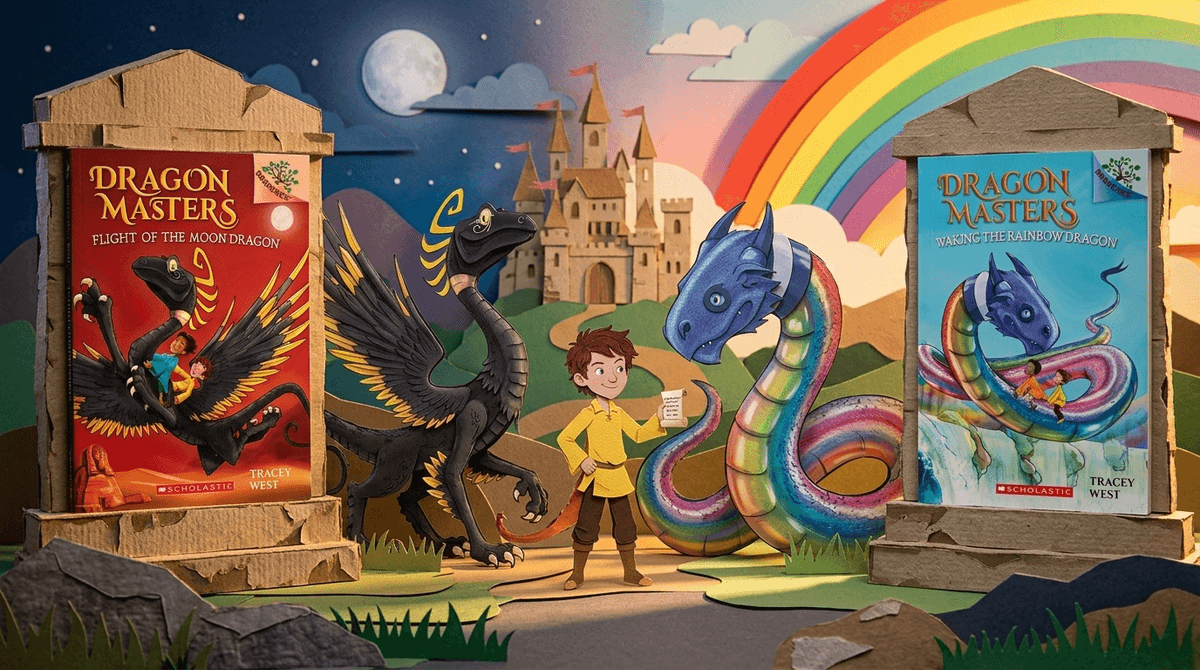
If your kid is currently staring at a page of text like it’s a chore list, Dragon Masters is the pivot. It’s the gateway drug to independent reading because it understands a fundamental truth about seven-year-olds: they want to feel like they’re reading a "real" book without the crushing weight of a 300-page block of text.
The Scholastic Branches blueprint
The genius here isn't in the writing—the prose is utilitarian at best—but in the formatting. Scholastic’s Branches line is basically the "easy mode" of literature. You get short chapters that end on mild cliffhangers, plenty of white space, and black-and-white illustrations on every single page.
For a kid who is used to picture books, a standard chapter book can feel like a desert. Dragon Masters provides a watering hole every thirty seconds. It’s less about the literary merit and more about the momentum. Once a kid realizes they can knock out three chapters before dinner, their internal narrative shifts from "I can't read" to "I'm a reader." That psychological win is the entire point of the series.
The "Gotta Catch ‘Em All" hook
Tracey West uses a formula that will feel familiar to any kid who has ever collected cards or played a monster-battling game. Each book introduces a new dragon with a specific elemental power—Earth, Sun, Water, Fire, Poison—and a new kid to pair with it. It’s a collectible card game in book form.
This structure is intentional. It creates a "what happens next?" loop that keeps kids asking for the next installment. If they finish the first five and are still hooked, you’re looking at a massive catalog of sequels. You can check out our parent's guide to the complete Dragon Masters series to see how deep that rabbit hole goes.
The roadmap to "Wings of Fire"
Think of Drake’s adventures as the training wheels for the heavy hitters. If your kid loves the dragon lore here but starts complaining that the stories are too short or "too easy," that is your cue to level up.
Most kids use these books as a bridge. They spend six months obsessed with Drake and the wizards, then suddenly they have the stamina to handle the more complex world-building of something like Wings of Fire. If you’ve finished this first set and aren’t sure if the quality holds up as the series progresses, take a look at the breakdown for Dragon Masters books 6–10.
The series does eventually run into the "seasonal rot" problem that hits any long-running franchise. By the time you get to the much later entries, like Defending the Swamp Dragon, the formula is well-worn. But for a first-grader just starting their journey, these first five books are the perfect entry point. They aren't trying to be high art; they’re trying to be finished, and that's exactly what a new reader needs.