The Art of the Red Herring
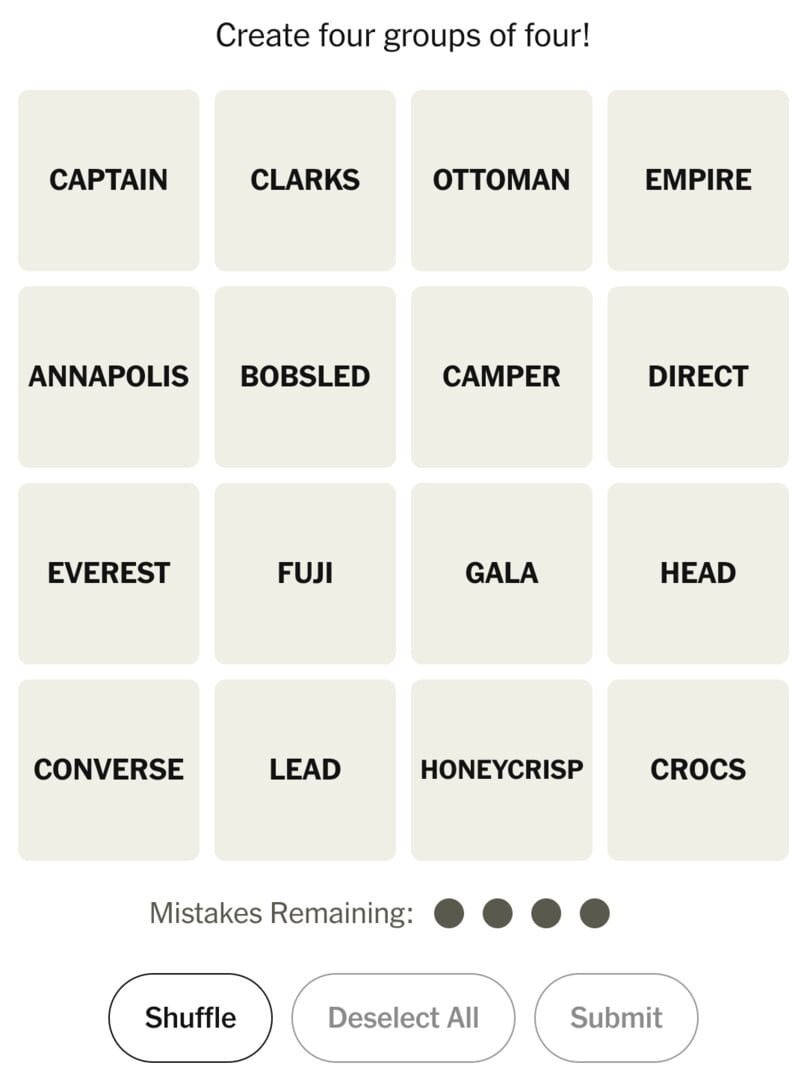
Word games usually test recall: how many five-letter words do you know, or how quickly can you anagram a string of letters? Connections, edited by Wyna Liu for The New York Times, tests something closer to cognitive flexibility. The board presents sixteen words arranged in a neat four-by-four grid. Your job is to sort them into four groups of four.
The catch is the bait. If you see BASS, FLOUNDER, CARP, SALMON, and PIKE on the board, the game is daring you to group four fish immediately. Pick four at random, and you will almost certainly waste a guess, because PIKE is meant for "Turnpikes and freeways," or CARP belongs in "Words that mean complain."
Watching a kid encounter this design for the first time is fascinating. Most kids start by rapid-firing whatever looks obvious. After a couple of days of burning their four allowed strikes before solving a single row, they slow down. They start scanning for the outlier. They begin asking what else a word can mean.
Why It Works as a Co-Play Game
Solo, Connections can occasionally feel infuriating when a puzzle leans heavily on adult cultural literacy—think obscure 1970s bands, poker terminology, or cocktail mixers. But played together over breakfast or during a car ride, those gaps turn into a feature.
Kids will routinely spot the literal, visual groupings or contemporary slang that adults completely miss, while adults supply the idiom context. The game has no timer, no leaderboard pressure, and no in-game currency pushing you to buy hints. You stare at sixteen words, debate why "RABBIT" and "HABIT" might be related, and close the tab when you are done.