Why Tower Defense Works on a Living Room Table
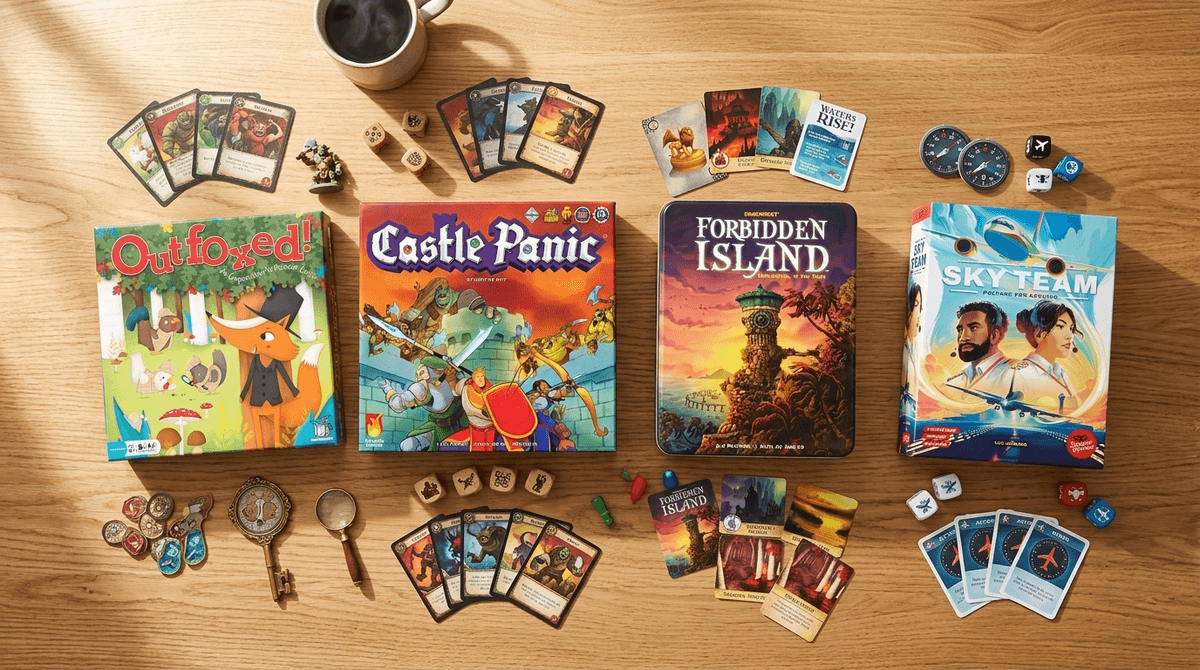
Most video game mechanics translate awkwardly to cardboard, but Justin De Witt nailed the tower defense loop back in 2009 by leaning on tactile clarity. In Castle Panic, the board is a giant target divided into colored sectors and distance rings. Monsters spawn in the forest edge and inexorably step inward toward your six center towers every turn.
Kids intuitively grasp the danger. A troll sitting in the Archer ring is a future problem; an orc standing directly in the Swordsman ring with two health points is a screaming emergency. Because cards only hit specific intersections—like a Blue Knight or a Green Archer—no single player ever has the hand required to solve the whole board. Cooperation isn't just encouraged; the math makes solo hero ball impossible.
The Master Slayer Rule Trap
The base box advertises a semi-cooperative rule called "Master Slayer," where players count up their monster trophies at the end to declare an individual winner.
Ditch this rule immediately. It introduces an ugly perverse incentive where players quietly withhold crucial defense cards so their sibling's wall gets smashed, just so they can swoop in on their own turn to claim the kill points. Castle Panic is at its absolute best as a pure, brutal cooperative puzzle where everyone celebrates when the final monster token hits the discard pile.
Managing the Alpha Player
The only real gameplay hurdle is "quarterbacking." Because cards are usually laid out flat on the table when playing with younger kids, a controlling older sibling or an eager parent can easily start barking orders: "Trade me that blue card, then play your archer, do not touch that swordsman."
To keep it enriching, enforce a simple household boundary: the player whose turn it is always makes the final call, and you can only propose trades from your own hand rather than dictating someone else's. Letting an eight-year-old make a slightly suboptimal play and watching them scramble to patch the wall later is where all the real strategic thinking happens.