

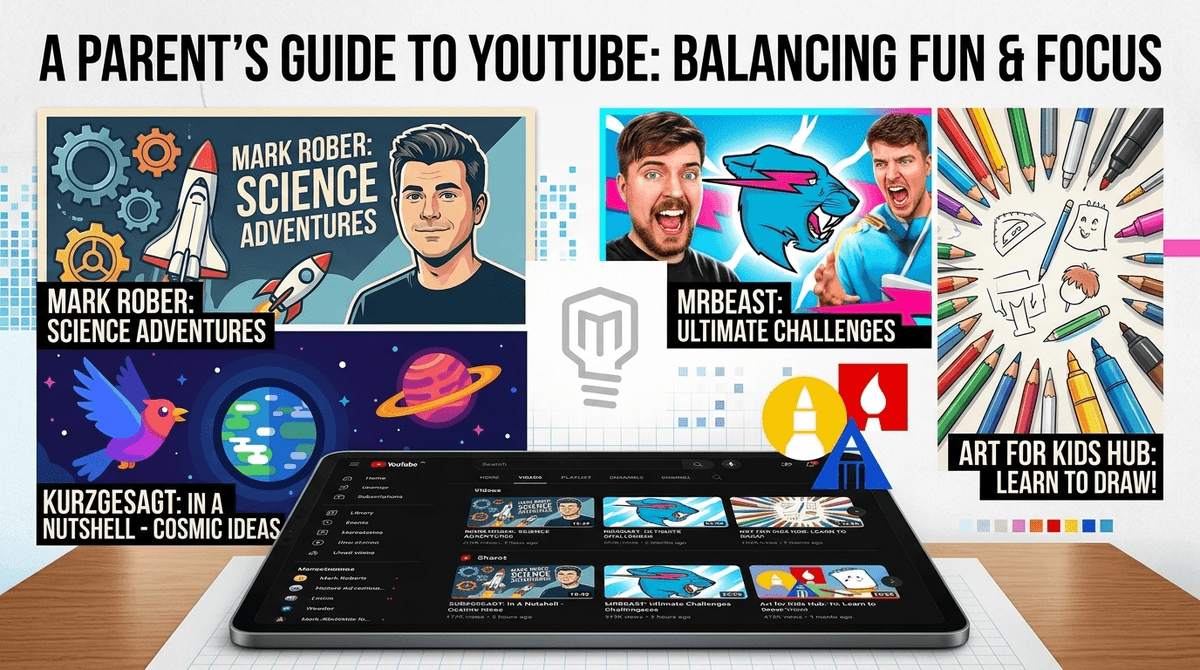
TL;DR: YouTube is the Wild West, and while it's easy to get lost in the "brain rot" of Skibidi Toilet or endless unboxing videos, it’s also the greatest free educational resource ever created. If you’re looking for the good stuff right now, check out Mark Rober for high-octane science, Art for Kids Hub for actual creativity, and Kurzgesagt for mind-blowing big-picture learning.
We’ve all been there. You’re trying to get dinner on the table, and you hand over the iPad for "just ten minutes." An hour later, you look over and your kid is watching a giant CGI toilet with a human head singing a remix while everything explodes. Or they’re watching a 25-year-old multi-millionaire scream while opening 500 mystery boxes.
You feel that familiar pang of parent guilt. Is their brain melting? Is this "Ohio" thing actually a cult? (Spoiler: No, it’s just Gen Alpha slang for "weird," but the content is still questionable).
According to recent data, over 90% of kids under 12 are regular YouTube users. It’s the default entertainment hub, beating out Netflix and Disney+ by a mile. But the gap between "high-quality educational content" and "digital junk food" is massive.
Here is how to curate a feed that actually feeds their brain instead of just rotting it.
Before we judge, we have to understand the appeal. Content like Skibidi Toilet or the high-energy chaos of MrBeast is designed using the same psychological triggers as slot machines. They use fast cuts, bright colors, and constant "micro-rewards" (loud noises, jokes, visual gags) every 3-5 seconds.
It’s not that your kid is "lazy"; it’s that their developing prefrontal cortex is no match for a billion-dollar algorithm designed to keep them clicking.

If we want kids to move away from the junk, we have to provide "healthy" content that is actually entertaining. Boring "educational" videos won't cut it when they're competing with Roblox streamers.
Science & Engineering (The "Cool" Factor)
These channels are the gold standard. They have high production value and make kids feel like they’re part of a secret club of geniuses.
-
The former NASA engineer who makes glitter bombs to catch porch pirates. It’s funny, it’s high-energy, and it teaches genuine physics and engineering principles. This is the peak of "stealth learning."
Mark Rober (Ages 6+)
-
Destin Sandlin explores the world with genuine curiosity. Whether he’s looking at how a butterfly’s wings work or the physics of a deep-sea explosion, it’s wholesome and intellectually stimulating.
Smarter Every Day (Ages 8+)
-
Perfect for the "Why is the sky blue?" phase. It’s bright, fast-paced, but grounded in real science.
SciShow Kids (Ages 4-8)
Big Ideas & History
-
Beautifully animated (and slightly existential) videos about space, biology, and the future of humanity. Warning: They don’t pull punches on topics like climate change or black holes, so it might spark some "deep" dinner table conversations.
Kurzgesagt – In a Nutshell (Ages 10+)
-
Short, animated lessons on everything from Greek mythology to how a virus works. It’s the ultimate "rabbit hole" for curious kids.
TED-Ed (Ages 8+)
Creativity & Movement
-
A dad and his kids draw together. It’s simple, encouraging, and actually results in your kid putting the screen down to pick up a marker.
Art for Kids Hub (Ages 5+)
-
Yoga through storytelling. Jaime is a legend for a reason—she keeps kids moving while they think they’re just playing through a story about Minecraft or Frozen.
Cosmic Kids Yoga (Ages 3-7)
Parents often ask: "Is MrBeast bad?" He’s not "brain rot" in the traditional sense. His videos often promote philanthropy and incredible work ethic. However, he also promotes a very specific brand of "hyper-consumerism." Every problem is solved with a suitcase of cash. It’s worth watching a few videos with your kid to talk about the difference between "doing good" and "doing good for views."
Here is the No-BS truth: YouTube Kids is not a "set it and forget it" solution. The algorithm can still fail, and "Elsagate" style content (weird, inappropriate videos disguised as kids' cartoons) still occasionally slips through.
- For Kids Under 8: Use YouTube Kids but set it to "Approved Content Only." This means you—the parent—select the channels they can watch. It takes 10 minutes to set up and saves you 10 hours of worrying.
- For Kids 9-12: Move to a "Supervised Account" on the main YouTube platform. This allows you to filter out the most mature content while giving them access to the educational channels that aren't available on the "Kids" app.
- The Sidebar is the Enemy: The "Recommended" sidebar is where kids go to die (metaphorically). It’s designed to lead them to more extreme, high-arousal content. Encourage them to stay in their "Subscriptions" tab.
How do you know if a channel is "Brain Rot"? Look for these red flags:
- High-pitched, repetitive sound effects. If it sounds like a casino, it's designed to be addictive.
- "Surprise" mechanics. Constant unboxing or "blind bags." This triggers the same dopamine response as gambling.
- Zero narrative or educational value. If the video is just someone playing Roblox and screaming "OH MY GOD" for 20 minutes, it's junk food. It’s fine in moderation (like a bag of chips), but it shouldn't be the whole meal.
Instead of saying "That show is stupid," try asking:
- "What did you learn from that video?"
- "Why do you think that creator is screaming so much?"
- "How do you think they made that special effect?"
If they can't answer, or if they seem "glazed over" or irritable when you ask them to turn it off, that’s your sign that the content is overstimulating their system.
YouTube isn't the enemy; the algorithm is. When we let our kids "surf," they usually end up in the digital gutter. But when we curate their feed with creators like Mark Rober or Art for Kids Hub, we’re giving them a front-row seat to the best teachers in the world.
Next Steps:
- Open your kid’s YouTube account tonight.
- Unsubscribe from the "screamers" and the toy unboxers.
- Subscribe to five of the educational channels listed above.
- Watch one with them.
Check out our full list of recommended YouTube channels by age