

TL;DR
Xavier Riddle and the Secret Museum is a solid PBS Kids show that hits the sweet spot for 6- and 7-year-olds who are ready for something with a bit more substance than pure entertainment. The time-travel premise is fun, the historical figures are genuinely inspiring, and the character lessons land without feeling preachy. The history is simplified (we're talking PBS Kids, not Ken Burns), but the show does an impressive job introducing young kids to people like Jackie Robinson, Helen Keller, and Harriet Tubman in age-appropriate ways. If your kid is asking bigger questions about fairness, courage, or "why can't I do this hard thing?"—this show gives you conversation starters wrapped in an adventure story.
Bottom line: It's quality screen time that won't make you cringe, and it might actually spark some "wait, tell me more about that person" conversations. Available free on PBS Kids and the PBS Kids app.
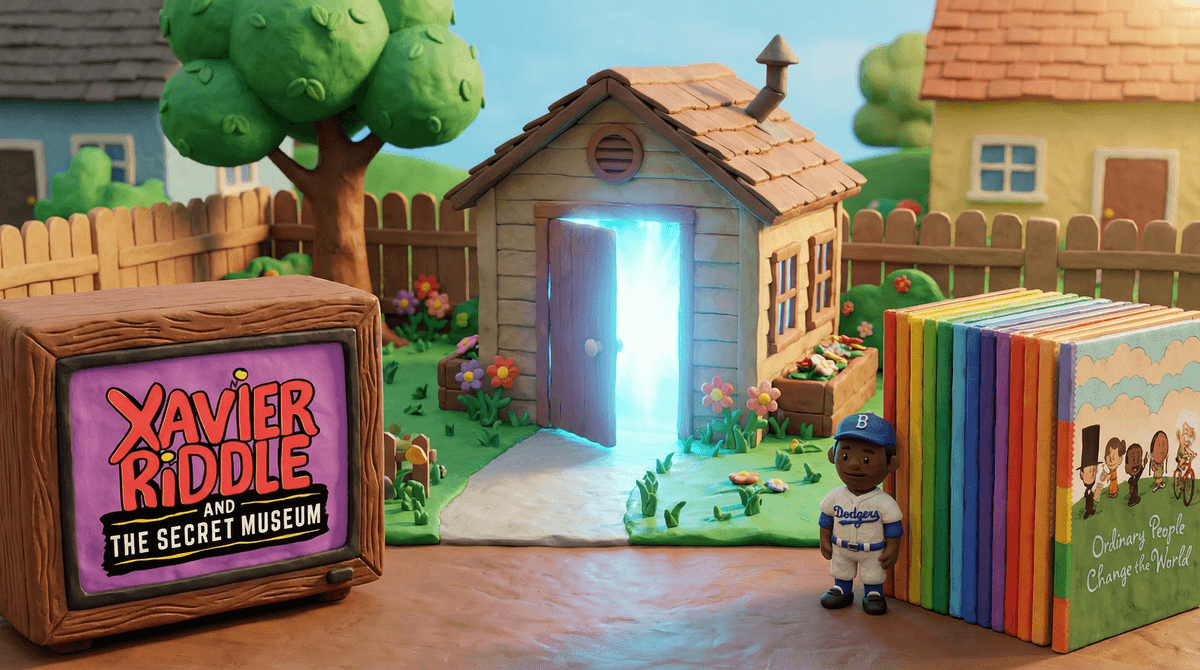
Xavier Riddle and the Secret Museum follows 8-year-old Xavier, his 6-year-old sister Yadina, and their friend Brad as they solve everyday kid problems by literally traveling back in time to meet historical heroes when they were children. Each 30-minute episode starts with a relatable dilemma—"How do I get better at reading?" or "Why should I keep trying when things are hard?"—and then the trio heads to Xavier's Secret Museum (which is actually in his backyard, because of course it is) to meet someone who faced a similar challenge.
The show is based on Brad Meltzer's Ordinary People Change the World book series, and it's designed specifically for kids ages 4-7. The animation is bright and friendly, the pacing is solid, and the structure is predictable in that comforting way that young kids love.
This age group is in a fascinating developmental sweet spot. They're old enough to grasp simple cause-and-effect ("Helen Keller couldn't see or hear, but she learned to communicate anyway"), but they're not yet ready for the full complexity of historical context. Xavier Riddle nails this balance.
The show emphasizes character traits over historical accuracy, which is honestly the right call for this age. When your 7-year-old meets Marie Curie in the show, they learn about persistence and curiosity, not the specifics of radioactive decay. The historical figures are presented as kids who had doubts, made mistakes, and had to work hard—which makes them feel accessible rather than untouchable.
The 30-minute runtime is perfect for this age. It's long enough to develop a story with some depth, but not so long that kids zone out or you end up with the "just one more episode" battle. And because it airs on PBS (weekdays at 9 AM, plus available on demand), you're not dealing with ads or algorithm-driven autoplay trying to serve up 47 more episodes.
The history is simplified—and that's okay. Some parents worry that the show glosses over important details or presents a sanitized version of historical events. Fair concern! The show absolutely does simplify. When Xavier meets Harriet Tubman, he learns about bravery and helping others, but the full horror of slavery isn't front and center. This is age-appropriate, but it also means you might want to supplement with books or conversations as your kid gets older and asks more questions.
The PBS Parents site actually has discussion guides that walk you through how to extend the lessons from each episode, which is genuinely helpful if you want to go deeper.
The show has a clear formula, which can feel repetitive to adults but works well for kids. Problem → time travel → meet hero → learn virtue → apply lesson → problem solved. If you're watching with your kid (which, honestly, you probably won't be doing for every episode), you might find it a bit predictable. But predictability isn't a bad thing for this age group—it helps them follow the story and anticipate what's coming.
Screen time context: About 92% of families in our community report their kids watch TV or streaming content, and 42% of kids use YouTube solo by this age. If your 6- or 7-year-old is going to be watching something, Xavier Riddle is a strong choice compared to the algorithm-driven chaos of YouTube or the passive consumption of random cartoons.
The show has been nominated for Annie and Daytime Emmy awards for its writing and directing, which tells you the production quality is solid. But beyond awards, the real question is: does it actually teach anything?
Yes, but mostly social-emotional learning rather than academic content. The core curriculum here is character development—empathy, perseverance, courage, kindness. Each episode features a real historical figure and highlights a specific virtue they embodied. The show explicitly encourages kids to see themselves as potential "heroes" who can make a difference, which is a genuinely lovely message for this age.
The historical content is surface-level, but it's a starting point. If your kid comes away from an episode asking "Who was Jackie Robinson?" or "Why couldn't Helen Keller see?"—that's a win. You can build from there with age-appropriate books about historical figures or deeper conversations.
It's very earnest. If your family's humor tends toward the sarcastic or ironic, Xavier Riddle might feel a little... wholesome. The kids are unfailingly kind to each other, problems are solved with communication and effort, and everyone learns their lesson by the end. It's not unrealistic exactly, but it's definitely idealized.
The time-travel logic is hand-wavy. If your kid is the type to ask "But how does the museum work?" or "Why can they understand each other if they're from different time periods?"—you're going to need to lean on "it's magic" as an explanation. The show doesn't try to explain the mechanics, which is probably wise, but it can be a sticking point for literal-minded kids.
Representation is good but not perfect. The show features a diverse cast of historical figures, including many women and people of color. Xavier's family is also racially diverse (his mom appears to be white, his dad appears to be Black). That said, the main trio is two boys and one girl, and Yadina sometimes falls into the "younger sister" role rather than being fully equal in the adventures.
Episodes are available free on PBS Kids, the PBS Kids app, and the dedicated Xavier Riddle app. No subscription required, no ads, no algorithm trying to autoplay your kid into a YouTube rabbit hole. This is genuinely one of the easiest shows to access without dealing with streaming service nonsense.
If you want to watch together, the discussion prompts on the PBS Parents site are actually useful. After an episode, you can ask: "What virtue did [historical figure] show?" or "How did that help Xavier solve his problem?" or "Have you ever felt like that?" It's a low-lift way to turn screen time into conversation.
If your kid loves Xavier Riddle, they might also enjoy:
- Wild Kratts (also PBS, animal facts with adventure)
- Odd Squad (PBS, math and problem-solving)
- The Magic School Bus Rides Again (Netflix, science adventures)
- Story Pirates (podcast, if you want to mix in audio content)
For books, the original Brad Meltzer Ordinary People Change the World series is a natural companion—same concept, more detail, and you can read them together.
Xavier Riddle isn't going to change your kid's life, but it's thoughtful, well-made, and genuinely educational in ways that matter for 6- and 7-year-olds. The history is simplified, but the character lessons are solid, and the show gives you natural openings for conversations about courage, kindness, and perseverance.
If you're trying to make intentional choices about screen time (and if you're reading this, you probably are), Xavier Riddle is a strong yes. It's free, it's accessible, and it's the kind of show where you won't feel like you need to "balance out" the content with something more enriching later.
Next step: Queue up an episode and watch it with your kid once to see if it clicks. If they're into it, let it run for a while—30 minutes of Xavier Riddle is a perfectly reasonable way to spend screen time. And if they start asking questions about the historical figures? That's your cue to grab a book or have a conversation. The show is doing its job.