

Look, if your kid can name every Avenger but draws a blank on Mae Jemison or Dolores Huerta, we've got some work to do. And honestly? That's not on you—it's on a system that still defaults to teaching history through a pretty narrow lens.
Here's the thing: representation in what our kids consume matters. Not in a check-the-box way, but in a "holy crap, someone who looks like me did THAT?" way. When kids see diverse role models who've actually shaped the world, it expands their sense of what's possible for themselves and deepens their understanding of whose contributions built the world they're living in.
So let's talk about how to introduce your kids to women of color who made history—not as a one-off Black History Month project, but as part of the ongoing conversation about who gets to be a hero in our stories.
Kids are forming their understanding of "normal" and "possible" right now. If every scientist they learn about is a white dude, if every leader looks the same, if every "important person" fits one mold—that becomes their baseline for who gets to do important things.
But here's what's wild: the internet and streaming have made it easier than ever to find these stories. We're not limited to whatever's in the school library anymore. There are documentaries, podcasts, YouTube channels, books, and shows specifically designed to highlight diverse historical figures.
The challenge isn't access—it's being intentional about seeking these stories out and making them part of your regular media diet, not just a special occasion thing.
The best entry point? Whatever your kid is already into.
Into space? Mae Jemison (first Black woman in space) is your gateway. A Computer Called Katherine tells Katherine Johnson's story for younger kids, and Hidden Figures is perfect for ages 10+.
Obsessed with superheroes? Talk about real-life heroes. Marsha P. Johnson fought for LGBTQ+ rights. Yuri Kochiyama was a civil rights activist. Dolores Huerta co-founded the farmworkers movement. These women literally changed laws and saved lives.
Into art or music? Frida Kahlo, Maya Angelou, Ella Fitzgerald, Misty Copeland—there are incredible documentaries and picture books about all of them.
Love sports? Wilma Rudolph, Althea Gibson, Serena Williams. The Queen of Basketball (about Lusia Harris) is a fantastic short doc on Disney+.
The key is connecting history to their existing interests, not making it feel like homework.
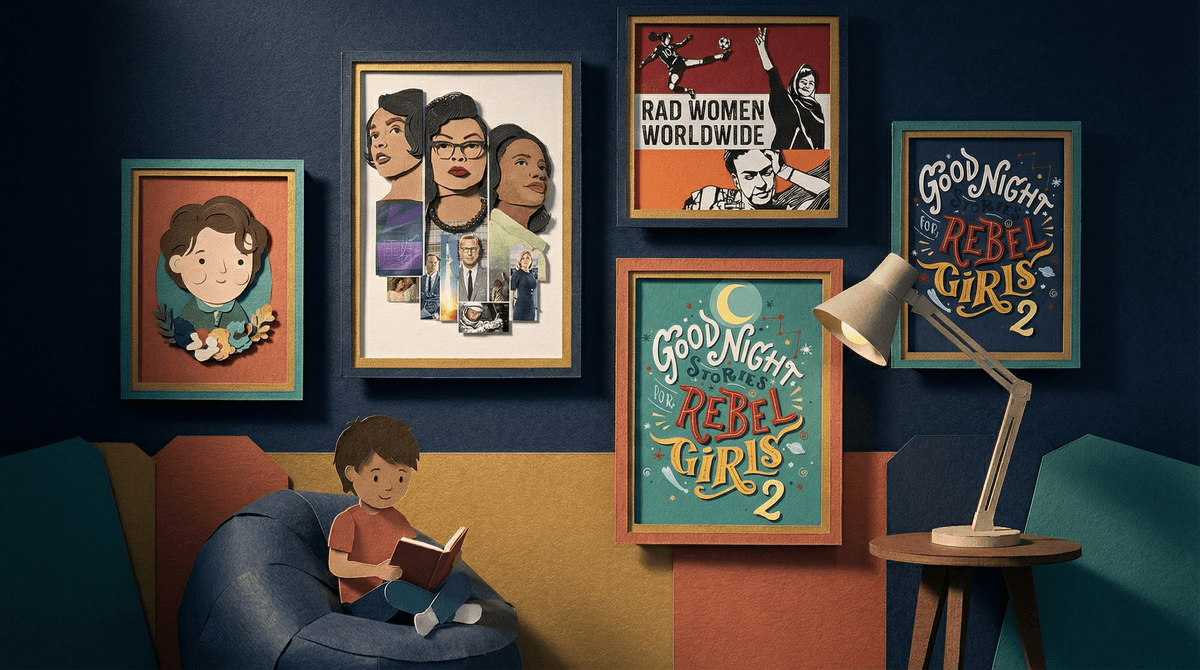
Ages 4-7: Picture books are your best friend here. Rad Women Worldwide and the "Little People, Big Dreams" series are great starting points. Keep it visual, keep it story-based, and don't worry about getting too deep into the historical context yet.
Ages 8-12: This is prime time for documentaries, chapter books, and podcasts. Brains On! has episodes on various scientists and inventors. Who Was? book series covers tons of historical figures. Netflix's "Amend: The Fight for America" has accessible episodes about civil rights.
Ages 13+: They can handle the full story now—including the messy, complicated parts. Ava DuVernay's 13th on Netflix is essential viewing (though intense—watch together). Podcasts like "Throughline" from NPR dive deep into historical context. Books like Stamped by Jason Reynolds and Ibram X. Kendi are written specifically for teens.
Don't make it weird. You don't need to announce "Today we're learning about diversity!" Just... put these stories in front of your kids. Watch the documentary. Read the book. Make it normal.
It's okay if you're learning too. Maybe you also didn't learn about Claudette Colvin or Zitkala-Sa in school. Cool—learn together. Kids actually love when parents are curious alongside them.
Representation isn't just for kids of color. White kids need to see diverse heroes too. It's how they learn that "important person" doesn't have one default setting.
Context matters for older kids. When you're talking about historical figures, especially with tweens and teens, don't sanitize the racism, sexism, and obstacles these women faced. The "despite all odds" part is what makes their achievements so powerful.
Use your existing subscriptions. You probably already have access to tons of this content. Netflix, Disney+, your library app—they all have documentaries and shows featuring diverse historical figures. Check out what's already available to you .
.
Here's where a lot of well-intentioned parents stumble: they do a Black History Month unit or an International Women's Day thing, and then it's back to the regular programming.
Instead, make this part of your regular media rotation:
- When picking a movie for family night, include biopics and documentaries in the mix
- Subscribe to a podcast that regularly features diverse voices and stories
- Keep books by and about women of color on the nightstand rotation
- When your kid asks "who invented that?" or "who discovered that?"—look it up together and see who actually did
The goal isn't perfection. You're not trying to cover every important figure or make sure your kid knows every name. You're just trying to make sure the heroes and role models they encounter aren't all cut from the same cloth.
Your kids are going to absorb someone's version of history and whose contributions matter. It might as well be one that reflects reality—which is that women of color have been scientists, activists, artists, leaders, and world-changers throughout history.
The good news? You don't need a curriculum or a special program. You just need to be a little bit intentional about the media you're already consuming. Swap one Marvel movie for Hidden Figures. Add Good Night Stories for Rebel Girls to the bedtime rotation. Put on a podcast about Shirley Chisholm on the drive to soccer practice.
Small moves, consistently, over time. That's how you raise kids who understand that heroes come in all colors, genders, and backgrounds—and who can imagine themselves as the next person to change the world.
Want more specific recommendations? Get age-appropriate books and shows about women of color who made history tailored to what your kid is already into.
Or explore how to talk to kids about representation in media more broadly—because this conversation goes way beyond just historical figures.