

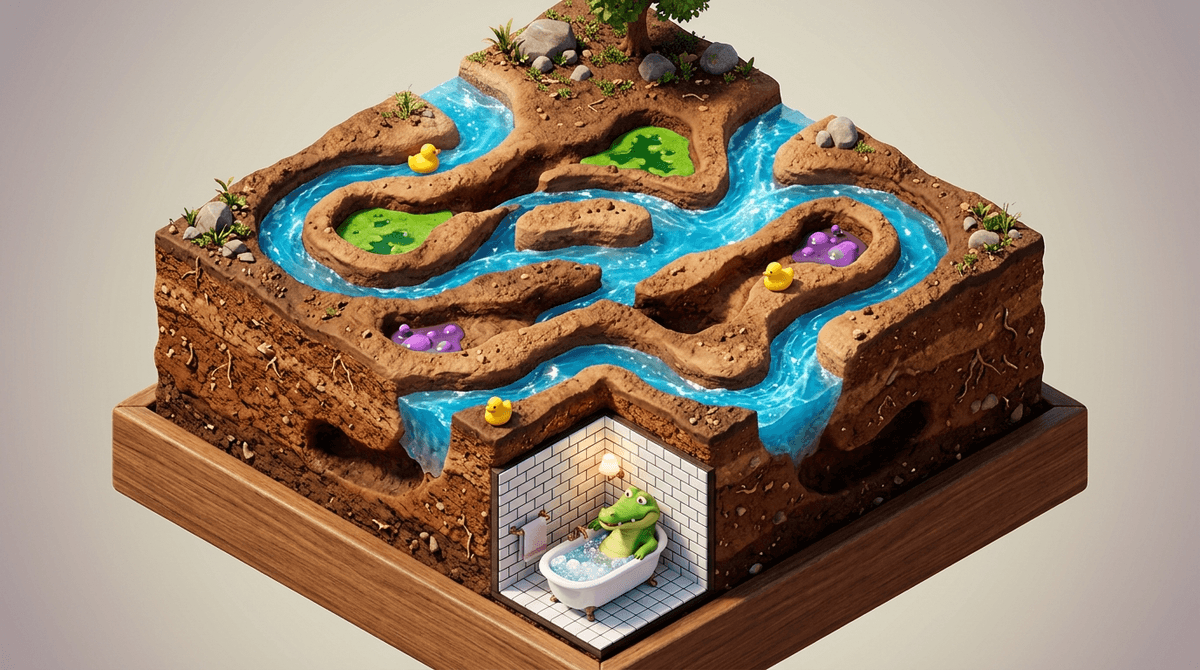
TL;DR: Where’s My Water? is an absolute classic physics-based puzzle game that actually makes kids think. It’s the "O.G." of mobile logic games, featuring Swampy the Alligator and some surprisingly complex fluid dynamics. While the gameplay is top-tier for brain development, the modern "free-to-play" version is cluttered with ads and prompts for in-app purchases that can be a headache for parents.
Quick Recommendations:
- For the logic lovers: Cut the Rope
- For beautiful, calm puzzles: Monument Valley
- For creative builders: Minecraft
- For classroom-style logic: Coolmath Games
If you’ve been in the parenting game for a while, you probably remember when this app first dropped in 2011. It was a massive hit because it was one of the first mobile games to actually feel like a game rather than just a digital distraction.
The premise is simple: Swampy is an alligator who lives in the sewers, but unlike his peers, he really likes being clean. He just wants to take a shower. Your job is to dig through dirt and navigate obstacles to get a fresh stream of water into his bathtub.
As the levels progress, it gets significantly more complicated. You aren't just moving water; you’re dealing with "algae" (which grows when it touches water), "toxic sludge" (which destroys your water), and various steam and ice mechanics. To "beat" a level perfectly, you also have to guide the water into three rubber ducks scattered around the screen.
There is something deeply satisfying about the physics in this game. Digging through the dirt with a finger feels tactile and intuitive. It’s the same reason kids (and let’s be honest, adults) find those "satisfying" sand-cutting videos on TikTok so mesmerizing.
Beyond the "crunchy" feel of the gameplay, Swampy is a charming character. Disney did a great job giving him personality without making him talk your ear off. When you fail to get the water to his tub, he whimpers or scrubs the walls; when you succeed, he celebrates. It’s cute, it’s low-stakes, and it feels rewarding.
Check out our guide on the best physics-based games for kids
We talk a lot about "brain rot" content—those mindless, high-dopamine loops that leave kids sounding like they’ve been hypnotized. Where’s My Water? is the opposite of that.
It requires:
- Spatial Reasoning: Kids have to visualize how water will flow, bounce, and pool before they even make a move.
- Problem Solving: If the toxic sludge touches the water, the level is over. Kids have to figure out how to neutralize the sludge or wall it off.
- Persistence: Some of the later levels are genuinely hard. They require trial and error, which builds that "growth mindset" we’re all trying to foster.
Here is where we have to get real. Back in the day, you paid $0.99 or $1.99 for this game and you owned it. It was clean, ad-free, and perfect.
Today, Disney (and most mobile developers) has shifted toward the "freemium" model, especially in Where’s My Water? 2. This is where things get annoying for intentional parents.
The free versions are often packed with:
- Intrusive Ads: You finish a level and are forced to watch a 30-second ad for some other "hero-battler" game that might not even be age-appropriate.
- Energy Mechanics: You might only get a certain number of "lives" or "energy" units. Once you run out, you either have to wait an hour to play again or pay real money to keep going.
- In-App Purchases: There are constant prompts to buy "hints" or power-ups.
If your kid is playing the free version, they are being marketed to constantly. If you can find a version included in a subscription like Apple Arcade or if you can still buy the "Premium" ad-free version in your app store, do that. It’s worth the five bucks to save your kid from the ad-induced brain melt.

Ages 4-6: They will love the early levels. They might need help with the more complex digging, but it’s a great "co-play" game. You hold the phone, they do the digging.
Ages 7-10: This is the sweet spot. They can handle the logic puzzles independently and will get a kick out of collecting all the ducks.
Ages 11+: They might find it a bit "kiddy," but the puzzles in the later chapters are challenging enough to keep even a teenager (or a parent) engaged for a while.
From a safety perspective, Where’s My Water? is very low-risk. There is no chat function, no multiplayer interaction, and no way for strangers to contact your child.
The only real "danger" is the credit card. If you haven't password-protected your App Store or Google Play account, a kid clicking "Buy more ducks" can lead to a very unpleasant surprise on your monthly statement.
Learn more about setting up parental controls on mobile devices
If your kid finishes Where’s My Water? and wants more, or if you’re looking for something with a bit more "meat" on its bones, check these out:
Very similar "physics puzzle" vibe. You have to cut ropes to feed candy to a little monster named Om Nom. It requires even more timing and precision than the alligator game.
If you want something that feels like art, this is it. It uses impossible geometry (think M.C. Escher) to create puzzles. It’s quiet, beautiful, and incredibly meditative.
If your kid starts asking "How does the water know where to go?", it’s time to introduce them to Scratch. They can actually learn to code their own simple physics simulations.
For the kid who loves the engineering aspect of routing water, this classic (and its modern spiritual successors) is all about building Rube Goldberg machines to solve tasks.
Where’s My Water? is a rare gem in the mobile world: a Disney product that is actually educational without hitting you over the head with "learning." It teaches the fundamentals of fluid dynamics and logic through a grumpy alligator who just wants to be clean.
The Screenwise move: Download the paid/premium version if it’s available to avoid the ads. If you’re stuck with the free version, use it as a teaching moment about how "free" apps actually make money by selling your attention.
- Check your subscription: See if you have Apple Arcade or Google Play Pass—this game is often included there without the annoying ads.
- Play together: Sit down for 10 minutes and try to solve a "hard" level together. It’s a great way to show them how you approach problem-solving.
- Talk about the "Why": Ask them, "Why did the water turn green when it hit that stuff?" It’s a tiny science lesson in the palm of their hand.