

TL;DR
- Robux is real money: 800 Robux is roughly $10. It’s designed to feel like "play money" so kids (and adults) spend more freely.
- Game Passes vs. Developer Products: Game Passes are usually one-time "permanent" upgrades for a specific game. Developer Products (like potions or currency) are one-time use and the biggest money sink.
- The Social Tax: In games like Roblox, "skins" and "emotes" are social currency. Not having them can lead to being called a "bacon hair" (a default, "poor" avatar).
- The Strategy: Use physical gift cards or a set monthly allowance via Roblox Premium rather than linking a credit card.
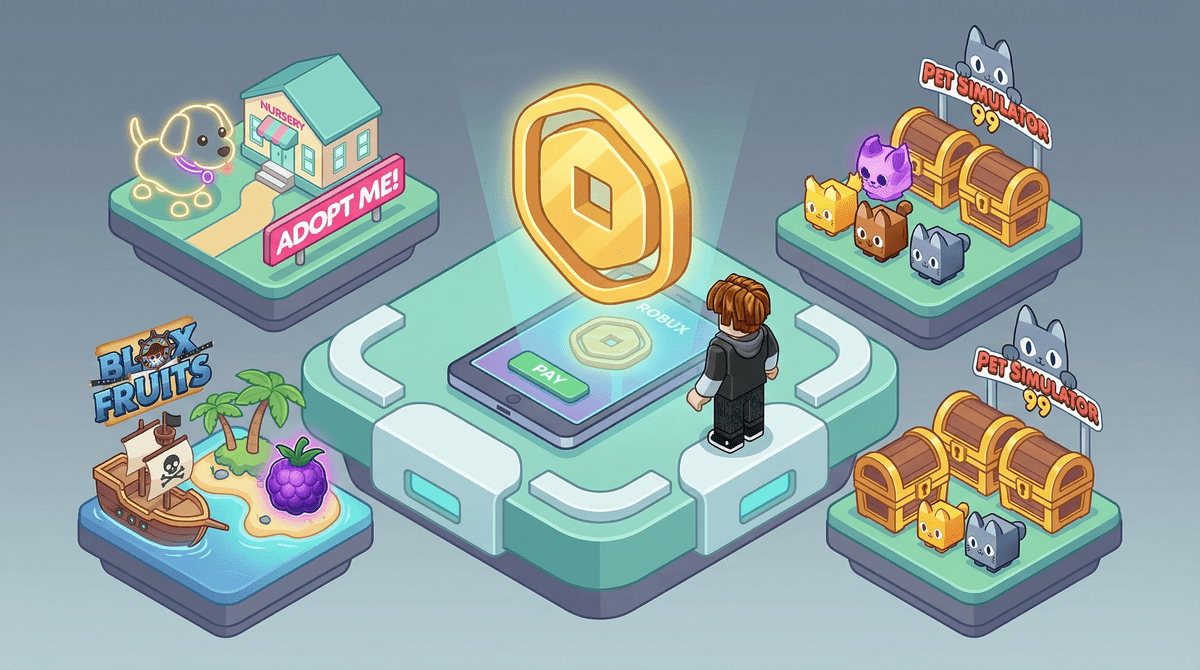
- Top Games to Watch: Blox Fruits, Adopt Me!, and Pet Simulator 99 are the heavy hitters for spending requests.
We’ve all been there. You’re trying to get dinner on the table or finish a work email, and a small human appears at your elbow with that specific look in their eyes. "Can I please, please, please just get 800 Robux? It’s for a permanent fruit in Blox Fruits and it’s on sale!"
If you feel like you’re running a small ATM for a digital world you don't fully understand, you aren't alone. About 75% of American kids ages 9-12 are on Roblox, and a huge chunk of them are navigating a complex economy that would make a Wall Street trader sweat.
But here’s the thing: Roblox isn't just one game. It's a platform—a "metaverse" if we have to use the buzzword—where millions of individual developers create their own experiences. This means the "rules" of spending change every time your kid hops from a racing game to a pet simulator.
Robux is the platform-wide currency. You buy it with actual human dollars, and then your kid spends it on digital goods.
The exchange rate is roughly 1 cent = 1 Robux, but it gets cheaper the more you buy.
- 400 Robux = $4.99
- 800 Robux = $9.99
- 1,700 Robux = $19.99
The genius (and the danger) of Robux is the decoupling of value. When a kid sees something costs "50 Robux," it feels like nothing. If they saw it cost "50 cents," they might still want it, but the psychological barrier is different. It’s the same reason casinos use chips instead of cash.

This is where most parents get tripped up. There are two main ways to spend Robux within a game:
1. Game Passes
These are one-time purchases that live on your kid's account forever. Think of it like buying an expansion pack. In Brookhaven, a Game Pass might unlock a "Penthouse" or a "Police Station" job. Once you buy it, they own it. Parent Verdict: These are the "safest" spend because they don't disappear.
2. Developer Products (Consumables)
These are the "brain rot" of the financial world. They are one-time use items. In Pet Simulator 99, this might be a "Triple Egg Hatch" potion that lasts for 15 minutes. In BedWars, it might be extra loot for one single match. Parent Verdict: These are the money pits. Your kid spends $2, and fifteen minutes later, the benefit is gone.
It’s easy to dismiss this as "buying pixels," but for kids, Roblox is their mall, their playground, and their school hallway.
- The Social Hierarchy: If you walk around with the default "Bacon Hair" avatar, you’re a "noob." Having a cool skin or a rare pet in Adopt Me! is the 2025 equivalent of having the right brand of sneakers in the 90s.
- The "Pay-to-Win" Factor: Many games are designed to be intentionally frustrating unless you spend money. They make the "grind" (the time spent working to level up) so slow that paying 200 Robux to "Skip Level" feels like a necessity rather than a luxury.
- FOMO (Fear Of Missing Out): Games often have "Limited Time" items. "If I don't get the Kitsune fruit in Blox Fruits today, it’s gone forever!"
Check out our guide on the most popular Roblox games of 2025
You’ll hear some parents defend Roblox by saying it teaches kids how to code and run a business. There is some truth to this!
If your kid is using Roblox Studio to build their own games and trying to figure out how to sell their own Game Passes, they are learning:
- Game Design: What makes people want to play?
- Economics: Supply and demand of digital goods.
- Coding: Using the Lua scripting language.
However, for 99% of kids, they aren't the ones making the money—they’re the ones spending it. If they want to learn the "business" side, encourage them to check out Scratch for coding basics or help them set up their own "experience" in Roblox Studio instead of just consuming.
Ages 6-9: The "No Linking" Phase
At this age, kids have zero concept of digital value.
- Action: Never link a credit card or PayPal to the account.
- Strategy: Use physical gift cards. When the $10 is gone, it’s gone. It’s a physical representation of a digital limit.
- Talk about it: "This card is worth 10 chores. If you spend it all on a hat today, you can't buy the dragon tomorrow."
Ages 10-13: The Allowance Phase
This is the "Ohio" phase of life—everything is weird, social pressure is peaking, and they want autonomy.
- Action: Consider Roblox Premium. For a monthly fee (starting at $4.99), they get a monthly Robux stipend.
- Strategy: Let them manage that stipend. If they blow it all on day one on "consumables," don't bail them out. It’s a low-stakes way to learn about budgeting.
Ages 14+: The "Show Me the Math" Phase
If they are still heavily into Roblox, they should understand the predatory nature of "gacha" mechanics (loot boxes).
- Action: Discuss the "cost per hour."
- Strategy: "You want $50 for this game? That’s the price of The Legend of Zelda: Tears of the Kingdom. Will this Roblox upgrade give you 100 hours of fun like Zelda will?"
If your kid is desperate for Robux, they will eventually find a YouTube video or a "friend" in chat promising "Free Robux Generators."
There is no such thing as free Robux.
These sites are almost always:
- Phishing scams to steal their account (and any items they already have).
- Malware for your computer.
- Survey scams that just farm their data.
Teach your kids early: If a site asks for your Roblox password to "give you money," it’s a scam. Full stop.
Not all Roblox games are created equal. Some are passion projects; others are "cash grabs" designed by professional studios to extract money from kids.
Red Flags of a Cash Grab Game:
- Constant pop-ups asking to buy "boosts."
- A "Leaderboard" that is clearly dominated by people who spent money.
- "Gambling" mechanics (e.g., spending 100 Robux for a chance to get a rare pet). Pet Simulator 99 is notorious for this.
If your kid is obsessed with a game that feels like a casino, it might be time to suggest alternatives like Minecraft (one-time purchase, infinite creativity) or Terraria.
Robux isn't inherently evil, but it is an expertly designed system to separate you from your money. The goal isn't necessarily to say "no" to every request, but to move from impulsive spending to intentional spending.
When your kid asks for Robux, ask them:
- Is this a Game Pass (permanent) or a consumable (temporary)?
- Are you buying this because it makes the game better, or because you’re worried about what other players think of your avatar?
- Are you willing to trade your real-world allowance/chore money for this?
By turning the "Please!" into a conversation about value, you're not just managing their screen time—you're raising a digitally literate human.
- Set up Roblox Parental Controls to limit monthly spending.
- Read our guide on 'Brain Rot' and digital culture to understand the slang they're using in these games.
- Check the WISE score for Blox Fruits to see if the spending is worth the gameplay.