

The Ultimate Guide to the Best Nonfiction Books for Kids in 2024
TL;DR: Nonfiction books for kids have gotten so much better in the last decade. We're talking graphic novels about climate science, memoirs from kid activists, and STEM books that don't feel like textbooks. Here are the standout picks by age group that kids actually want to read.
Quick Picks by Age:
- Ages 4-7: The Book of Mistakes, Ada Twist, Scientist
- Ages 8-10: I Survived series, Brown Girl Dreaming
- Ages 11-14: The 57 Bus, Stamped: Racism, Antiracism, and You
Nonfiction used to be the thing kids read when they had to write a report. Not anymore. The nonfiction landscape for kids has completely transformed—we're seeing stunning graphic novels about real events, memoirs that read like novels, and science books that feel more like treasure hunts than homework.
The challenge? There's a lot out there, and not all of it is created equal. Some books are still stuck in that dry, textbook-y mode. Others are so dumbed down they're insulting. The best nonfiction for kids respects their intelligence, tells compelling stories, and makes them curious about the world.
Real talk: getting kids hooked on nonfiction early is one of the best things you can do for their reading life. Not because fiction isn't valuable—it absolutely is—but because nonfiction teaches kids that reading is a tool for understanding the actual world around them.
Kids who read nonfiction develop stronger critical thinking skills, build background knowledge that helps with all reading comprehension, and learn that books can answer their weird, specific questions about everything from black holes to why people say "OK."
Plus, for reluctant readers or kids who claim they "don't like reading," nonfiction can be the gateway. A kid who won't touch a novel might devour a graphic novel about the Titanic or a book about video game design.
This isn't traditional nonfiction, but it teaches a real concept: mistakes are part of the creative process. It's gorgeous, philosophical without being preachy, and kids love the interactive element of watching the artist "fix" each mistake.
Part of the "Questioneers" series, this introduces the scientific method through a curious Black girl who asks all the questions. It's rhyming, fun, and normalizes the idea that science is about curiosity, not just memorizing facts. There's also a Netflix show if your kid wants more.
These are solid, photo-heavy books about animals, space, dinosaurs—all the classics. They're not groundbreaking, but they're reliable and kids can browse them independently. The photos are the real draw here.
A picture book biography of Temple Grandin that introduces autism and neurodiversity in an age-appropriate way. It's part of a series called "Rebel Girls" that covers amazing women in STEM and beyond.
This is the sweet spot age where kids can handle more complex topics but still want engaging, visual formats.
Technically historical fiction, but these books are so well-researched and include nonfiction sections that they belong on this list. Kids are obsessed with these—they cover everything from the sinking of the Titanic to Hurricane Katrina. Each book follows a kid surviving a historical disaster, and there's real history woven throughout.
A memoir in verse about growing up Black in the 1960s and 70s. It's beautiful, accessible, and introduces kids to the Civil Rights Movement through a personal lens. Won basically every award. Some schools use it in 4th-5th grade curricula.
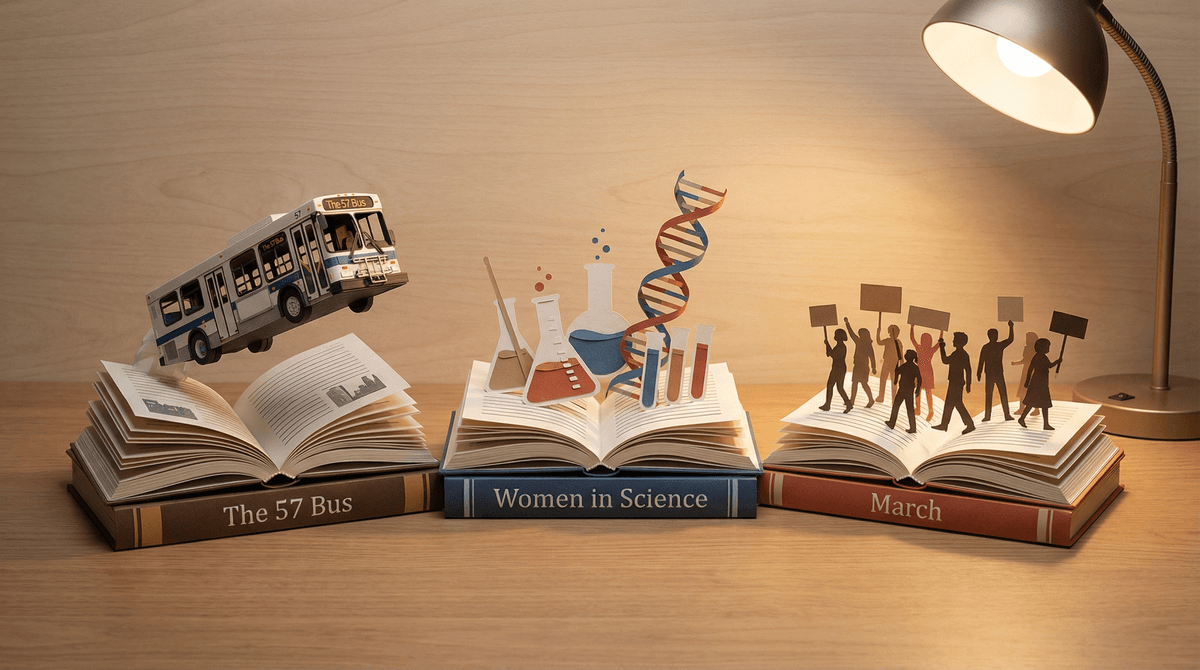
Illustrated profiles of women scientists throughout history. The art style is appealing, the bios are substantial without being overwhelming, and it covers scientists from diverse backgrounds. There are companion books about women in sports and art too.
Wait, this is fiction! But hear me out—the companion book The Wild Robot Escapes includes actual information about robotics, AI, and wilderness survival. If your kid loved the story (or the movie), you can pivot to nonfiction about robots and nature.
These are the workhorses of elementary school book reports. They're not fancy, but they're readable, cover basically everyone and everything, and kids can tackle them independently. Great for building background knowledge.
Pure fun facts in bite-sized chunks. Perfect for the kid who won't sit down with a traditional book but will spend 30 minutes reading random facts about space toilets and exploding beetles. Don't underestimate the power of "fun facts" to build reading stamina.
Middle schoolers can handle complex topics, multiple perspectives, and nuance. The best nonfiction for this age doesn't talk down to them.
This is the gold standard for middle grade nonfiction. It's about a real incident where a white teen set a Black agender teen's skirt on fire on a bus in Oakland. It's about race, gender identity, criminal justice, and restorative justice. It reads like a thriller. Every middle schooler should read this.
A "remix" of Kendi's adult book Stamped from the Beginning, rewritten for teens by Jason Reynolds. It's a history of racist ideas in America, but Reynolds makes it conversational and accessible. Some parents worry it's too political—here's a guide to talking about it.
Indigenous wisdom about nature and reciprocity, adapted from the adult bestseller. It's philosophical and beautiful, and it offers a completely different perspective on environmentalism than most kids get in school.
Reads like a spy thriller, but it's all true. About the development of the atomic bomb during WWII. Sheinkin is a master at making history feel urgent and immediate. He has other books (The Port Chicago 50, Undefeated) that are equally gripping.
Graphic novel memoir by the late Congressman John Lewis about his role in the Civil Rights Movement. The art is powerful, the story is essential, and the graphic novel format makes it accessible even for reluctant readers. This won basically every award and belongs in every middle school library.
About the Black women mathematicians at NASA who were crucial to the space program. If your kid saw the movie, they'll want to read this. The young readers' edition is adapted but not dumbed down.
More accessible than Stamped for some kids, this one focuses on actionable steps. It's written directly to young people and includes reflection questions. Good for kids who want to do something, not just learn about problems.
Most STEM books for kids are either too basic or too textbook-y. These are the exceptions:
The XKCD cartoonist explains complicated things using only the 1,000 most common words. It's hilarious and actually teaches complex concepts. Works for ages 8 and up.
A classic, updated for the digital age. Explains how machines and technology work through detailed illustrations and woolly mammoth cartoons. It's big, it's comprehensive, and kids can dip in and out.
Already mentioned above, but worth repeating. The illustrations make it approachable, and it covers scientists kids won't learn about in school.
Adapted from his adult bestseller. It's Neil deGrasse Tyson explaining the universe to kids. Some of it will go over their heads, but that's okay—it makes kids feel smart to tackle "adult" concepts.
Graphic novels are having a moment in nonfiction, and thank goodness because they're making complex topics accessible.
Semi-autobiographical about being a Black kid at a predominantly white private school. It's technically fiction, but it's teaching real things about microaggressions, code-switching, and identity. Won the Newbery Medal.
George Takei's memoir about being in a Japanese American internment camp as a child during WWII. The graphic novel format makes this accessible for middle schoolers, and it's a crucial part of American history that often gets glossed over.
Explains the flaws in the U.S. Constitution through illustrated examples. It's nonpartisan, historically grounded, and makes civics interesting. Good for ages 10+.
Most of these are honestly not great—they promise exciting experiments but deliver baking soda volcanoes. If your kid wants hands-on science, you're better off with:
- Subscription boxes like KiwiCo that actually deliver materials and instructions
- YouTube channels like Mark Rober or SciShow Kids
- Books that explain the science behind everyday things rather than trying to be activity books
That said, if you want an actual book, The 101 Coolest Simple Science Experiments delivers on its promise with experiments you can actually do with stuff you have at home.
Ages 4-7: Look for books with strong visuals, clear text, and topics that connect to their immediate world. They're building the foundation that nonfiction can be fun.
Ages 8-10: They can handle more complex topics but still need engaging formats. Graphic novels, photo-heavy books, and series work well. This is when you can introduce harder topics (death, injustice, natural disasters) through age-appropriate lenses.
Ages 11-14: They're ready for nuance, multiple perspectives, and uncomfortable truths. Don't shy away from books about racism, LGBTQ+ issues, or difficult history—but be available to talk about what they're reading. Here's a guide to talking about hard topics.
"My kid only wants to read fiction/only wants to read nonfiction"
Both are fine! Some kids are story people, some are fact people. If your kid only reads fiction, you can sneak in nonfiction through graphic novels, memoirs, and narrative nonfiction that reads like a story. If they only read nonfiction, that's actually great—they're building knowledge and reading stamina. Don't force it.
"Are these books too political?"
Books about real things are going to touch on race, gender, politics, and social issues because those are part of real life. The books recommended here are age-appropriate and historically/scientifically grounded. If you're worried about a specific book, Check if a book is too political for your kid or read it yourself first.
"My kid won't read anything that looks like a textbook"
Then don't give them textbook-y books! Stick with graphic novels, narrative nonfiction, and visually appealing books. The I Survived series is technically fiction but teaches real history. March is a graphic novel. Thing Explainer is hilarious. Meet them where they are.
"How do I know if a nonfiction book is accurate?"
Check the back matter—good nonfiction for kids includes source notes, bibliographies, and author notes about their research process. Look for books from reputable publishers (Scholastic, National Geographic, major trade publishers). Check Common Sense Media or Goodreads reviews from educators and librarians.
The best nonfiction books for kids are the ones they'll actually read. That might be a graphic novel about the Civil Rights Movement, a photo book about weird animals, or a memoir in verse. The goal isn't to force them through dry textbooks—it's to show them that nonfiction can be just as compelling as any story, because it is a story. It's the story of our world.
Start with what your kid is already interested in. Dinosaurs? Space? Sports? Social justice? There's a great nonfiction book for that. And once they're hooked on one topic, they'll branch out to others.
- Check your library's digital collection through apps like Libby or Hoopla—many of these books are available as ebooks or audiobooks
- Ask your school librarian what nonfiction books are popular with your kid's grade level
- Let your kid browse the nonfiction section and pick based on covers and topics that interest them—that autonomy matters
- Read together and talk about what surprises them, what they want to know more about, or what they disagree with
Want more specific recommendations? Find books for your kid's specific interests or explore alternatives to screen time that include reading.