

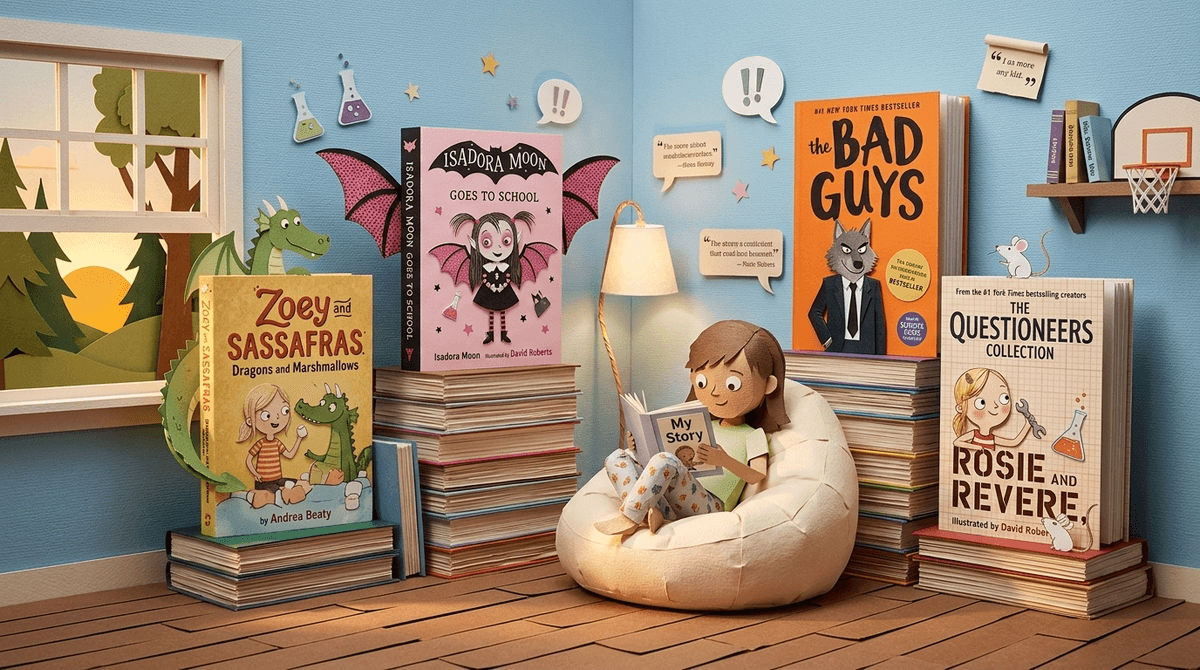
The 2026 'What's Next' Reading List: Transitional Books Beyond the Classics
Your kid has blazed through Magic Tree House and Junie B. Jones, and you're tired of recommending the same five series every parent on the playground already knows about. Here are fresh, diverse, genuinely engaging transitional chapter books that bridge picture books and novels—organized by what your kid is actually into right now:
For the kid who loves weird humor: The Questioneers series by Andrea Beaty • Stinkbomb and Ketchup-Face by John Dougherty
For the budding scientist: Ada Twist, Scientist chapter books • The Magnificent Makers by Theanne Griffith
For the fantasy fan: Isadora Moon by Harriet Muncaster • Zoey and Sassafras by Asia Citro
For the realistic fiction lover: Jasmine Toguchi by Debbi Michiko Florence • Clementine by Pennypacker
The sweet spot for ages 5-8 is tricky. They're reading independently (or want to), but 200-page novels feel overwhelming. They need books with:
- Chapters short enough to finish before bedtime (seriously, this matters when 30% of families in our community are still navigating bedtime routines with screens)
- Illustrations every few pages to break up text and provide visual context clues
- Characters who look and live like real kids today—not just the homogenous suburban fantasyland of older series
- Vocabulary that stretches without frustrating, usually around 2nd-3rd grade reading level
- Stories that respect their intelligence while acknowledging they're still little
The classics (Frog and Toad, Henry and Mudge, Mercy Watson) aren't going anywhere. But let's be honest—kids today are consuming stories through YouTube, Roblox narratives, and increasingly sophisticated animated shows. They can handle more complex themes and diverse storytelling than we sometimes give them credit for.
Ages 6-9
If your kid thinks everything is "sus" or "Ohio" (translation: weird), they'll devour this British series about siblings with ridiculous names fighting badgers who want to take over the kingdom. The humor is genuinely funny—not that cloying "kids' book funny" that makes you want to hide the book. Think Monty Python meets Captain Underpants, but with actual plot development and surprisingly clever wordplay.
Ages 5-8
Part graphic novel, part chapter book, this Australian series about reformed villain animals trying to be heroes hits that perfect sweet spot. The text is large, illustrations are plentiful, and the moral complexity (can bad guys become good?) is way more interesting than most early reader fare. Plus, the movie came out a few years back, so kids who saw it are primed for the books.
Ages 6-9
Written by an actual neuroscientist, this series features two friends who get transported to a magical makerspace to solve science challenges. The diversity is natural (not performative), the science is real, and the problems require actual thinking. Each book tackles a different STEM concept—sound waves, human body systems, engineering principles—without feeling like a textbook disguised as fiction.
Ages 6-10
Zoey helps magical creatures using the scientific method, which is honestly brilliant. The books model real scientific thinking (observation, hypothesis, experimentation) while maintaining genuine fantasy wonder. The illustrations by Marion Lindsay are gorgeous, and each book is perfectly sized for a kid who's ready for chapters but not ready for Harry Potter.
Ages 5-8
Half-fairy, half-vampire Isadora deals with very normal kid problems (making friends, school camping trips, losing teeth) in a slightly magical world. The pink-and-black illustrations are distinctive and plentiful, and the stories validate the very real feeling of not quite fitting in anywhere. British origin, but the themes are universal.
Ages 5-8
Superhero chapter books with a girl protagonist who discovers her powers and attends a secret training academy while managing regular school. The font is large, chapters are bite-sized, and there's enough action to keep the Minecraft-obsessed kids engaged. Not groundbreaking literature, but solid, fun, and gets reluctant readers turning pages.
Ages 6-9
Japanese-American Jasmine navigates being the youngest sibling, cultural identity, and everyday challenges with humor and heart. The books incorporate Japanese traditions naturally, and Jasmine's problems (wanting to ring the bell at the temple, dealing with older sisters, making friends) feel authentic. The illustrations by Elizabet Vukovic are charming without being cutesy.
Ages 6-10
Okay, this one's been around since 2006, but it's criminally underrated compared to Junie B. Jones. Clementine is impulsive, creative, and probably has ADHD (never explicitly stated, but the representation is clear). The books are funny, the family dynamics are realistic (working parents, apartment living), and Clementine's voice is distinctive without being annoying.
Ages 6-9
Ty is a Black boy who loves maps, road trips, and his close-knit family. Each book involves a different journey (to his grandparents' house, to a family reunion, to discover local history) that teaches geography and Black history without feeling preachy. The episodic structure works perfectly for emerging readers who need clear beginnings and endings.
Ages 6-10
The Netflix series is excellent, but the original graphic novels are even better for transitional readers. Hilda's adventures in a Scandinavian-inspired world full of trolls, giants, and mysterious creatures have genuine stakes and beautiful artwork. The text-to-image ratio is perfect for kids who find pure text intimidating.
Ages 6-9
Grumpy cat Catwad and his annoyingly optimistic friend Blurmp star in comic-style stories that are legitimately hilarious. Similar format to Dog Man but with slightly more sophisticated humor and less potty jokes. Great for the kid who claims they "don't like reading" but will spend hours on graphic novels.
Ages 6-9
If your kid loved the picture books (Rosie Revere Engineer, Ada Twist Scientist), the chapter book series expands these characters into longer mysteries. Each book follows a different Questioneer solving a problem using their unique skills—engineering, science, art. The diverse cast of characters and emphasis on growth mindset make these feel current without being heavy-handed.
Ages 5-7
Diary format, lots of illustrations, simple vocabulary—this is the perfect series for the younger end of transitional readers. Eva the owl's adventures are gentle and affirming, dealing with friendship, family, and school in an accessible way. Not challenging literature, but exactly what a struggling or reluctant reader needs to build confidence.
About reading levels vs. interest levels: Just because your 5-year-old can technically read these books doesn't mean they'll connect with all the themes. A 5-year-old reading at a 3rd-grade level might decode the words in Clementine but miss the social nuances. That's fine—let them enjoy the story at their level and revisit it later.
About screen time trade-offs: Here's the data from our community: kids average 4.2 hours of screen time daily, with only 30% of families reporting that their kids manage their own bedtime routines. If you're trying to shift some of that screen time to reading, transitional chapter books are your secret weapon. They're engaging enough to compete with YouTube Kids but short enough that finishing a chapter feels achievable.
About diversity: The publishing industry has made real progress since 2020, but you still have to be intentional. If your kid's bookshelf is all white protagonists, they're missing out on better stories. The books on this list feature kids of different races, abilities, family structures, and cultural backgrounds—not as "issue books" but as normal kid adventures.
About "boy books" vs. "girl books": This is still a thing in 2026, unfortunately. If your son won't touch a book with a girl on the cover, that's a parenting problem to address, not a reading preference to accommodate. Same goes for girls avoiding "boy" protagonists. The best books on this list have universal themes that any kid can connect with.
The transitional chapter book phase is short—maybe 18 months to two years before they're ready for middle-grade novels. Make it count by offering books that respect their growing independence while still providing the scaffolding they need.
Skip the "classics" everyone already knows about and try something from this list. Watch for what clicks—humor? Fantasy? Science? Realistic problems?—and then Get more recommendations in that category .
.
The goal isn't to eliminate screens entirely (70% of families in our community still manage bedtime for their kids, which often involves negotiating screen time). The goal is to build a reading habit strong enough to compete with the dopamine hits of Roblox and YouTube. These books can do that—they're just that good.
- Hit the library with this list and let your kid choose 3-4 books based on covers and back-cover descriptions
- Read the first chapter together even if they're reading independently—it helps them get invested in the characters
- Don't force it if a book isn't clicking after two chapters; try something else from the list
- Create a cozy reading spot that's more appealing than the screen (good lighting, comfy chair, no distractions)
- Track what they love and Find similar titles
Want more personalized recommendations based on your kid's specific interests and reading level? Find transitional chapter books for your kid or explore our full guide to building a reading habit.