

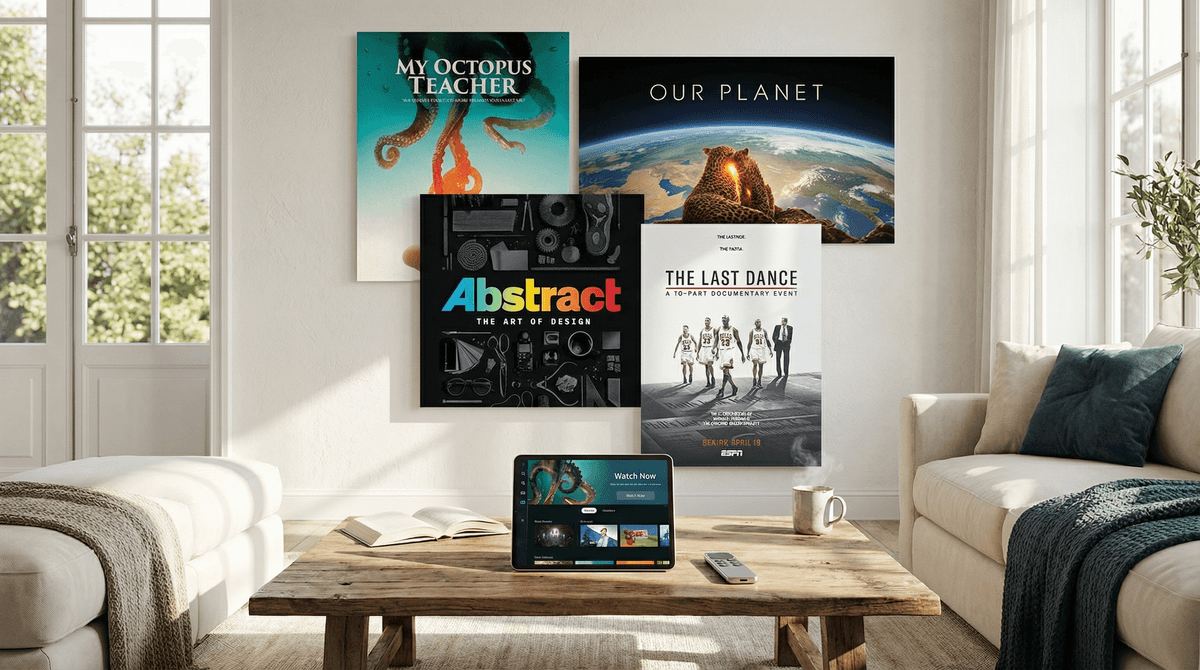
Netflix Documentaries That Turn Screen Time Into Family Learning Time
TL;DR: Not all screen time is created equal. These documentaries spark conversations, build knowledge, and give you something to talk about besides Skibidi Toilet. From My Octopus Teacher to Our Planet, here are the best educational docs streaming on Netflix right now for ages 7+.
Let's be honest: you're going to lose the screen time battle sometimes. But here's the thing—when your kid wants "just one more episode," wouldn't you rather it be about the intelligence of octopi than whatever fever dream YouTube algorithm has cooked up this week?
Screenwise Parents
See allDocumentaries are the secret weapon of intentional parenting. They're still screen time, yes, but they're screen time that teaches critical thinking, sparks dinner table conversations, and occasionally makes your kid go "wait, WHAT?" in the best possible way.
The docs below aren't boring educational content from 1987. They're beautifully shot, genuinely engaging, and actually age-appropriate. Most importantly, they give you something to build on—a jumping-off point for deeper conversations about science, nature, creativity, or how the world works.
My Octopus Teacher (Ages 7+)
This is the one that made adults cry about an octopus, and it works just as well with kids. A filmmaker befriends a wild octopus in a South African kelp forest and documents their relationship over a year. It's intimate, beautiful, and teaches kids about animal intelligence, ocean ecosystems, and the patience required for real observation.
Why it works: The emotional connection is immediate. Kids get invested in the octopus's survival, and suddenly they're learning about camouflage, predator-prey relationships, and marine biology without realizing it's "educational."
Parent note: There are some intense predator moments (sharks, specifically), but nothing gratuitous. The octopus does die at the end—it's a natural death after laying eggs, but younger or more sensitive kids might need a heads-up about the circle of life.
Our Planet (Ages 8+)
David Attenborough's voice + stunning 4K nature footage = the gold standard of nature documentaries. Eight episodes covering everything from frozen worlds to jungles to coastal seas. Each episode is about 50 minutes, so it's a commitment, but the payoff is huge.
Why it works: The cinematography is genuinely jaw-dropping. Kids who've grown up on screens have high standards for visual quality, and this delivers. Plus, it doesn't shy away from climate change impacts, making it a great conversation starter for older elementary and middle schoolers.
Parent note: Some episodes have intense predator-prey sequences (the walrus cliff scene in "Frozen Worlds" is particularly brutal). Preview first if your kid is sensitive to animal death.
Chasing Coral (Ages 10+)
A team of divers, photographers, and scientists set out to document coral bleaching before it's too late. It's part nature doc, part detective story, part call-to-action about climate change.
Why it works: The time-lapse photography of coral bleaching is both beautiful and devastating. It makes an abstract concept (ocean acidification) viscally real. Great for kids who are starting to ask bigger questions about environmental issues.
Parent note: This one does deal with climate anxiety head-on. The ending is hopeful but realistic. Good for kids who can handle "we have a problem, and we need to work on solutions" conversations.
Our Universe (Ages 9+)
Morgan Freeman narrates this six-part series that connects animal behavior to cosmic phenomena. Each episode pairs an animal's life story with a parallel cosmic event—like how a baby elephant's journey mirrors the formation of galaxies.
Why it works: The parallel storytelling is clever and makes massive cosmic concepts feel relatable. Plus, it's Morgan Freeman. Kids who love Minecraft often love thinking about systems and how things connect—this scratches that itch.
Parent note: Some episodes have predator moments, but they're brief and contextual.
A Year in Space (Ages 10+)
Follow astronaut Scott Kelly during his year-long mission aboard the International Space Station. It's not just about space—it's about what happens to the human body in space, the psychological challenges of isolation, and the logistics of living in zero gravity.
Why it works: Kids get to see the mundane details of space life (how do you go to the bathroom? how do you exercise?), which makes it feel real and achievable rather than science fiction.
Parent note: This is more slow-paced and contemplative than action-packed. Best for kids who are genuinely curious about space rather than just into Star Wars.
Chef and writer Stephen Satterfield traces the origins of African American cuisine from Africa to Texas. It's food history, cultural history, and American history all rolled into one beautifully shot series.
Why it works: Food is an accessible entry point to harder conversations about slavery, migration, and cultural resilience. Plus, it's genuinely interesting to see how dishes evolved and spread.
Parent note: The show doesn't shy away from the realities of slavery and racism, but it handles it with nuance and respect. Great for middle schoolers who are ready for more complex historical narratives.
Babies (Ages 8+)
Fifteen families across the world, cutting-edge science about infant development, and some genuinely adorable babies. Each episode focuses on a different aspect of development—first steps, first words, first friendships.
Why it works: Kids love seeing babies do things they themselves used to do. It's also fascinating science about brain development, motor skills, and attachment theory.
Parent note: This is wholesome and safe for pretty much any age, though younger kids might find it boring.
Explained (Ages 12+)
This Vox series breaks down one topic per episode in about 20 minutes. Topics range from the racial wealth gap to cryptocurrency to K-pop. It's like a really good YouTube explainer video, but with higher production values.
Why it works: Short episodes mean low commitment. The topics are current and relevant, so kids actually care. Great for teens who want to understand the world but don't want to read a textbook.
Parent note: Some episodes deal with mature topics (sex, drugs, politics). Preview first to make sure it aligns with your family's values and your kid's maturity level.
Abstract: The Art of Design (Ages 10+)
Each episode profiles a different designer—from sneaker designers to stage designers to graphic designers. It's about the creative process, problem-solving, and what it takes to be great at something.
Why it works: Kids who love Roblox or building in Minecraft are often natural designers. This shows them that design is a real career path and gives them a peek behind the curtain of how things they use every day get made.
Parent note: Totally safe and appropriate. Some episodes might be more interesting than others depending on your kid's interests.
The Creative Brain (Ages 11+)
Neuroscientist David Eagleman explores how creativity works in the brain. It's part science doc, part profile of creative people across different fields.
Why it works: Kids who are told they're "not creative" (usually because they're not good at drawing) need to hear that creativity is broader than art class. This shows creativity in coding, cooking, comedy, and more.
Parent note: Some concepts are pretty heady. Best for kids who like thinking about thinking.
The Last Dance (Ages 12+)
The definitive documentary about Michael Jordan and the 1997-98 Chicago Bulls season. Even if your kid doesn't care about basketball, this is a masterclass in excellence, teamwork, and what it takes to be the best.
Why it works: The storytelling is incredible. It's not just sports highlights—it's about leadership, pressure, and the cost of greatness. Great for middle schoolers who are starting to get serious about their own activities.
Parent note: Some language and mature themes (gambling, competitiveness that borders on cruelty). Jordan is portrayed as brilliant but not always likable, which is actually a good lesson.
14 Peaks: Nothing Is Impossible (Ages 10+)
Nepali mountaineer Nirmal Purja attempts to summit all 14 of the world's 8,000-meter peaks in seven months. It's absolutely bonkers and genuinely inspiring.
Why it works: The achievement is so audacious that kids can't help but be impressed. Plus, it centers a non-Western protagonist, which is refreshing in the adventure doc space.
Parent note: Some perilous moments and discussion of deaths on mountains, but nothing graphic.
Ages 7-9: Start with nature docs like My Octopus Teacher, Our Planet (selected episodes), and Babies. These have clear narratives and visual storytelling that doesn't require sustained attention to complex concepts.
Ages 10-12: Branch into science (Our Universe), creative (Abstract), and sports docs (14 Peaks). They can handle more complex ideas and longer episodes.
Ages 13+: Everything's on the table. The Last Dance, High on the Hog, and Explained tackle mature themes with nuance. These work best when you can watch together and discuss.
Co-watch when possible. I know, I know—the whole point of screen time is sometimes that you get a break. But documentaries are so much more valuable when you can pause and discuss. "Wait, did you see that?" moments are where the learning happens.
Follow their interests. If your kid is obsessed with space, start with A Year in Space. If they're into art, try Abstract. Meeting them where they are makes them more likely to engage.
Use it as a springboard. After My Octopus Teacher, check out books about ocean life or visit an aquarium. After The Last Dance, talk about what excellence looks like in their own activities.
Don't force it. If they're not into it, that's fine. Not every kid is a documentary kid, and that's okay. But if you present it as an option alongside their usual shows, you might be surprised what they choose.
Documentaries won't replace Bluey or Avatar: The Last Airbender in your kid's heart, and that's fine. But they're a tool in your toolbox—a way to make screen time do double duty as both entertainment and education.
The best part? These aren't "kid documentaries" that talk down to their audience. They're just good documentaries that happen to be appropriate for kids. That means you might actually enjoy watching them too, which makes family movie night a lot more bearable than another round of Paw Patrol.
Start with one that matches your kid's interests, watch it together, and see where the conversation goes. Worst case scenario, they learn something. Best case scenario, you spark a genuine curiosity that leads them down a rabbit hole of discovery.
And hey, if they still want to watch YouTube after, at least you tried.
Want more recommendations? Check out our guides on educational YouTube channels for kids, best podcasts for family road trips, or how to talk to kids about screen time.