

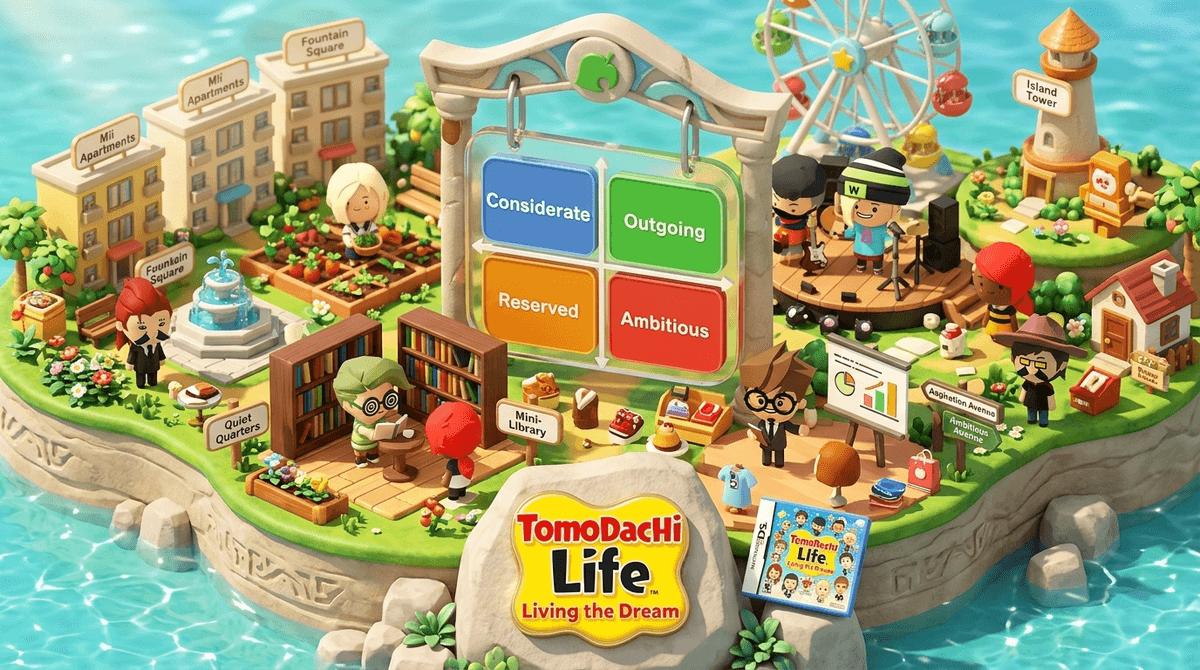
The Tomodachi Life: Living the Dream personality chart is essentially a secret decoder ring that translates five sliders—Movement, Speech, Energy, Attitude, and Overall—into one of 16 distinct personality types that dictate exactly how your child's Mii will act, who they’ll befriend, and even what color their house will be. While it looks like a fun "vibe check" for your digital avatars, it’s actually a rigid mathematical formula that determines the social hierarchy of their virtual island.
TL;DR: The Tomodachi Life: Living the Dream personality chart is a 4-quadrant system (Considerate, Outgoing, Reserved, and Ambitious) that governs Mii AI behavior. To get a specific personality, you must adjust four functional sliders—the fifth "Overall" slider is purely cosmetic—making it a great tool for kids to experiment with social archetypes. Screenwise recommends this as a low-risk, high-creativity alternative to social-heavy platforms like Roblox.
If your kid has been glued to their Switch since Tomodachi Life: Living the Dream dropped on April 16, you’ve probably heard them debating whether a Mii should be a "Sweetie" or a "Maverick."
In the game, you don’t just pick a personality from a list. You move five sliders during character creation. The game then crunches those numbers and assigns one of 16 personalities. The "chart" is a community-created map that shows parents and players exactly where to put those sliders to get the desired result.
Think of it as a simplified Myers-Briggs for cartoon characters. It’s the engine that drives the "social simulation" part of the game. If two Miis have compatible personalities, they might become best friends or get married; if they clash, you’re going to be dealing with a lot of digital "sadness bubbles" and island drama.
The 16 personalities are divided into four main groups. Depending on whether you have the North American or European version of the game, the names might vary slightly, but the logic is the same:
These are the "vibes" Miis. They are generally peaceful, empathetic, and easy to get along with.
- Sweetie / Softie: The most empathetic Miis who are highly in tune with others' feelings.
- Cheerleader / Optimist: The "golden retriever" energy of the island—always beaming.
- Buddy / Carer: The loyal friend who puts everyone else first.
- Daydreamer / Dreamer: The idealistic ones who spend a lot of time staring at the ocean.
These Miis are the life of the party. They have high energy and love social interaction.
- Charmer: Radiant, stylish, and effortlessly cool.
- Merrymaker / Bubbly: The social butterfly who finds the silver lining in every bad situation.
- Go-Getter / Adventurer: Bold, witty, and always the center of attention.
- Dynamo / Hot-Blooded: Assertive leaders who trust their instincts (and can be a bit intense).
These are the introspective, "think-before-they-speak" types.
- Observer / Introvert: Self-sufficient Miis who keep their emotions close to the chest.
- Perfectionist: Creative Miis who find beauty in the details and strive for excellence.
- Thinker: Introspective and great at analyzing situations from every angle.
- Strategist / Patient: Unique and creative thinkers who don't care what others think of them.
These Miis are driven, focused, and sometimes a little blunt.
- Rogue / Individualist: Independent thinkers who prefer to do things their own way.
- Maverick / Headstrong: Determined self-starters who let nothing stand in their way.
- Achiever / Busy Bee: Diligent, productive, and highly efficient planners.
- Visionary / Leader: Intelligent Miis who speak with confidence and command respect.
The magic (and the frustration) of Tomodachi Life: Living the Dream is that the game doesn't tell you what personality you're building while you're moving the sliders. It’s a surprise reveal at the end.
Kids love the "Mii-Search" aspect of this—consulting charts, watching YouTube tutorials, and trying to perfectly replicate their real-life friends or favorite fictional characters. It’s a form of digital dollhouse play, but with a layer of "social science" that makes it feel more complex than just picking an outfit.
Here is the thing that most kids (and some parents) miss: The "Overall" slider is a placebo.
According to community data and technical breakdowns of the game’s code, only the first four sliders—Movement, Speech, Energy, and Attitude—actually calculate the personality. The "Overall" slider (Normal to Quirky) is purely cosmetic for the personality assignment. If your child is stressing out because they can’t get the "Overall" slider perfect, tell them to let it go. It doesn't change whether they become a "Thinker" or a "Charmer."
Also, unlike the original 3DS game, Living the Dream allows players to change a Mii’s personality at any time via the Residents menu. This is a huge win for digital wellness because it reduces the "perfectionism anxiety" that comes with character creation. If a Mii is being too "Rogue" and causing fights, your kid can just go in and slide them toward "Sweetie."
Instead of just looking at the chart as a way to "win" the game, use it to talk about real-world social dynamics:
- "Which one are you?": Ask your child which of the 16 types they think best describes them in real life. It’s a low-pressure way to talk about self-image.
- "Social Chemistry": When two Miis fight, ask your child why they think that happened. "Do you think a Maverick and a Sweetie see the world the same way?"
- "The Placebo Effect": Talk about that "Overall" slider. It’s a great lesson in how some "choices" in tech and games are just there for flavor and don't actually affect the outcome.
Q: What age is Tomodachi Life: Living the Dream appropriate for? It’s rated E for Everyone. Screenwise recommends it for ages 7 and up. The "drama" is very slapstick and G-rated—think Miis rolling around on the floor because they lost a game of Wii Sports, not anything heavy.
Q: Can Miis of the same gender date in the Switch version? Yes. Unlike the original 2013 game, Tomodachi Life: Living the Dream includes expanded options for pronouns and dating preferences, allowing for much more diverse island relationships.
Q: Is this game better than Animal Crossing? "Better" is subjective, but Animal Crossing: New Horizons is about decorating and collecting, while Tomodachi Life is about people-watching and chaos. If your kid likes The Sims 4 but wants something more "Nintendo," this is it.
Q: Does the personality chart work on the Switch 2? Yes, the game is fully backwards compatible with the Nintendo Switch 2, and the personality mechanics remain identical across both consoles.
The Tomodachi Life: Living the Dream personality chart is a harmless, creative way for kids to engage with a social sandbox. It’s "brain rot" adjacent because of the weird humor, but it actually requires a surprising amount of intentionality and planning. If your child is spending their screen time debating the nuances between a "Visionary" and a "Strategist," they’re practicing social categorization and empathy in a safe, offline environment.
Ask our chatbot for a specific slider configuration for any personality type