

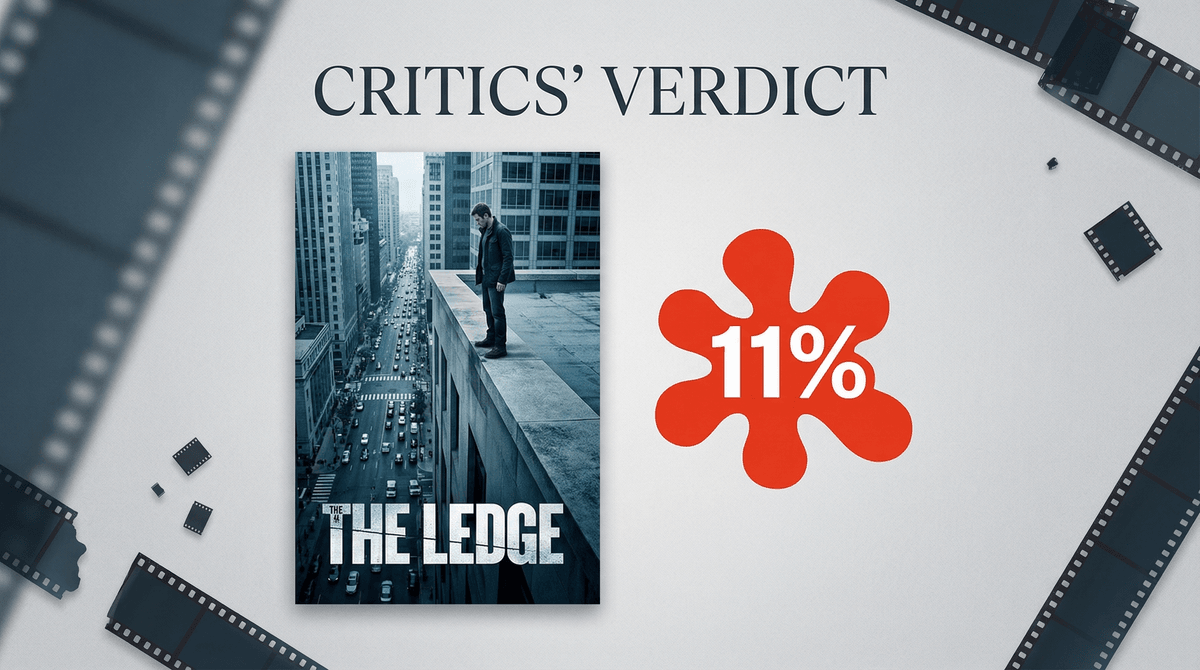
The Ledge (2011): Why This Thriller Bombed with Critics
TL;DR: The Ledge earned a dismal 11% on Rotten Tomatoes, and for good reason. This faith-versus-atheism thriller tries to tackle big philosophical questions but ends up feeling like a heavy-handed debate disguised as a suspense film. If you're wondering whether this is worth watching with older teens—or if you stumbled across it while scrolling—here's what you need to know about why critics absolutely hated it.
The Ledge is a 2011 thriller starring Charlie Hunnam (yes, from Sons of Anarchy), Terrence Howard, Liv Tyler, and Patrick Wilson. The premise sounds intriguing: a police officer (Howard) tries to talk down a man (Hunnam) threatening to jump from a hotel ledge. Through flashbacks, we learn about the jumper's atheism, his affair with his neighbor's wife (Tyler), and her fundamentalist Christian husband (Wilson) who's essentially forcing him to jump.
It's directed by Matthew Chapman (Charles Darwin's great-great-grandson, which the film's marketing leaned into hard), and it clearly wants to be a provocative exploration of faith, morality, and choice. Instead, it landed with a thud.
11% on Rotten Tomatoes. That's not a typo.
To put that in perspective, Battlefield Earth has a 3%, but at least that film is entertainingly bad. The Ledge sits in this awkward zone where it's not fun-bad, just... bad-bad.
The audience score is slightly better at 35%, but that's still firmly in "most people who watched this regretted it" territory. Critics were particularly brutal, with reviews ranging from "preachy and unconvincing" to "a philosophical thriller that forgets to be thrilling."
The Dialogue Is Painfully On-the-Nose
The biggest complaint? The script feels like it was written by someone who just discovered atheism forums and Christian apologetics websites and decided to copy-paste arguments into character dialogue. Nobody talks like these people talk.
Sample exchange vibes:
- "As an atheist, I believe..."
- "But the Bible says..."
- "Science proves..."
It's less natural conversation and more like watching two people read position papers at each other. Roger Ebert's review called it "an ungainly assembly of religious and philosophical discussions masquerading as a thriller." Ouch.
The Characters Are Cardboard Cutouts
Charlie Hunnam's character is Atheist Man™—he's defined entirely by his lack of belief and his supposed moral superiority despite, you know, having an affair with his married neighbor. Patrick Wilson plays Christian Villain™, a fundamentalist so cartoonishly evil that he makes actual religious people look reasonable by comparison. He's controlling, manipulative, and basically twirls a metaphorical mustache while quoting scripture.
Liv Tyler's character exists mostly to be fought over, which feels especially dated. And Terrence Howard's cop is supposed to be our everyman guide through this mess, but even he can't save the clunky exposition.
It's Not Actually Suspenseful
For a movie about a guy on a ledge threatening to jump, there's shockingly little tension. The flashback structure kills any momentum, and by the time you understand why he's up there, you might be thinking "honestly, jumping seems less painful than sitting through more of these conversations."
The "thriller" elements feel tacked on, like the filmmaker realized halfway through that a 90-minute philosophy debate wouldn't sell tickets and hastily added some danger.
The Philosophy Is Shallow
Here's the thing: plenty of films tackle faith versus reason and do it well. The Tree of Life explores existential questions through poetry and imagery. Silence grapples with faith in crisis without reducing characters to talking points.
The Ledge treats complex theological and philosophical questions like a high school debate competition. It's not interested in nuance—it wants to score points. Critics noted that both the atheist and Christian perspectives are presented in their most extreme, least charitable forms, which makes the whole thing feel like a strawman argument come to life.
You might be here because:
- Your teen found it while browsing thrillers and you're wondering if it's appropriate
- You're in a faith community and heard it mentioned as "that anti-Christian movie"
- You're looking for films that explore faith questions with older kids
Let me address each:
Is It Age-Appropriate?
It's rated R for language, sexual content, and thematic elements involving suicide. The affair storyline includes some sexual situations (not graphic, but present), and the entire premise revolves around suicide and emotional manipulation.
For most families, this isn't appropriate for anyone under 17-18, and even then, there are much better films to watch that explore similar themes without the ham-fisted execution.
Is It Anti-Christian?
It's more anti-fundamentalist than anti-Christian, but it's so poorly executed that it ends up being anti-everyone. The Christian character is a villain, yes, but the atheist character is also kind of insufferable. The film seems to think it's being balanced by making everyone terrible, but that's not balance—it's just lazy writing.
If you're in a faith community looking for movies that engage thoughtfully with religious questions, skip this and watch Silence, Of Gods and Men, or even The Mission instead.
Better Films for Exploring Faith Questions
If you want to watch something with older teens that actually engages with big questions about meaning, morality, and belief, try:
- The Tree of Life (PG-13) - Terrence Malick's meditation on grace, nature, and existence. Challenging but beautiful.
- Silence (R) - Scorsese's exploration of faith under persecution. Mature but profound.
- Contact (PG) - Science versus faith done right, with Jodie Foster and Matthew McConaughey.
- Life of Pi (PG) - A gorgeous exploration of storytelling, faith, and survival.
All of these treat their subjects with respect and complexity, unlike The Ledge's sledgehammer approach.
As parents, we want our kids to think critically about big questions—morality, faith, meaning, purpose. We want them to encounter different viewpoints and develop their own beliefs thoughtfully.
The Ledge is a cautionary tale in how NOT to do this. It presents extreme caricatures of both religious and non-religious perspectives, then pats itself on the back for being "provocative." Real people with real beliefs—whether Christian, atheist, or anything else—are far more complex and interesting than these cardboard characters.
If you want to help your teen engage with questions about faith and reason, start with actual conversations, not movies where characters deliver monologues at each other. And if you do want to use film as a starting point, choose movies that respect their characters enough to let them be human beings rather than walking thesis statements.
The Ledge bombed with critics because it's a preachy, poorly written thriller that sacrifices character development, suspense, and nuance for heavy-handed philosophical debates. At 11% on Rotten Tomatoes, it's a rare example of critics and audiences mostly agreeing: this one's a miss.
Skip it. Life's too short, and there are too many actually good movies that explore similar themes with intelligence, empathy, and craft. Your teen will get more out of a thoughtful conversation with you about faith and doubt than from watching Charlie Hunnam stand on a ledge delivering atheist talking points for 90 minutes.
If you're looking for thrillers that actually thrill, check out alternatives to generic thrillers. If you want films that engage with big questions, I've got recommendations above that won't make you want to jump off a ledge yourself.
Next Steps: If your teen is asking questions about faith, doubt, or morality, that's actually wonderful—it means they're thinking. Here's how to have those conversations without needing a terrible movie as a conversation starter.