

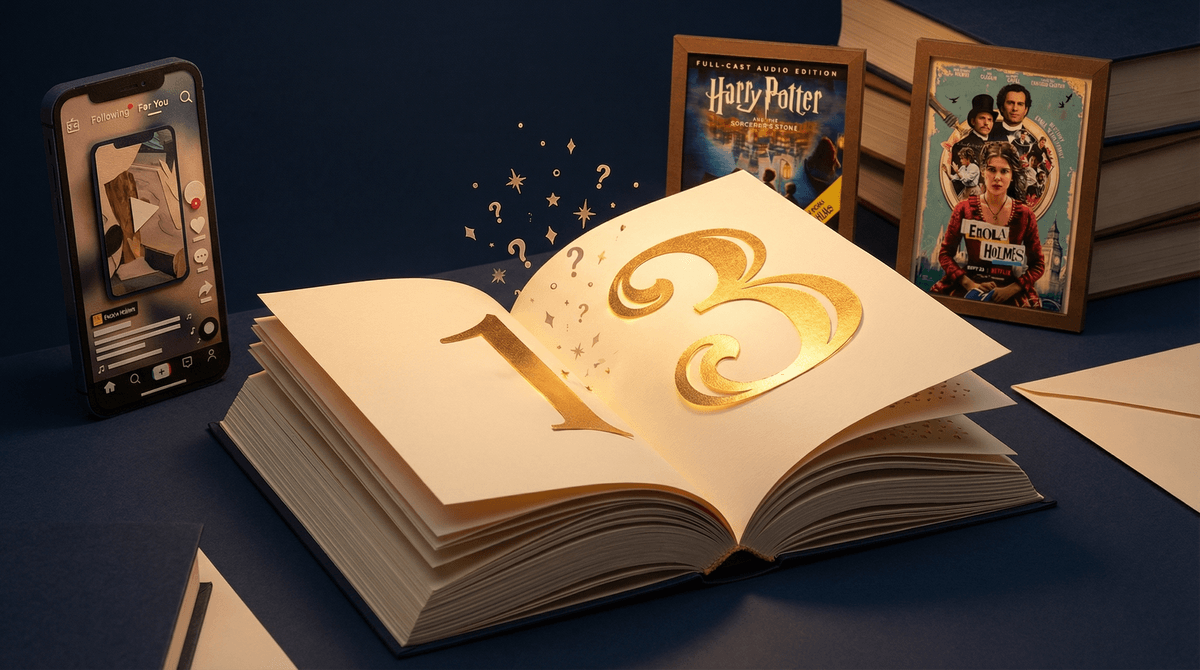
If your kid has been mysteriously asking to look at "page 13" of random books, or you've caught them frantically flipping through novels and textbooks with intense focus, welcome to the latest internet rabbit hole: the Page 13 phenomenon.
Here's the deal: Page 13 started as a TikTok trend where users claim that page 13 of any book contains a "hidden message" or "secret" that's supposedly creepy, prophetic, or weirdly relevant to your life. Kids are filming themselves reading page 13 of whatever book is nearby—Harry Potter, their science textbook, a cookbook—and treating the first sentence or a random line as some kind of mystical fortune-telling.
It's basically like a literary version of a Magic 8-Ball, except with more dramatic music and significantly more views.
The "mystery" isn't actually mysterious at all. There's no conspiracy, no hidden code embedded by publishers, no secret society of authors coordinating messages on page 13. It's literally just... page 13. But the internet has decided it's meaningful, and now millions of kids are participating in what is essentially collaborative pareidolia—seeing patterns where none exist.
This trend hits several sweet spots for the middle school and early high school crowd (roughly ages 10-16):
It's low-stakes mysterious. Kids get to feel like they're uncovering something secret without any actual risk or complexity. It's Mystery Lite™—all the intrigue of a conspiracy theory, none of the QAnon.
It's participatory. Everyone can do it. You don't need special equipment, gaming skills, or even a specific book. Any book works, which makes it incredibly accessible and easy to join.
It's perfectly TikTok-able. The format is simple: dramatic zoom on a book, flip to page 13, read the line with ominous music, react with shock. It's a ready-made content template that even shy kids can execute.
It has that "choose your own meaning" vibe. Like horoscopes or fortune cookies, the vagueness of random sentences lets kids project whatever meaning they want onto the text. "The door was locked" becomes deeply significant when you're 13 and everything feels meaningful.
First, this is harmless. Like, genuinely harmless. Kids are reading books. They're flipping through physical pages. In an era where we're constantly worried about screen time, this trend actually gets them touching paper.
That said, there are a few things worth understanding:
It's feeding into magical thinking. While the trend itself is innocent, it does reinforce the idea that random coincidences are meaningful patterns. For younger kids especially, this can blur the line between fun and actual belief. If your 10-year-old is genuinely convinced that page 13 predicted their day, that might be worth a gentle conversation about probability and pattern-seeking.
It's very TikTok-driven. Most kids participating in this are either creating content for TikTok or consuming it there. If your kid isn't supposed to be on TikTok yet (it's technically 13+, though we all know that's loosely enforced ), this trend might be a sign they're watching anyway—either on a friend's phone or through a secret account.
The "secrets" can occasionally be genuinely unsettling. Because it's random, sometimes page 13 contains violence, death, or mature themes—especially if kids are grabbing YA novels or adult books. A kid looking for a fun mystery might stumble onto "The blood pooled beneath the body" and actually get spooked.
Ages 8-10: If younger kids are asking about this, they're probably hearing about it from older siblings or friends. You can let them try it with age-appropriate books (picture books often don't have 13 pages, which is its own funny discovery), but frame it clearly as "a silly game" rather than something real. Use it as a springboard to talk about how our brains like to find patterns even when things are random.
Ages 11-13: This is the prime demographic. They're old enough to participate but young enough that the line between game and belief might be fuzzy. Let them have fun with it, but check in: "Do you actually think page 13 is magic, or is this just a fun thing people are doing?" Most will roll their eyes and say "obviously it's just for fun, Mom," which is exactly what you want to hear.
Ages 14+: Teens are generally in on the joke. They understand it's performative and absurd. The bigger question is whether they're spending hours creating content around it or doomscrolling through other people's page 13 videos. That's less about the trend itself and more about general TikTok time management.
Instead of dismissing it as "dumb internet stuff" (even though... it kind of is), use it as a conversation starter:
"What's the weirdest page 13 you've found?" Let them share. Show genuine interest. It's a book! They're reading! Take the win.
"Why do you think people think page 13 is special?" This opens the door to talking about confirmation bias, pattern-seeking, and how trends spread online.
"Have you noticed that you can make almost any sentence seem meaningful if you try?" Do it together. Pick a random page from a random book and see how you can spin it to "predict" something about your day. It's a gentle way to demonstrate how our brains work.
"Are you seeing this on TikTok?" If they're not supposed to be on the app, this is your opening. If they are, it's a chance to talk about what else they're seeing in their feed.
Page 13 is the digital equivalent of playing "Light as a Feather, Stiff as a Board" at sleepovers—it's spooky-adjacent, totally harmless, and something kids will look back on with mild embarrassment in five years.
The trend will fade (they always do), but the underlying appeal—mystery, participation, meaning-making—is eternal. Kids have always looked for patterns and secrets. The internet just gives them new places to look.
Let them flip through books searching for cosmic significance. Worst case scenario? They accidentally read something.
-
If your kid is into this: Ask them to show you their favorite page 13 finds. Make it a family game night activity. See if page 13 of the cookbook predicts dinner.
-
If you're worried about TikTok exposure: Learn how to set up TikTok parental controls or have a conversation about what they're watching and why.
-
If they want to make content about it: Talk about digital footprints and what they're comfortable having online. A video of them reading a book is low-risk, but it's still a good opportunity to discuss consent and permanence.
-
If you want to redirect the mystery-loving energy: Introduce them to actual puzzle books, escape room games, or mystery series like Enola Holmes or Knives Out. Or try Pandemic or Mysterium for cooperative mystery-solving that doesn't involve doomscrolling.
The hidden secret of page 13? There isn't one. And that's actually the most important thing for kids to learn.