

The Best Family-Friendly Games on Apple Arcade
TL;DR: Apple Arcade is genuinely one of the best gaming deals for families—$6.99/month for 200+ games with zero ads, zero in-app purchases, and zero predatory mechanics. Here are the standout titles worth your time:
For younger kids (4-8):
For tweens (8-12):
For teens and family co-op:
If you've been burned by Roblox draining your bank account or your kid getting sucked into the endless dopamine loop of free-to-play games, Apple Arcade is the antidote.
Every game is premium quality with no surprise charges. No "watch this ad to continue," no "buy 1000 gems for $4.99," no manipulative timers. Just games. The way they used to be.
You download them, you play them, that's it. Works offline too, which is clutch for road trips and flights.
The catch? Most of these games aren't household names. You won't find Minecraft or Fortnite here. But honestly? That's kind of the point. These are thoughtfully designed games that respect your kid's attention instead of exploiting it.
This is pure, wholesome digital play for the preschool and early elementary set. Kids explore a neighborhood with adorable characters, play mini-games, and engage in open-ended creative activities. No objectives, no pressure, just vibes.
It's basically the digital equivalent of a toy box—kids can dress up characters, decorate houses, throw parties. My favorite part? There's no way to "fail" at anything. It's genuinely designed for exploration and imagination rather than achievement.
Best for: Ages 3-7
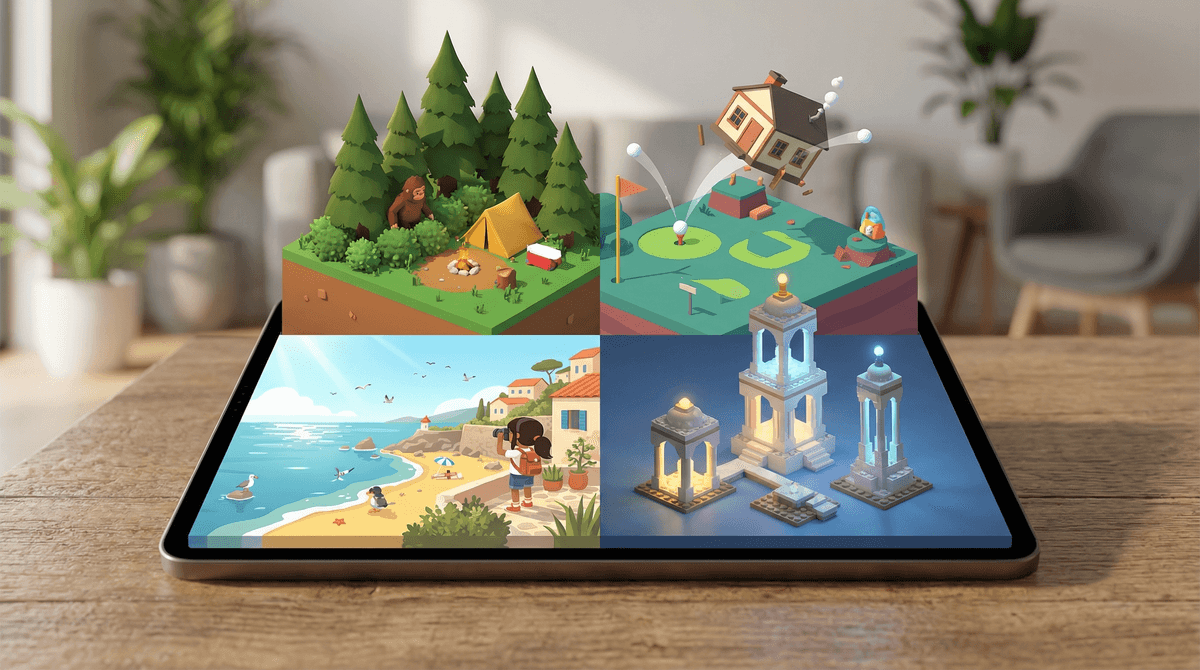
This game has no business being as charming as it is. You play as a sasquatch who lives in the woods and sneaks into a nearby park to steal food from campers. Over time, you can get a job, buy a house, race cars, solve mysteries, and even run for mayor.
The humor is gentle and silly, the gameplay is genuinely engaging, and there's tons to discover. Kids love the "sneaking around" aspect (you have to avoid park rangers), and parents appreciate that it's basically teaching resource management and problem-solving.
Best for: Ages 6-12 (honestly, adults love this one too)
A beautiful, meditative game about swinging through the jungle as a family of gibbons. The art style is gorgeous, the music is soothing, and the environmental message is present but not preachy.
It's simple to play (you're basically just timing your swings from branch to branch), but it has real emotional weight. There are moments of loss and challenge that older kids will appreciate, while younger ones just enjoy the satisfying rhythm of movement.
Best for: Ages 6-10
This game is absolutely bonkers in the best way. It starts as a golf game, then immediately breaks every rule. You're launching houses, kicking soccer balls, solving puzzles, and laughing at absurd physics.
Each level is a surprise, and the humor lands perfectly for this age group. It's clever without being mean, challenging without being frustrating, and weird in that "I can't believe this is a real game" way that kids love.
Best for: Ages 8-14
If your kid loves LEGO but you're tired of stepping on bricks, this is your game. It's a puzzle game where you build paths and structures to solve challenges, and it's genuinely beautiful—like, "I want to frame screenshots" beautiful.
The puzzles start simple and gradually introduce new mechanics. There's no dialogue, just a wordless story told through building. It's meditative and satisfying in the same way that actual LEGO building is, but without the cleanup.
Best for: Ages 7-12
You play as a young girl visiting her grandparents on a Mediterranean island, and you spend your time photographing wildlife, cleaning up trash, and rallying the community to protect a nature reserve.
It's cozy, it's wholesome, and it has actual heart. The environmental themes are present but never preachy—it's just a game about caring for the place you love. Perfect for kids who loved The Wild Robot by Peter Brown or are into nature and animals.
Best for: Ages 8-13
Yes, there's a legit NBA game on Apple Arcade, and it's actually good. It's a stripped-down, more accessible version of the console game—perfect for kids who want to play basketball without the overwhelming complexity of the full simulation.
Great for sports-loving kids and excellent for family competition. The controls are intuitive enough for younger players while still having enough depth for teens.
Best for: Ages 10+
Remember Crossy Road? This is the platformer version, and it's fantastic for family co-op play. Up to four players can work together (or hilariously sabotage each other) to climb towers, avoid obstacles, and unlock new characters.
The difficulty scales well, so younger siblings can participate without holding everyone back, and older kids/parents can still find challenge. It's chaotic, it's funny, and it's one of the few games where everyone can play together without anyone getting bored.
Best for: Ages 7+, best with multiple players
This is a full-blown JRPG from the creator of Final Fantasy, and it's legitimately one of the best RPGs you can play on mobile. The story is engaging, the turn-based combat is strategic, and the visuals are stunning (they're made from physical dioramas that were photographed).
It's long (40+ hours), so this is for kids who are ready to commit to a real adventure. Perfect for teens who loved Pokémon but want something with more story depth.
Best for: Ages 12+
Grindstone (Ages 10+): A puzzle game with surprising depth and a darkly funny sense of humor. You're a warrior clearing dungeons by chaining together enemies. Sounds violent, but it's cartoony and strategic.
Mini Motorways (Ages 8+): A zen city-building puzzle game about designing road networks. Incredibly satisfying, teaches systems thinking, and has that "just one more turn" quality.
Spire Blast (Ages 6+): A simple but addictive puzzle game about knocking down towers. Great for younger kids who need something engaging but not overwhelming.
Bloons TD 6+ (Ages 8+): Tower defense strategy without the typical free-to-play nonsense. Kids love the colorful monkeys and satisfying gameplay loop.
The subscription works across all Apple devices in your family sharing plan. One subscription, everyone plays on their own device with their own progress. This is huge for families with multiple kids.
Not every game will land. The library is big, and some games are genuinely experimental or niche. Let your kids browse and try things. The beauty is there's no cost to downloading and deleting.
Screen time is still screen time. These games are higher quality and less manipulative than free-to-play alternatives, but they're still games. Set boundaries just like you would with any other media.
Some games have mild cartoon violence. Apple Arcade is generally family-friendly, but not every game is for every age. Check the age ratings in the App Store before handing over your device.
The value is insane if you use it. At $6.99/month, you need to play maybe 2-3 games to get your money's worth compared to buying premium games individually. But if your kids only want Roblox and YouTube, it's a waste.
If your kids are used to Fortnite or Roblox, Apple Arcade games might feel "boring" at first. They're not designed to trigger constant dopamine hits. There are no battle passes, no daily login rewards, no FOMO mechanics.
This is a feature, not a bug, but it takes adjustment.
Try this approach:
- Let them pick 2-3 games to try based on screenshots
- Play together for the first session
- Give it a week before judging whether they're "into it"
- Don't force it—some kids genuinely prefer multiplayer social games, and that's okay
For more on transitioning away from high-stimulation games, check out this guide on alternatives to Fortnite.
Apple Arcade isn't going to replace all gaming in your house, and it's not trying to. But it's one of the few gaming platforms that actually respects families instead of trying to extract maximum revenue from them.
The games are thoughtful, the business model is transparent, and there's genuine variety here—from silly physics games to deep RPGs to creative sandboxes.
If you're tired of managing Robux purchases or negotiating V-Bucks, this is worth trying. The first month is usually free, so there's literally no risk.
Start with Sneaky Sasquatch or What the Golf? and go from there. Worst case? You've spent $7 to learn it's not for your family. Best case? You've found a gaming solution that actually works for everyone.
- Try the free trial (usually 1-3 months depending on promotions)
- Download 3-5 games based on your kids' ages and interests
- Set expectations that these games are different from free-to-play titles
- Check in after a week to see what's landing
Want more recommendations? Ask about cozy games for kids or educational games that don't feel like homework.