

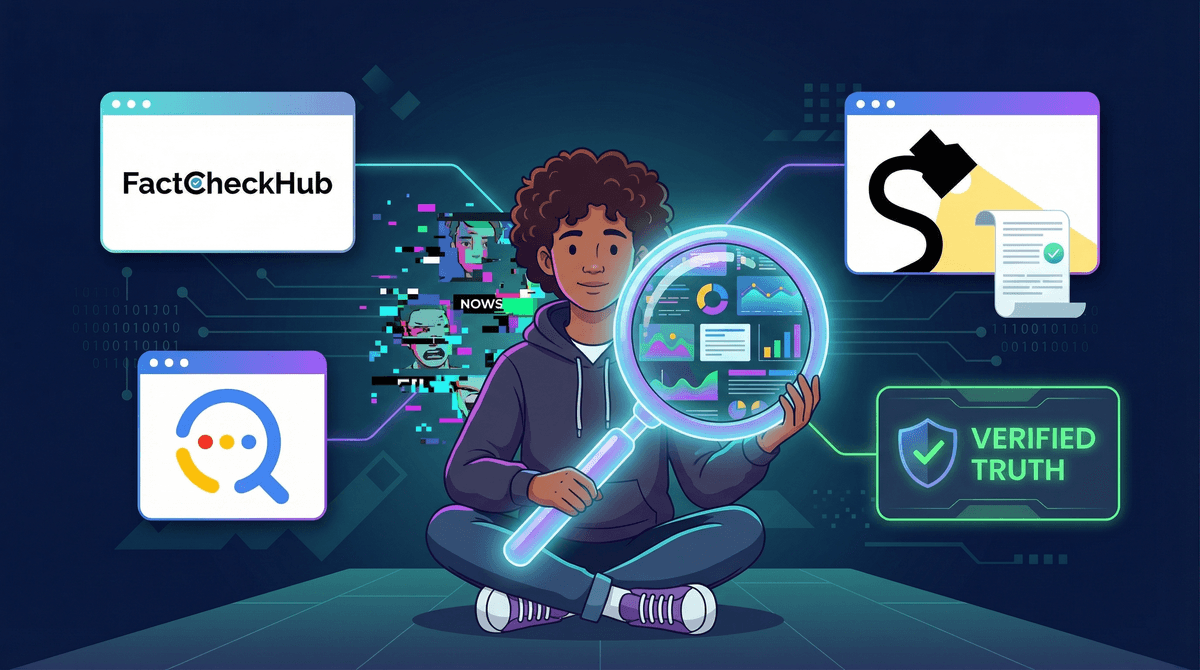
Deepfakes, AI, and the "Trust Me Bro" Source: Helping Teens Spot Fake News
Remember when fake news meant a tabloid claiming Bigfoot was running for president? Yeah, those were simpler times. Now we're living in an era where a deepfake video of a celebrity saying something outrageous can rack up millions of views before anyone realizes it's AI-generated, and your teen is getting their news from TikTok creators who cite their sources as "I saw it somewhere."
The truth is, teens are swimming in a sea of misinformation, and most of them don't even know they're wet. Between AI-generated images that look completely real, "news" accounts that are actually rage-bait farms, and the whole "vibes-based" approach to truth ("it feels true so it must be"), we've got our work cut out for us.
Fake news isn't new—propaganda and misinformation have been around forever. But what's different now is the speed, scale, and sophistication of it all.
We're talking about:
- AI-generated images and videos (deepfakes) that are nearly impossible to distinguish from real ones
- Coordinated disinformation campaigns designed to manipulate emotions and spread quickly
- "News" that's actually engagement bait designed to make you angry enough to share
- Real news taken wildly out of context and packaged to support a narrative
- Satire and parody that teens take at face value because they didn't check the source
And here's the kicker: teens often can't tell the difference. A 2023 study found that most high schoolers couldn't distinguish between real news articles and sponsored content, and they rarely checked sources before sharing information. They're digital natives, sure, but that doesn't mean they're digitally literate.
Your teen might be able to spot a scam email from a mile away, but that doesn't mean they're immune to misinformation. Here's why they're particularly susceptible:
The Algorithm Knows What They Like Social media algorithms feed teens content that aligns with what they already believe and engage with. This creates echo chambers where misinformation gets reinforced rather than challenged. If they watch one conspiracy theory video, guess what's flooding their feed next?
Emotional Thinking Over Critical Thinking Teen brains are still developing, particularly the prefrontal cortex (the part that handles critical thinking and impulse control). When they see something that triggers strong emotions—outrage, fear, excitement—they're more likely to share it immediately without fact-checking.
Social Currency Being first to share "breaking news" or a wild story gives teens social clout. The pressure to be in-the-know and part of the conversation often trumps the need to verify information.
Source Blindness Many teens don't even look at where information comes from. A professional-looking TikTok or Instagram post feels just as credible as a New York Times article. The concept of journalistic standards? Not really on their radar.
This isn't just about teens believing silly internet rumors. Misinformation has real consequences:
- Health decisions based on fake medical advice (remember the Tide Pod challenge?)
- Political polarization driven by deliberately divisive content
- Harassment campaigns started by false accusations
- Financial scams targeting teens who believe fake investment opportunities
- Damaged reputations when teens share false information about peers or public figures
And once something is shared, it's nearly impossible to take back. Even if your teen deletes it, screenshots are forever.
Okay, so what do we actually do about this? Here's the thing: you can't fact-check everything your teen sees, and honestly, you shouldn't try. What you can do is teach them to be their own fact-checkers.
Start with the SIFT Method
This is probably the most practical framework for teens (developed by digital literacy expert Mike Caulfield):
S - Stop: Don't immediately react or share. Take a breath.
I - Investigate the source: Who is behind this information? Are they credible? Do they have expertise? What's their agenda?
F - Find better coverage: Is anyone else reporting this? What do reliable news sources say?
T - Trace claims to the original context: Is this quote or image being used in its original context, or has it been manipulated?
Teach Them to Ask Questions
Help your teen develop a healthy skepticism (not cynicism—there's a difference) by asking:
- Who created this and why?
- What's the source? (And no, "someone on TikTok" is not a source)
- Does this make me feel a strong emotion? (That's often a red flag)
- Can I find this information from multiple reliable sources?
- Is this too good (or bad) to be true?
Practice Spotting Deepfakes and AI Content
Sit down with your teen and look at examples of AI-generated content together. Point out tells like:
- Weird hands or fingers (AI still struggles with these)
- Unnatural lighting or shadows
- Inconsistent backgrounds
- Odd text or spelling in images
- Audio that doesn't quite match lip movements
There are great resources online that show side-by-side comparisons of real vs. AI-generated content. Make it a game—can they spot the fake?
Introduce Them to Fact-Checking Sites
Bookmark these together:
- Snopes.com (for general fact-checking)
- FactCheck.org (for political claims)
- PolitiFact (another good political fact-checker)
- Media Bias/Fact Check (to understand source reliability)
Show them how to use reverse image search (Google Images or TinEye) to check if photos have been manipulated or taken out of context.
Ages 11-13: Focus on the basics of source evaluation. Help them understand the difference between news, opinion, advertising, and entertainment. Practice identifying clickbait headlines together. This is a good age to start talking about how algorithms work and why their feed shows them certain content.
Ages 14-16: Dig deeper into media literacy. Discuss bias (everyone has it, including news sources they trust), how to evaluate sources, and the importance of reading beyond headlines. Introduce them to fact-checking sites and practice using them together. Talk about the consequences of sharing misinformation.
Ages 17-18: At this point, they should be able to independently evaluate sources and spot red flags. Focus on more nuanced topics like understanding different types of bias, recognizing sophisticated manipulation techniques, and thinking critically about AI-generated content. They're about to be voting-age adults—they need these skills.
Here's the thing: if you come at your teen with "YOU'RE BEING MANIPULATED BY THE INTERNET," they're going to tune you out immediately. Instead, try these approaches:
Use Current Examples When you see something questionable in your own feed, share it with your teen. "Hey, I saw this wild claim about [topic]. Want to help me figure out if it's real?" Make it collaborative, not preachy.
Share Your Own Mistakes Tell them about a time you fell for misinformation or shared something without checking it first. Vulnerability builds trust and shows that this is something everyone struggles with.
Make It About Empowerment, Not Fear Frame media literacy as a superpower. "You're going to be way ahead of most people because you know how to spot this stuff." Teens love feeling like they have insider knowledge.
Acknowledge the Complexity Don't pretend everything is black and white. Sometimes it's genuinely hard to tell what's true, and that's okay. The goal isn't perfection—it's developing the habit of questioning and verifying.
Real talk: some teens are going to roll their eyes at all of this. They might say "I know what's real and what's fake" (spoiler: they often don't), or they might just not care because it's all "just for fun."
If that's your kid, try these angles:
Connect it to their values: If they care about social justice, talk about how misinformation harms marginalized communities. If they're into gaming, discuss how fake news about game releases or controversies affects the community.
Make it personal: Point out how misinformation could affect them directly—false rumors at school, scams targeting teens, or fake news about topics they care about.
Set boundaries around sharing: If they won't fact-check for themselves, make it a house rule that they can't share news or controversial content without running it by you first. Yes, they'll hate this. But better annoyed than spreading dangerous misinformation.
Your teen is going to encounter fake news, deepfakes, and AI-generated content. That's not a maybe—it's a guarantee. The question is whether they'll have the skills to recognize it and the judgment to not spread it further.
Media literacy isn't optional anymore—it's as essential as teaching them to look both ways before crossing the street. And just like with crossing the street, you can't be there every time to check for them. They need to develop these skills themselves.
The good news? Teens are actually pretty good at this once they understand why it matters and have the tools to do it. They just need someone to teach them—and that someone is you.
-
Start small: Pick one upcoming news event or viral story and walk through fact-checking it together with your teen.
-
Set up their tools: Bookmark fact-checking sites on their devices. Show them how to use reverse image search.
-
Make it ongoing: This isn't a one-time conversation. Make media literacy a regular part of your discussions about what they're seeing online.
-
Model good behavior: Let them see you questioning sources, reading full articles (not just headlines), and verifying information before sharing.
-
Learn more about how to talk to teens about digital literacy
 and get strategies for making these conversations feel natural rather than preachy.
The internet isn't going to get less complicated. But your teen can get better equipped to navigate it—starting now.