

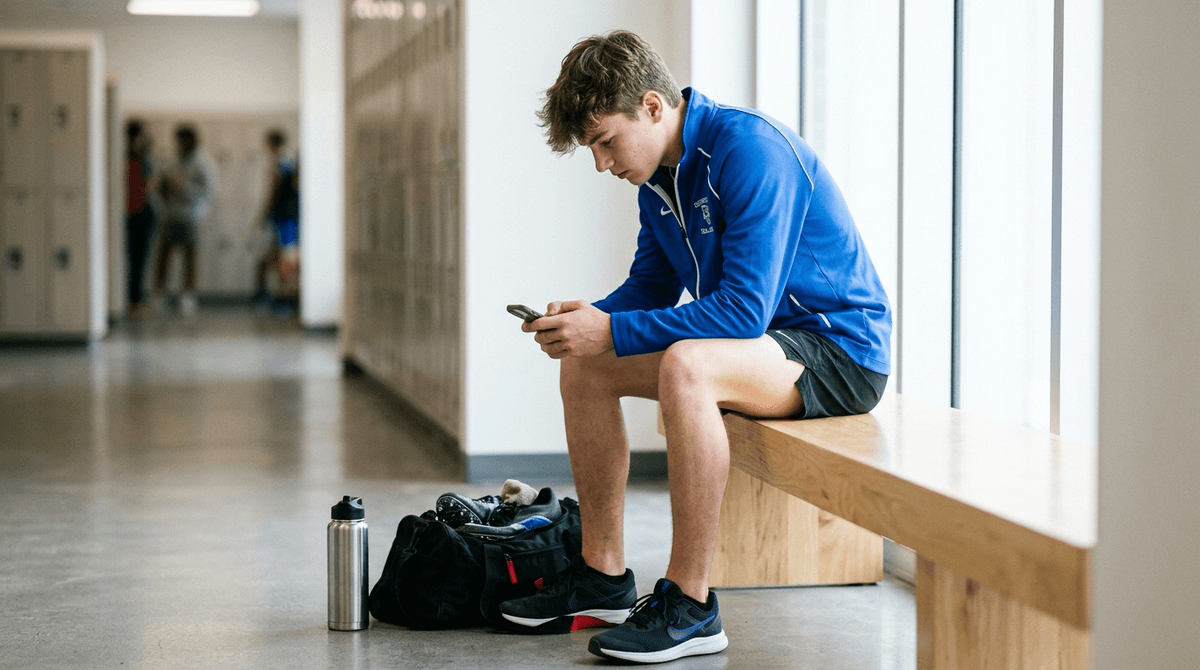

Signing your teen up for sports keeps them physically fit, but it will not crowd out their screens or fix their junk food habits. Even competitive high school athletes log more than four hours of recreational screen time every day.
Joining an organized sports team protects teen boys against high BMI and physical inactivity, but it does nothing to reduce their daily screen time. Active athletes spend just as many hours glued to phones and consoles as their sedentary peers, while sleeping significantly less each night.
Parents often assume that packing a teen’s afternoons and weekends with team sports solves the digital dilemma. If a kid spends two hours running on a field, the logic goes, they will naturally have less time to scroll social media or play video games.
This study shows that assumption is false. Teens do not trade screen time for sports; they simply carve screen time out of their sleep and downtime. Relying on athletics as a natural screen barrier leaves digital habits completely unchecked.
Sedentary lifestyles and adolescent weight gain are climbing globally, leading researchers to examine whether athletic participation acts as a broader lifestyle shield. Investigators compared high school athletes and non-athletes to see if the discipline required for sports carried over into healthier habits overall: better food choices, less recreational tech use, and consistent sleep.
Athletic participation created a stark divide in physical fitness, but left digital consumption and general nutrition virtually untouched:
- Weight and movement: Nearly all athletes (99%) met recommended physical activity targets, compared to just over half (56%) of non-athletes. Athletes maintained an average healthy BMI of 23.6, while non-athletes averaged 29.7, bordering on obesity.
- Identical screen use: Both groups averaged over four hours of screen time daily. Being on a competitive sports roster did not shave a single minute off recreational screen use.
- The sleep deficit: Athletes slept two hours less per night than non-athletes (9.1 hours versus 11.3 hours), likely due to early practices, late games, and homework squeezed around training.
- Dietary blind spots: Athletes ate fast food and drank soda at nearly identical rates to non-athletes. Only one dietary factor consistently predicted a higher BMI across the board: frequent energy drink consumption.
Athletes do not drop their phones to play sports; they sacrifice sleep to keep their phones. When a teenager's day is packed with classes, homework, and demanding practices, late-night screen time becomes their primary window for unstructured leisure and socializing. Unless parents set firm boundaries around overnight device use, intense sports schedules can inadvertently strip away rest instead of screens.
This was an observational snapshot of 124 high school boys (ages 16–17) in a single city (Riyadh, Saudi Arabia). It cannot prove that sports caused the lower BMI—leaner, more active teens may simply be more likely to join sports teams in the first place.
The data also relied on self-reported questionnaires. The non-athletes' reported average of 11.3 hours of sleep per night is almost certainly an overestimation, though the comparative deficit for athletes remains clear. These patterns may also play out differently for girls or younger children.
- If your teen joins a competitive sports team… keep household screen boundaries firm, because intense practice schedules will not naturally curb their screen time.
- If training schedules run late into the evening… remove phones and gaming consoles from the bedroom to protect their overnight sleep window.
- If you want to protect your athlete against unhealthy weight gain… specifically ban energy drinks from their sports bag, as they showed the strongest dietary link to a higher BMI.
Sports build fitness and manage weight, but they cannot manage your teen’s relationship with technology. Keep your digital boundaries in place regardless of how many hours your kid spends on the field.
Bin Radhyan F, Tomar R, Bursais AK et al. (2026). Physical activity, dietary habits, screen time, and sleep duration among Saudi male adolescent athletes and non-athletes: a cross-sectional study. Frontiers in public health. doi:10.3389/fpubh.2026.1871762 — pubmed.ncbi.nlm.nih.gov