

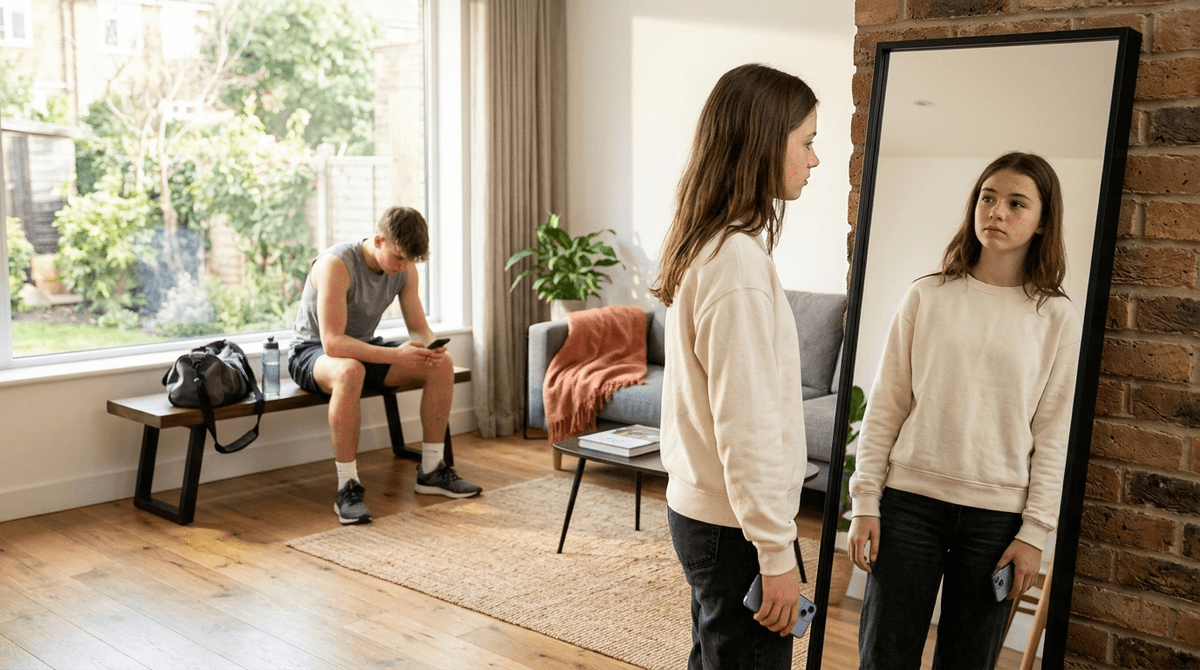

Feeling unhappy with one's body is now the default setting for teenagers, but the reasons behind that distress split sharply along gender lines. While girls struggle primarily with social comparisons and curated online media, boys' insecurities hinge on their physical fitness and personal sense of self.
Adolescent body dissatisfaction is an epidemic with distinct gender roots: only one in four girls feels good about her body—driven largely by social media comparisons—while boys' body image tracks directly with physical fitness and identity.
Default parenting advice treats body image as a single, uniform problem solved by vague reminders about "inner beauty." This paper shows that generic talks fall flat because boys and girls are responding to entirely different pressures.
If you are waiting for your teenager to mention body insecurities before stepping in, you are already behind. When fewer than a quarter of girls and fewer than half of boys feel positive about their appearance, body dissatisfaction is not an isolated crisis affecting a few vulnerable kids—it is the baseline reality of the middle- and high-school years.
The researchers surveyed 802 Canadian teenagers aged 13 to 18 to isolate what predicts whether a kid likes what they see in the mirror.
- Positive body image is rare: Only 23% of teenage girls and 13% of non-binary youth reported feeling good about their appearance, compared to 43% of boys.
- Girls compare outwards: Girls' body dissatisfaction is tied directly to social comparisons and curated media portrayals.
- Boys measure inwards: Boys' body image hinges primarily on their perceived physical fitness levels and overall sense of personal identity.
- It bleeds into overall health: Teens with poor body image—especially girls—consistently rated their overall mental and physical health as significantly worse.
Because boys report higher satisfaction than girls (43% versus 23%), parents often assume their sons are doing fine. But 43% is still a failing grade; more than half of adolescent boys dislike their bodies.
Boys simply mask their distress differently. While girls talk about wanting to be smaller or looking like influencers, boys channel their anxiety into athletic output, muscle gain, or silent withdrawal. When a teen boy obsesses over workout metrics, protein, or athletic performance, parents often praise the discipline without realizing it may stem from the exact same self-loathing that drives a teen girl's crash diet.
This was an observational snapshot in time using an online survey. It shows strong associations between media, fitness, and body dissatisfaction, but it cannot prove that one directly causes the other. The study also had a relatively small sample of non-binary teens, meaning findings for that specific group come with a wider margin of error.
- If your daughter spends hours scrolling visual platforms like Instagram or TikTok… …shift conversations away from how she looks and audit her feeds together, helping her identify how algorithmic curation and digital filters distort reality.
- If your son is suddenly fixated on fitness routines or muscle building… …ask what is driving his goals, watching for signs that physical exercise has shifted from healthy play into an anxious attempt to fix his self-worth.
- If your teen identifies as non-binary… …check in proactively about body comfort and physical dysphoria, as they face the highest rates of distress and the least visibility in standard health discussions.
- If your teenager expresses chronic dissatisfaction with their weight or face… …treat it as a potential red flag for broader mental health struggles rather than writing it off as routine teenage vanity.
Stop waiting for warning signs of body distress—assume your teenager is already swimming in it, and tailor your support to the specific pressures of their gender.
Woldetinsae L, Vafaei A, Phillips SP (2026). When adolescents look at their bodies: Individual and social explanations for the dissatisfaction with what they see-A cross-sectional study. Canadian journal of public health = Revue canadienne de sante publique. doi:10.17269/s41997-026-01229-3 — pubmed.ncbi.nlm.nih.gov