

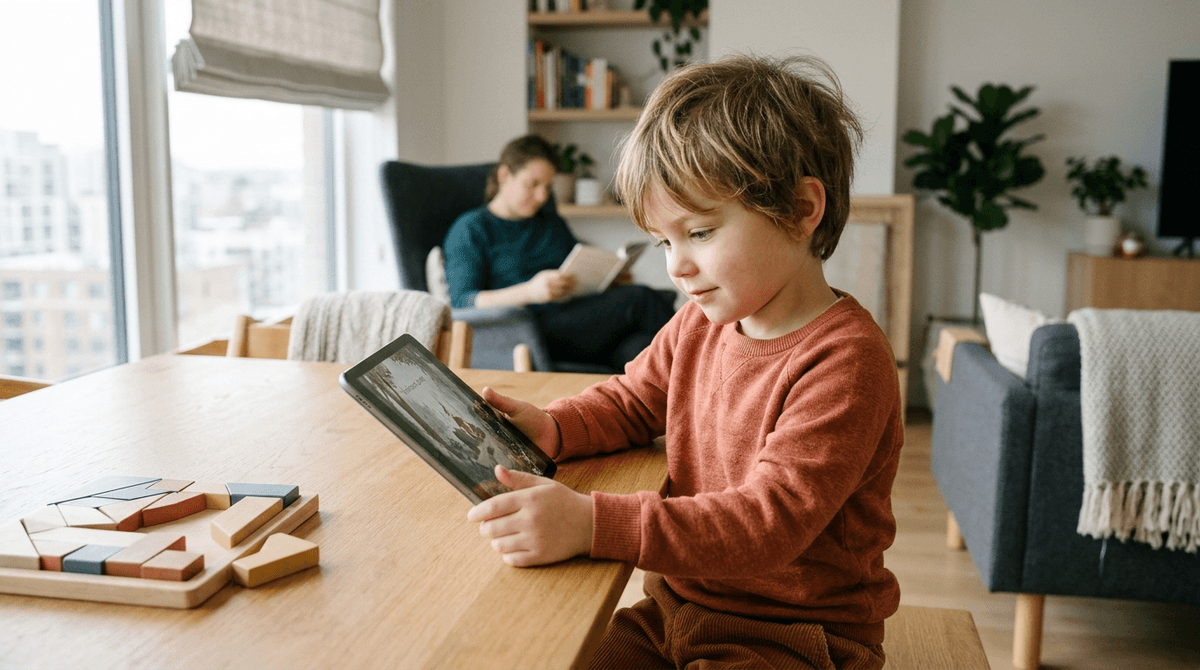

A structured tablet game can nudge four-year-olds toward empathy and better behavior, but it won't supercharge their memory or attention span. Early results from a Chilean trial suggest screens are far better at modeling feelings than building brainpower.
Targeted digital games can boost social-emotional skills like empathy in preschoolers, but they do not sharpen core cognitive functions like working memory or impulse control.
App developers love promising that their games will build smarter, more focused toddlers. This trial flips that marketing pitch on its head: screen-based play can model sharing and emotional recognition, but it cannot substitute for the messy, real-world interactions that build raw focus and self-control.
If you are choosing digital media for a four- or five-year-old, look for games designed around feelings and conflict resolution rather than brain-training drills that promise to raise their IQ.
Educational app stores are flooded with "brain-training" mini-games that claim to build working memory and planning skills. Researchers wanted to test whether an intentionally designed tablet platform could move the needle on both cognitive and emotional milestones in low-income preschools before kindergarten begins.
Children who played the game for 15 minutes twice a week showed clear gains in empathy and home behavior, but zero cognitive edge.
- Empathy climbed: Kids using the platform showed a clear, measurable increase in empathy assessments compared to peers following the standard preschool curriculum.
- Behavior improved at home: Parents reported fewer emotional outbursts and behavioral difficulties on standard screening checklists.
- Focus and memory stayed flat: The game made no difference in working memory, inhibitory control, or planning skills.
- Kids genuinely liked it: Four- and five-year-olds rated their enjoyment 4.6 out of 5, completing 24 sessions over 12 weeks without frustration or burnout.
Executive functions like impulse control and memory require physical, multi-sensory feedback that a flat glass screen simply cannot deliver. Tapping a tablet to stop an animated car does not train a four-year-old's brain to stop grabbing a toy from their sibling in real life.
Story-based games, however, give children a visual vocabulary for complex feelings like sadness, anger, and fairness. Recognizing an emotion on a screen translates into daily life much faster than tapping a screen translates into general self-discipline.
Treat these results as an early signal rather than definitive proof. The trial involved only 162 children across seven schools in Santiago, Chile, making it a small pilot designed primarily to see if the software worked smoothly in classrooms.
Crucially, parents and teachers knew which children were playing the game, which almost certainly biased their reports of "better behavior." The study also stopped tracking the kids the moment the 12-week trial ended, so there is no data on whether the empathy bump lasted into kindergarten.
- If your preschooler struggles to name emotions or understand peers' feelings, download narrative-driven games that center on social conflicts rather than flashcards or math drills.
- If you are paying for an app subscription to "train" your toddler's attention span or working memory, cancel it and invest in blocks, puzzles, or outdoor obstacle courses instead.
- If you introduce educational apps at home, cap them at 15 minutes a few times a week, matching the dosage that kept preschoolers engaged without behavioral pushback.
Stop buying "brain games" to build your toddler's memory, and feel free to use well-designed, story-based apps if you want a tool that sparks conversations about kindness.
Gaete J, Ríos N, Rojas-Barahona CA et al. (2026). Japi 2.0, a gaming platform to stimulate cognitive and socio-emotional skills in early childhood: results of a pilot randomized controlled trial. Child and adolescent psychiatry and mental health. doi:10.1186/s13034-026-01133-1 — pubmed.ncbi.nlm.nih.gov