

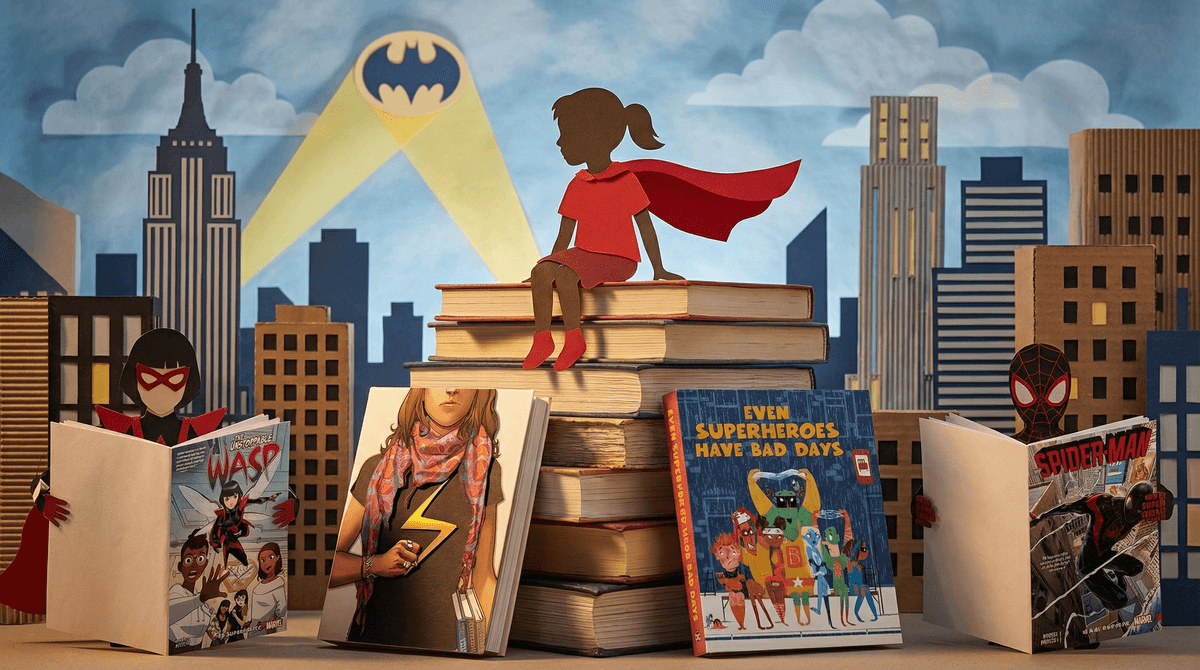
We're talking comic books, graphic novels, chapter books, and everything in between featuring caped crusaders, web-slingers, and kids discovering their own powers. From classic Marvel and DC characters to newer diverse heroes like Ms. Marvel and Miles Morales, superhero books have evolved way beyond the dusty comics your uncle kept in plastic sleeves.
The superhero book landscape for kids today is legitimately impressive. You've got traditional comics, manga-style adaptations, graphic novel series that win actual literary awards, and chapter books that use superhero frameworks to explore real issues. And here's the thing parents sometimes miss: these aren't just "gateway drugs" to "real reading." Graphic novels and comics ARE real reading, full stop.
Kids are drawn to superhero stories for the same reasons adults binge Marvel movies: the power fantasy is irresistible. Who hasn't wanted to swing between buildings or turn invisible during an awkward family dinner?
But there's more going on here. Superhero narratives give kids a framework for understanding complex moral questions: When is it okay to break rules? What do you do when authority figures are wrong? How do you balance personal desires with responsibility to others? Spider-Man's whole deal is literally "with great power comes great responsibility" — that's philosophy dressed up in spandex.
The visual storytelling format also clicks for a lot of kids who struggle with traditional chapter books. Following action across panels, interpreting facial expressions, understanding how time flows across a page — these are sophisticated literacy skills. Research shows that graphic novels can actually improve reading comprehension and vocabulary, especially for reluctant readers.
Ages 5-7: Picture Books and Early Readers
Start with books that introduce superhero concepts without the violence:
- The "Superkid" series by various authors — simple stories about kids with everyday "superpowers" like kindness
- Dog Man by Dav Pilkey — technically more silly than superhero, but scratches that comic book itch
- "Even Superheroes Have Bad Days" — picture book about emotional regulation with a cape
Ages 8-10: Graphic Novels and Early Comics
This is the sweet spot for getting hooked:
- Amulet series by Kazu Kibuishi — fantasy-adventure graphic novels with strong sibling dynamics
- The Last Kids on Earth — zombie apocalypse meets superhero team-up
- Marvel's "Unstoppable Wasp" — teen girl scientist superhero, genuinely fun
- Spider-Man: Miles Morales graphic novels — more diverse representation, age-appropriate action
Ages 11-14: Complex Narratives
Now we're cooking:
- Ms. Marvel (Kamala Khan) — Muslim teen superhero navigating identity, family, and powers
- "New Kid" and "Class Act" by Jerry Craft — not technically superhero books, but graphic novels that tackle real issues
- Classic Spider-Man comics from the library — most public libraries have digital comic collections through apps like Hoopla
- Nimona — shapeshifter sidekick story that questions hero/villain binaries
Ages 13+: Everything
At this point, they can handle most mainstream superhero content, but heads up:
- Some Marvel/DC storylines get genuinely dark (looking at you, "The Killing Joke")
- The industry has a complicated history with how it draws female characters — worth a conversation
- Manga superhero stories like My Hero Academia are huge right now and mostly age-appropriate, though some violence
The Cost Factor
Comic books and graphic novels are expensive. A single issue can be $4-5, and graphic novels run $12-25. But here's your hack: libraries are absolutely stacked with this stuff now. Most library systems have extensive graphic novel sections, and digital borrowing through Libby or Hoopla means unlimited free comics.
Also, used bookstores often have comic sections where you can get volumes for $3-5. And if your kid gets really into it, comic shops sometimes have "$1 bins" of older issues.
The "Is This Actually Educational?" Question
Yes, but let's be honest about what we mean by educational. Will reading Spider-Man teach your kid calculus? No. Will it:
- Build visual literacy skills
- Introduce complex vocabulary in context
- Model moral reasoning
- Provide diverse representation
- Give you shared cultural touchstones to discuss
Absolutely. Some educators argue that graphic novels are actually superior for teaching narrative structure because the visual elements make story beats explicit.
The Violence Concern
Superhero stories involve fighting. That's the genre. But there's a massive range between "Spider-Man webs up a burglar" and "Wolverine graphically eviscerates someone."
For younger kids, stick with books explicitly marketed as children's content. For tweens and teens, it's worth flipping through before handing over — comic book violence can be surprisingly intense because it's visual. The good news is that most superhero stories are ultimately about stopping violence and protecting people, not glorifying it.
Representation Matters
The superhero genre has historically been very white and very male. But the last decade has brought legitimate progress: Kamala Khan (Ms. Marvel) is a Pakistani-American Muslim girl. Miles Morales is Afro-Latino. America Chavez is a queer Latina. Riri Williams (Ironheart) is a Black teen girl genius.
These aren't token characters — they're leading their own compelling stories. If your kid only sees heroes who look like them (or never sees heroes who look like them), you're missing opportunities.
Make It Social
Read them together, especially with younger kids. Talk about the choices characters make. "Why do you think Spider-Man didn't just punch that guy?" "What would you do if you had invisibility powers?"
Connect to Other Media
If they loved the Spider-Man: Into the Spider-Verse movie, grab the Miles Morales comics. If they're into My Hero Academia on Netflix, the manga is excellent. Use their existing interests as bridges.
Don't Force the "Book Report" Energy
The fastest way to kill a kid's love of reading is to turn every book into a lesson. Sometimes Spider-Man is just fun, and that's enough.
Set Up a Swap System
Graphic novels are perfect for trading with friends. If multiple families are buying them, organize a swap every month or two. Stretches your budget and builds community.
Superhero books aren't a lesser form of reading — they're a different form of storytelling that happens to be really effective at hooking reluctant readers and teaching visual literacy. From Dog Man to Ms. Marvel, there's a superhero book for basically every age and interest level.
The best superhero stories teach kids that power comes with responsibility, that standing up for others matters even when it's hard, and that everyone has something that makes them special. Also that with great power comes great electricity bills, but that's usually subtext.
Your local library probably has hundreds of these books available right now for free. Start there, see what clicks, and don't stress if your kid wants to read the same Spider-Man volume seventeen times. Rereading is how kids build fluency and confidence.
- Hit your library: Ask the children's librarian for graphic novel recommendations based on your kid's age and interests
- Try before you buy: Most comic shops let you browse, and many have reading areas
- Start with characters they know: If they loved a superhero movie, find books featuring that character
- Check out alternatives to traditional chapter books if you want more options for reluctant readers
And if you're worried about whether all this comic book reading "counts," remember: kids who read for pleasure become adults who read for pleasure. Whether that pleasure comes from Shakespeare or Spider-Man matters way less than you think.