

TL;DR: The "Not Boring" Science Shortlist
If you’ve got five minutes before the kids start asking for "just one more" video, here are the heavy hitters that actually deliver on the STEM promise without the "educational" snooze factor:
- Best for High Energy: Emily's Wonder Lab (Netflix)
- Best for Engineering & Pranks: Mark Rober (YouTube)
- Best for "How the World Works": StoryBots (Netflix)
- Best for Middle Schoolers: Brainchild (Netflix)
- Best for Visual Learners: Kurzgesagt – In a Nutshell (YouTube)
Find STEM shows for a 10-year-old who loves explosions
We’ve all been there. You want them to watch something "good," so you put on a dry documentary about tectonic plates, and within three minutes, they’ve pivoted to a video of a giant toilet with a head coming out of it.
The struggle to find STEM (Science, Technology, Engineering, and Math) content that isn't "brain rot" but also doesn't feel like a mandatory Tuesday morning assembly is real. In 2026, the competition for your kid's attention isn't just other TV shows; it's the high-octane, dopamine-dripping world of Roblox and TikTok.
If a show wants to compete, it has to be fast, it has to be funny, and it probably needs to involve at least one thing blowing up (safely, of course). Here is the curated list of STEM shows that actually engage kids, categorized by how they’ll likely fit into your family’s vibe.
Most "educational" shows fail because they prioritize the lesson over the story. Kids have a built-in radar for being lectured. The second a show starts talking at them instead of with them, they’re out. The shows listed below succeed because they treat science as an adventure, a mystery, or a giant prank. They use the same editing styles kids see on YouTube—fast cuts, high energy, and relatable hosts—but they swap the mindless "Ohio" memes for actual physics and chemistry.
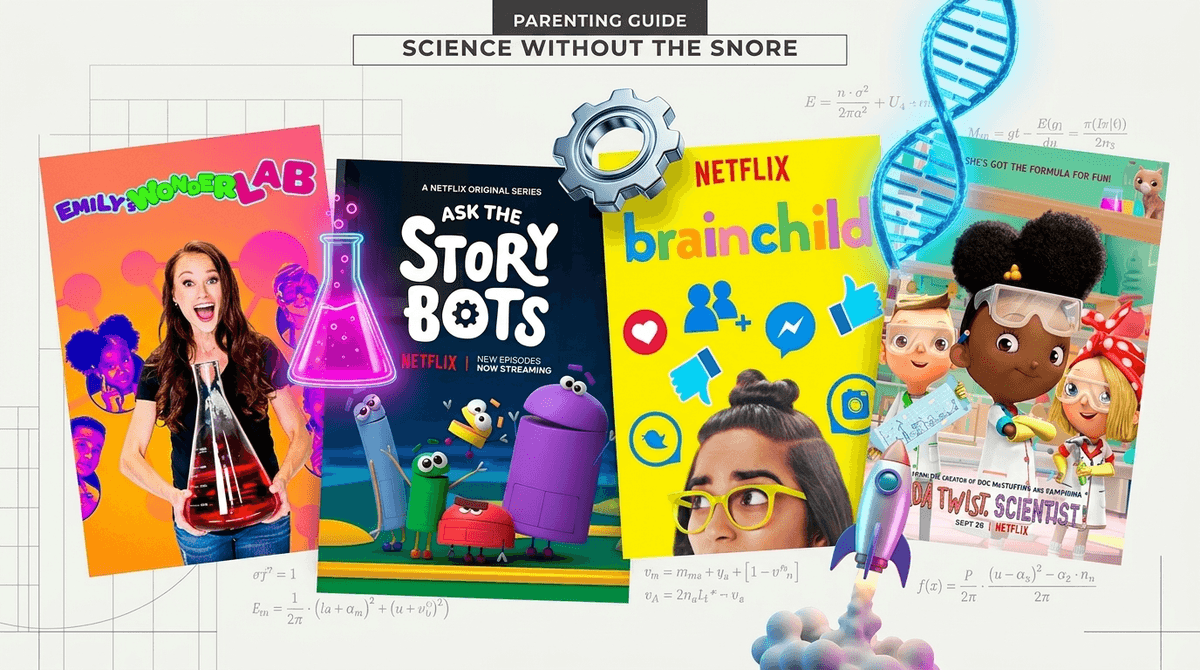
Emily Calandrelli is basically the cool older sister every kid wants. She’s an MIT-engineer-turned-science-communicator who makes huge, messy experiments look like the best party ever. Why it works: Each episode is short, punchy, and ends with a "stay-at-home" experiment. It’s perfect for the 5-9 age range because it’s bright, loud, and genuinely exciting. It’s the antithesis of a boring classroom.
Produced by Pharrell Williams, this show is specifically designed for the "tween" demographic (ages 8-12). It tackles topics like social media, germs, and dreams using relatable metaphors and high-quality graphics. Why it works: It explains the "why" behind things kids actually care about. It doesn't shy away from complex topics but breaks them down in a way that doesn't feel condescending.
Check out our guide on the best science apps for middle schoolers
Let’s be honest: for kids over the age of 7, YouTube is the primary search engine and entertainment hub. Instead of fighting it, we can point them toward creators who are doing STEM better than most networks.
If your kid hasn't found Mark Rober yet, they will. He’s a former NASA engineer who spent years working on the Curiosity Rover, but he’s famous for building "Glitter Bombs" to catch porch pirates. Why it works: This is the gold standard for "stealth learning." Kids watch for the "prank" or the "challenge," but they stay for the 10-minute deep dive into mechanical engineering, CAD design, and fluid dynamics. It’s high-production, high-stakes, and completely addictive.
Destin Sandlin is an aerospace engineer who explores the world with genuine curiosity. Whether he’s looking at how a butterfly’s wings work or what happens when you fire a supersonic baseball cannon, his enthusiasm is infectious. Why it works: It models how to be curious. He often starts a video not knowing the answer and walks the viewer through the scientific method to find it.
This channel uses beautiful, distinct animation to explain everything from black holes to the human immune system. Why it works: It’s visually stunning. Even if a kid doesn't fully grasp the nuances of "The Dyson Sphere," the animation keeps them locked in. Note for parents: Some episodes can get a bit existential (think: "The End of the Universe"), so it’s better for ages 10+.
You don't need to wait until they're 10 to start the STEM journey. These shows lay the groundwork for logical thinking and problem-solving without being "babyish."
This is arguably one of the best kids' shows ever made. Period. Tiny robots answer questions like "How do ears hear?" or "Where does nighttime come from?" Why it works: The music is actually good (not "kids' music" bad), and the guest stars include people like Snoop Dogg and Edward Norton. It’s funny for parents and fascinating for kids.
Based on the Ada Twist, Scientist book, this show follows a young girl with a giant curiosity who uses the scientific method to solve problems in her neighborhood. Why it works: It focuses on the process of science—hypothesizing, testing, and failing—rather than just the facts.
Sometimes the old ways are the best ways, but they usually need a modern coat of paint.
The reboot of the 90s classic features Kate McKinnon as Ms. Frizzle’s sister. It keeps the same "field trip into a human stomach" energy but updates the tech and the science. Why it works: It’s nostalgic for us, but the pacing is fast enough for kids raised on YouTube Kids.
While the original MythBusters is still great, the "Jr." version features a cast of incredibly talented kids who do the heavy lifting. Why it works: Seeing peers build complex structures and handle power tools is incredibly empowering for kids. It moves the "scientist" archetype away from "old man in a lab coat" and toward "kid in a workshop."
While most of these shows are "safe," the definition of age-appropriate in STEM usually comes down to two things: intensity and imitation.
- Ages 4-7: Focus on shows like StoryBots and Ada Twist, Scientist. At this age, the goal is "wonder." We want them to think the world is a giant puzzle.
- Ages 8-12: This is the prime time for Mark Rober and MythBusters Jr.. They are old enough to understand the safety warnings and appreciate the complexity of the builds.
- Ages 13+: They can handle the deeper dives of Kurzgesagt or Veritasium. This is also a great time to introduce them to Scratch if they want to start building their own digital science projects.
The biggest "trap" of STEM shows is that they can become passive consumption. Your kid might know everything about black holes but have no idea how to use a screwdriver.
The best way to use these shows is as a launchpad. If they watch an episode of Emily's Wonder Lab about non-Newtonian fluids (Oobleck), have the cornstarch and water ready in the kitchen. If they’re obsessed with Mark Rober, maybe it’s time to look into a KiwiCo subscription or a simple LEGO Technic set.
A note on "The YouTube Rabbit Hole": Channels like Mark Rober are fantastic, but YouTube's algorithm is designed to keep kids watching anything. One minute they’re learning about centrifugal force, and three clicks later, they’re watching a "MrBeast-style" challenge that has zero educational value. Pro-tip: Use the "Share" feature to send specific videos to your kid's device rather than letting them browse the "Recommended" sidebar.
Science doesn't have to be a snore. In fact, if it is, you're probably watching the wrong show. The best STEM content in 2026 is high-energy, visually stunning, and often a little bit messy.
By curated their "watchlist" with shows that respect their intelligence and match their energy levels, you’re not just filling time—you’re feeding a curiosity that might just lead to the next great invention (or at least a really cool science fair project).
Next Steps:
- Pick one show from the list above based on your kid's age.
- Watch an episode together. (Yes, actually watch it—Mark Rober is genuinely entertaining for adults, too).
- Ask one question: "How do you think they built that?" or "Do you think we could do that experiment here?"
- Check the Screenwise community data to see what other parents in your school district are letting their kids watch.