

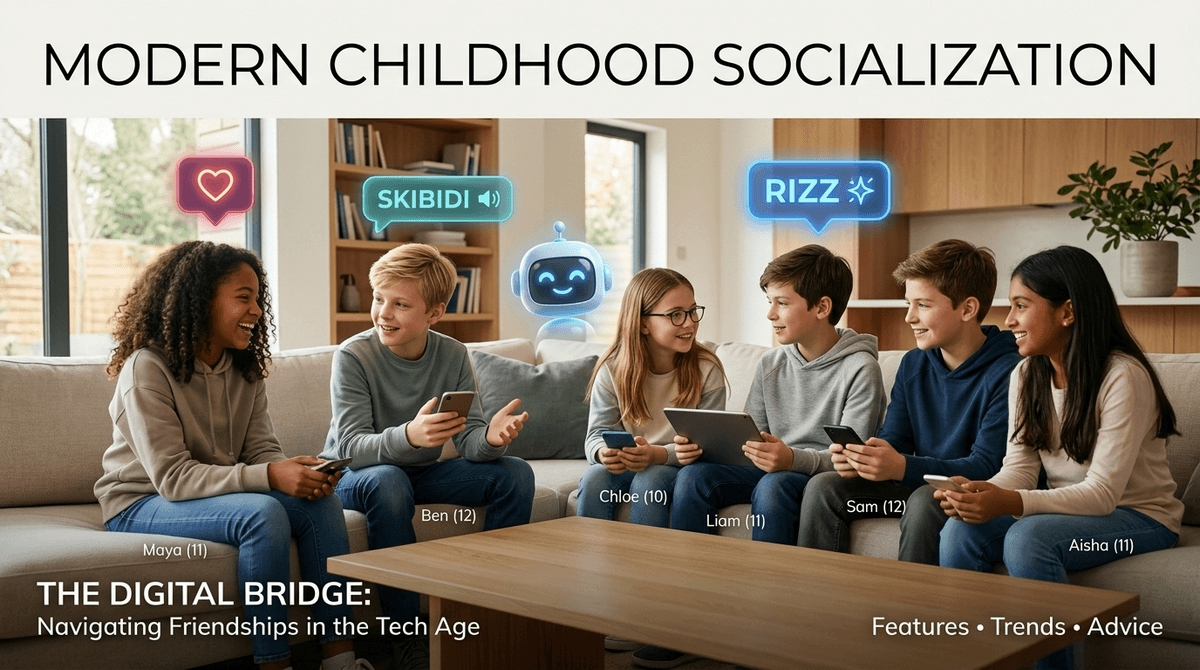
TL;DR: Modern social skills aren't just about eye contact and firm handshakes anymore; they’re about navigating the unwritten rules of Discord servers, understanding the nuance of a Roblox trade, and knowing when an AI "friend" is crossing a boundary. To keep your kid from becoming a digital hermit, focus on collaborative gaming, media literacy regarding AI, and validating their digital slang (even the weird stuff) so you remain their go-to consultant.
Quick Links for Social Development:
- Best for Empathy: Sky: Children of the Light
- Best for Collaboration: Minecraft
- Best for Conflict Resolution: Among Us
- Best for Communication: It Takes Two
If you’ve heard your child describe a burnt piece of toast as "so Ohio" or seen them mesmerized by a head popping out of a toilet, you might feel like the generational gap has become a canyon. But here’s the no-BS reality: slang like "Skibidi" and "Rizz" is just the "Grok" and "Radical" of Gen Alpha.
Socializing for kids today is a hybrid experience. They aren’t "going online" to hang out; they are always hanging out, and the screen is just the venue. The skills they need now involve managing digital reputations, interpreting text-based tone, and—increasingly—distinguishing between human connection and AI-generated companionship.
We call it "brain rot" because, to us, it looks like a chaotic mess of low-quality animation and nonsensical humor. But for kids, Skibidi Toilet isn't just a video; it's social currency.
When kids talk about these memes at school, they are building "in-group" bonds. If you ban the slang or mock the interest, you aren't just "protecting their brain"—you're accidentally cutting them out of the lunchtime conversation. The goal isn't to love the brain rot; it's to understand that it’s the current language of childhood friendship.
Ask our chatbot for a breakdown of the latest Gen Alpha slang
This is where things get a bit "Black Mirror." We’re seeing a massive spike in kids (especially middle schoolers) using apps like Character.ai to talk to fictional characters or AI versions of celebrities.
On one hand, it’s a safe space to vent. On the other, AI provides a "perfect" social interaction that real humans can’t match. A bot won't get bored, won't argue back (unless programmed to), and is available 24/7. This can make real-world friendships—with all their messy disagreements and "boring" moments—feel exhausting by comparison.
This app allows users to chat with AI personalities. While it’s marketed as a creative tool, many kids use it for emotional support. The risk isn't just "stranger danger" (since it's a bot), it's the displacement of real human empathy. If your kid is spending three hours a day talking to a bot, they aren't practicing the "give and take" of a real relationship.
If we want kids to be socially savvy, we have to steer them toward platforms that reward actual interaction rather than passive consumption.
This is the gold standard for digital empathy. You literally cannot progress in the game without helping others. It uses non-verbal communication (gestures and music) to build bonds. It’s a beautiful antidote to the toxicity often found in competitive shooters.
While it’s a game about lying, it’s actually a masterclass in deductive reasoning and social engineering. Kids have to argue their case, read other people's behavior, and work together to find the "imposter." It’s basically a digital version of the board game Mafia.
When played on a private server with friends, Minecraft is a digital playground. It teaches resource management, collaborative planning, and—most importantly—how to handle "griefing" (when someone breaks your stuff). These are real-world social conflicts played out in a low-stakes environment.
A beautiful, niche game where the only objective is to write anonymous, kind letters to real people and receive them back. It’s a fantastic way to practice digital etiquette and see the impact of words on others.
Ages 5-8: The "Co-Play" Stage
At this age, digital social skills should be 100% supervised. Play Animal Crossing: New Horizons together. Talk about why it’s nice to send a gift to a neighbor. The goal here is modeling. Show them how to be a "good sport" when a game gets frustrating.
Ages 9-12: The "Group Chat" Gauntlet
This is when the drama starts. Messenger Kids or text groups can become toxic fast.
- The Rule: If you wouldn't say it to their face at the playground, don't type it.
- The Check-in: Periodically ask, "Is the group chat making you feel good or stressed out?"
Ages 13+: The "Identity" Era
Teens are using Discord and Snapchat to curate who they are. This is the time to talk about digital permanence and the "performative" nature of social media.
While we want to be the "cool, informed parent," we can't ignore the darker corners.
- Unmoderated Spaces: Apps like Omegle (and its many clones) are a hard no. There is zero social benefit to talking to random strangers on camera.
- The "Isolation" Loop: If your child is only socializing via Roblox and refuses to go to the park or have friends over, the digital world isn't supplementing their social life—it's replacing it.
- In-Game Bullying: "Griefing" or stealing items in games can feel like a minor thing to parents, but to a kid, it’s a genuine social betrayal. Take it seriously.
The next time your kid says something is "low-key mid" or "only in Ohio," don't roll your eyes. Ask them what it means. "Wait, is that a good thing or a bad thing?" When you show curiosity about their digital culture, you build a bridge. If they feel you "get it," they are much more likely to come to you when a digital friendship goes south or when a "friend" on Discord asks for a weird favor.
The hardest part of the screen age is the transition. Many kids who are "socially savvy" in a Minecraft chat become paralyzed when a cashier asks them a question.
- Order for themselves: Make them talk to the waiter or the librarian. No screens at the table.
- Host "Analog" Gaming: Invite friends over for Catan or Exploding Kittens. It forces them to read body language and physical cues that are missing in the digital world.
- The 20-Minute Transition: Don't expect them to go from a high-intensity Fortnite match to a polite family dinner in 10 seconds. Give them a "buffer" to decompress.
Digital social skills are real social skills. Navigating a 10-person group chat requires a level of emotional intelligence that most of us didn't have to develop until our 20s.
Our job isn't to pull them out of the digital world; it's to give them the map and the compass to navigate it without losing their humanity. Validate their world, monitor their AI usage, and keep the "real world" inviting enough that they actually want to log off.
- Audit the AI: Check if your kid has Character.ai or uses Snapchat's My AI. Start a conversation about the difference between a bot and a friend.
- Play a "Social" Game: Download Sky: Children of the Light and play it together for 30 minutes.
- Set a "Human First" Rule: Designate specific times (like car rides or meals) where the focus is on the people physically in the room.
Check out our full guide on setting healthy digital boundaries