

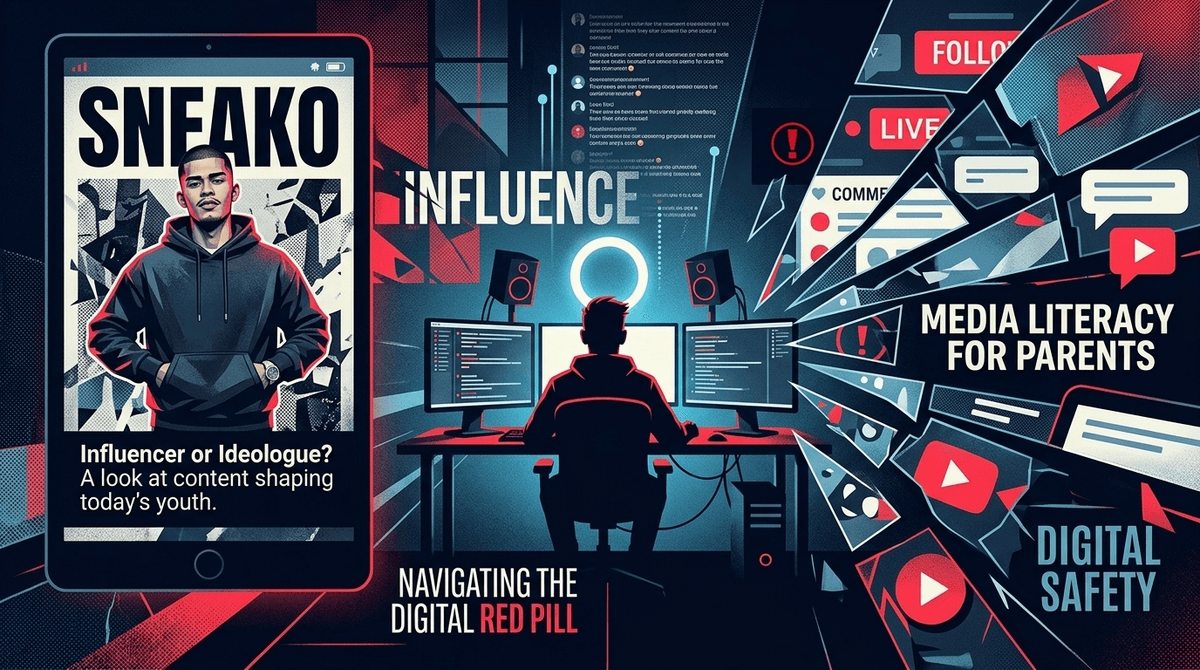
Sneako is essentially the younger, more "extremely online" version of Andrew Tate, and if your teen son is suddenly using words like "high-value," "matrix," or "bot," he’s likely been deep-diving into Sneako’s 2026 YouTube comeback. After years of being relegated to the fringes of the internet on platforms like Rumble, Sneako has managed to claw his way back into the mainstream algorithm, and he’s currently one of the primary voices shaping how Gen Z and Gen Alpha boys view masculinity, relationships, and "the truth."
TL;DR
Sneako is a highly controversial "Red Pill" influencer who recently successfully appealed his YouTube ban, leading to a massive 2026 resurgence among teen boys. His content often promotes "alpha male" ideologies, skepticism of mainstream institutions, and views on women that many find regressive or misogynistic. Screenwise recommends watching our guide to navigating the Red Pill pipeline to help facilitate healthy conversations about masculinity with your kids.
Sneako (real name Nico Kenn De Balinthazy) didn't start out as a lightning rod for controversy. Back in the day, he was actually a highly respected "creative" vlogger. He made fast-paced, existential, and genuinely artistic videos about life in New York, being a teenager, and the grind of content creation. He was the kid other kids looked up to because he was talented behind a camera.
But around 2022, his content shifted hard. He began associating with the "Red Pill" community—a corner of the internet obsessed with "sexual strategy," traditional gender roles, and the idea that men are being systematically suppressed by modern society. He was eventually banned from YouTube for violating terms regarding hate speech and harassment, which only fueled his "canceled" persona. He spent the last few years on Rumble and X (formerly Twitter), building a massive, loyal, and often aggressive fanbase of young men who felt like he was the only one "telling it like it is."
You might be wondering why a guy who was banned years ago is suddenly the talk of the school bus again in 2026. It’s a perfect storm of three things:
- The Re-Platforming: In early 2026, following shifts in platform leadership and new "free expression" policies, Sneako’s main YouTube channel was reinstated. He didn't just return; he exploded.
- Short-Form Saturation: Even when he was banned, his fans were busy. They take his long-form streams and chop them into 15-second TikToks and YouTube Shorts. Your kid doesn't have to seek out Sneako to see him; the algorithm brings Sneako to them.
- The "Lifestyle" Hook: Sneako doesn't just talk about politics or women. He talks about fitness, making money, and discipline. To a 14-year-old boy who feels awkward or unmotivated, Sneako’s "stop being a loser" rhetoric can feel like the mentorship they’re looking for, even if it comes wrapped in toxic ideology.
Ask our chatbot for tips on talking to boys about influencers
It is very easy to look at Sneako and say, "This is just garbage." And honestly? A lot of it is. But if we want to reach our kids, we have to understand the appeal.
Sneako offers a "script" for manhood at a time when many boys feel the old scripts are gone and the new ones are confusing. He preaches self-improvement, physical fitness, and financial independence. For a kid struggling with confidence, hearing "You can be a king if you work hard and ignore the haters" is a powerful drug.
The problem is the "price" of that script. To buy into Sneako’s brand of masculinity, boys are often told they have to view women as "low-value" or "distractions," and view any mainstream media or education as "the matrix" trying to keep them weak. It creates a "me against the world" mentality that can make kids defensive and isolated from their families.
Since his return, Sneako has been involved in several viral moments that have kept him at the top of the "trending" tab:
- The "AI Girlfriend" Debate: Sneako made headlines for a series of streams where he argued that AI-driven relationships are "more loyal" than real women, a take that went viral for being both bizarre and deeply concerning to developmental experts.
- The Physical Confrontations: Like many "IRL" (In Real Life) streamers, Sneako often films himself in public, getting into staged or semi-staged arguments to generate "clout."
- Religious Pivots: Sneako’s conversion to Islam and his subsequent "traditionalist" takes have created a unique crossover between religious conservative circles and the edgy internet underground.
If you find out your kid is watching Sneako, the worst thing you can do is come in hot with a "You’re banned from the internet" lecture. That just proves Sneako’s point that "the adults are trying to hide the truth from you."
Instead, try the "Curious Friend" approach:
- "I saw a clip of that Sneako guy. He’s pretty intense. What do you think about the stuff he says about 'the matrix'?" This lets them explain it to you, which gives you a window into what parts they actually believe.
- Focus on the contradictions. Sneako often talks about "freedom" while being beholden to the YouTube algorithm for his paycheck. He talks about "discipline" while spending 10 hours a day arguing with strangers on a screen. Pointing out these gaps is often more effective than calling him "bad."
- Offer better alternatives. If they like the self-improvement aspect, steer them toward creators like Mark Rober for curiosity or Hybrid Calisthenics for fitness and genuine kindness.
Q: Is Sneako appropriate for a 13-year-old? No, Screenwise generally rates Sneako’s content as 16+. While he avoids some of the more explicit "adult" content found on Rumble, his rhetoric regarding women, mental health, and social dynamics is often too complex and polarizing for younger teens to process without a very high level of media literacy.
Q: How can I block Sneako on my son's phone? You can’t easily "block" a single person across the internet, but you can use YouTube's "Don't recommend channel" feature. If your son is using TikTok or Instagram, you can also filter out specific keywords like "Sneako" or "Red Pill" in the app's privacy settings.
Q: Why do people call him a "grifter"? Many critics, and even some former fans, call Sneako a grifter because he frequently changes his core beliefs (religious, political, and social) to whatever is currently getting the most views and "donations" during his live streams.
Q: Is Sneako as bad as Andrew Tate? They share the same "Red Pill" DNA, but Sneako’s style is more erratic and focused on "clout" and viral stunts. While Andrew Tate presents a more polished "billionaire" image, Sneako feels more like a peer to teen boys, which can actually make his influence more direct and harder to spot.
Sneako is a symptom of a larger trend: young men looking for direction in a digital world that feels increasingly chaotic. He provides easy answers to hard questions. Our job as parents in 2026 isn't just to play "content cop," but to be the person our kids can talk to when those easy answers start feeling a little bit hollow.
If you're worried about the "rabbit hole," keep the conversation open. And maybe suggest a game of Stardew Valley or Terraria—remind them that there are ways to build a "high-value" life that don't involve yelling at a webcam.