

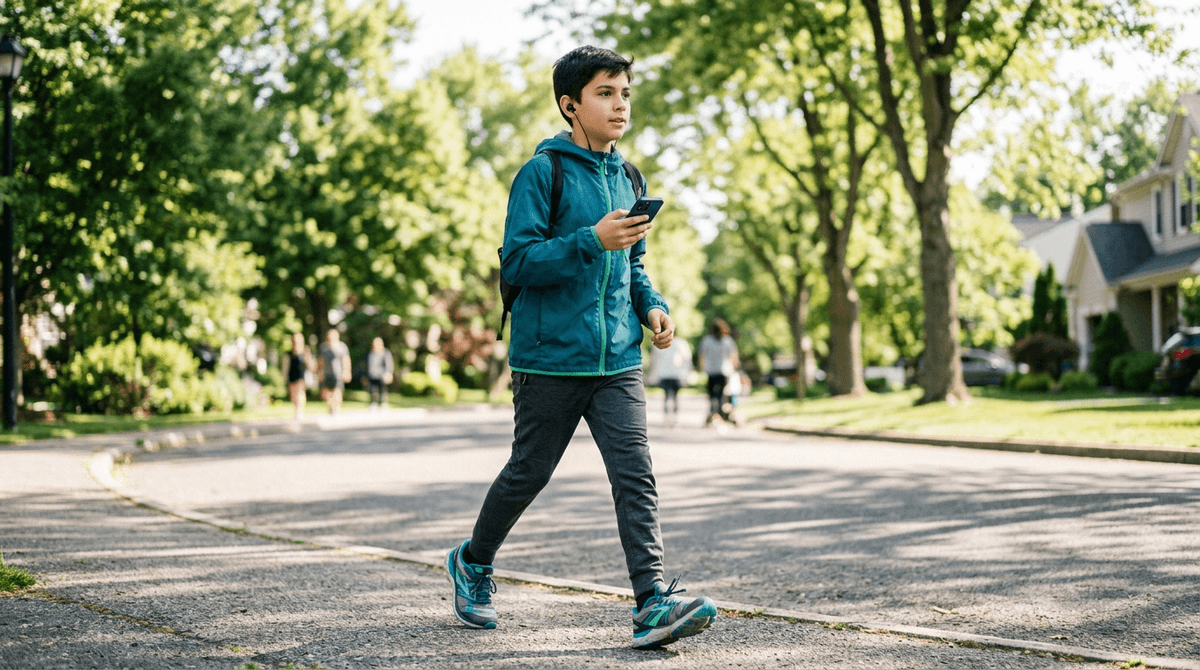

A quarter of smartphone use happens while people are on their feet, challenging the common assumption that looking at a screen always equals sitting still. What shapes physical activity isn't overall screen time, but the specific apps being used.
Phones do not trap you on the couch nearly as much as health trackers assume. Roughly one out of every four minutes spent on a smartphone occurs while standing up or actively walking around, with movement dictated almost entirely by whether an app is a passive entertainment feed or an active utility.
Weekly screen time reports lump every minute into a single alarming total, treating a glance at a grocery list or navigation while pushing a stroller the same as two hours collapsed on the sofa. That raw number fuels unnecessary parent guilt while completely obscuring how your body actually moves throughout the day.
If your goal is to reduce physical inactivity, putting your phone in another room misses the mark. The hardware isn't keeping you stationary; infinite-scroll social media apps are.
Public health guidelines have long treated mobile screen time as a direct proxy for sitting around. But as smartphones replaced maps, cameras, shopping lists, and phone cords, researchers needed high-resolution data to check whether looking at a pocket computer actually guarantees a sedentary body.
Smartphone use is far more physically dynamic than standard health assumptions suggest. By pairing continuous Android app logs with wrist-worn movement sensors, researchers found:
- A quarter of phone time happens on your feet. Participants spent a median of 26% of their screen time standing or moving, though individual habits ranged widely from 6% to 74%.
- Upright screen time splits evenly between walking and standing. Of the minutes spent using a phone while not seated, roughly 48% involved active walking and 52% involved standing still.
- Social feeds pin you to the couch. TikTok, Instagram, and Facebook sessions were sedentary 75% to 80% of the time.
- Utility apps keep people upright. Maps, cameras, and voice call apps saw about half of their use while participants were walking around or standing.
Treating all screen time as sedentary lets app developers off the hook for their design choices. Algorithmic feeds, autoplay loops, and endless recommendation engines are intentionally designed to keep bodies completely motionless to maximize view duration. Utility tools like navigation or timers naturally integrate into active daily routines. When pediatricians and wellness trackers measure only total screen minutes, they penalize helpful tools and misdiagnose why people stay glued to the couch.
The data comes from a small sample of 63 caregivers of preschool-aged children in the Eastern United States, and 94% were women. Mothers of young kids already perform an enormous amount of standing and walking while managing household tasks, which likely elevated active phone use.
The study also only tracked Android devices because Apple restricts this depth of app-level tracking. Furthermore, the sensors logged whenever a screen was powered on—meaning a phone propped on the kitchen counter playing music while someone prepped dinner registered as active screen time even if nobody was touching it.
- If you want to cut down on sitting around: Delete or set strict app limits for TikTok, Instagram, and Facebook rather than attempting a blanket ban on your phone.
- If you feel guilty about your weekly screen time report: Check your battery breakdown to see how many hours went to functional tools like Maps, camera, or phone calls before assuming you were unproductive or lazy.
- If you want to model healthy digital habits for your kids: Keep functional phone tasks visible while on your feet, but save passive social scrolling for times when kids are asleep.
Stop agonizing over total phone hours, because a significant chunk of that time is just modern life managed on your feet. Focus your energy on pruning the social apps that physically paralyze you on the couch, and let the functional tools do their job guilt-free.
Culverhouse J, Finnegan OL, Bowen K et al. (2026). Not all screen time is sedentary: evidence from aligned smartphone sensing and accelerometry data in adults. Journal of activity, sedentary and sleep behaviors. doi:10.1186/s44167-026-00109-y — pubmed.ncbi.nlm.nih.gov