

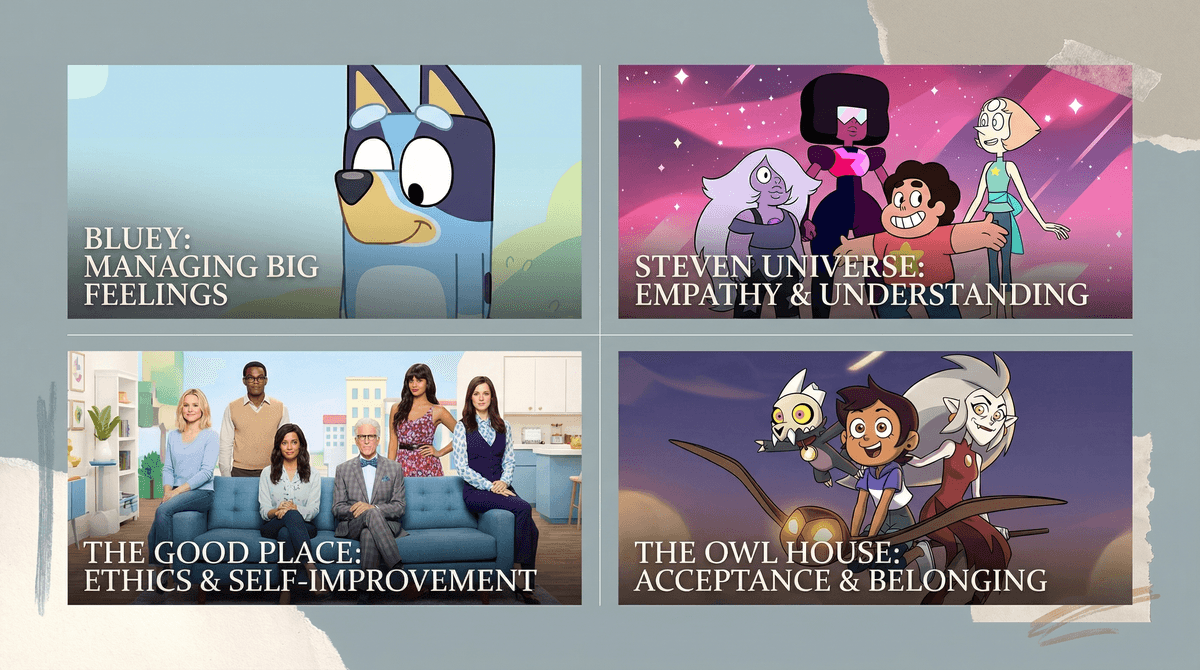
TL;DR: The Emotional Toolkit Playlist If you’re short on time, here are the heavy hitters for different age groups that actually move the needle on mental health conversations:
- Ages 4-7: Bluey (specifically the "Space" or "Cricket" episodes) and Daniel Tiger’s Neighborhood.
- Ages 8-12: Inside Out, Inside Out 2, and Steven Universe.
- Ages 13+: Atypical, Heartstopper, and The Good Place.
Find shows for a 10-year-old struggling with social anxiety
We’ve all been there: your kid is having a meltdown, or worse, they’ve gone totally silent and "ghosted" the family dinner while physically sitting right there. When you ask "What's wrong?" you get the dreaded "I don't know" or the classic "I'm fine."
The reality is that kids often lack the vocabulary to describe the internal "brain fog" of depression or the "tight chest" of anxiety. They don't have the words yet, but they do have characters. Using media as a bridge isn't "letting the TV parent your kids"—it's providing a shared language. When Riley in Inside Out 2 experiences a panic attack, it gives you a 1:1 visual to point at and say, "Does your brain ever feel like that whirlwind?"
I’m going to be honest: the first movie was a masterpiece for emotional literacy, but the sequel is a mandatory watch for the "Anxiety Generation." It introduces Anxiety as a character who thinks she’s helping by planning for every possible disaster. It perfectly illustrates how anxiety isn't a "villain," but a protector that has gone rogue.
- The Lesson: Anxiety is a part of us, but it shouldn't be the one driving the console.
- Best for: Ages 8 and up.
Don't let the seven-minute runtime fool you. Bluey is essentially a parenting masterclass disguised as a show about Australian dogs. Episodes like "Space" touch on processing trauma and abandonment in a way that is subtle but profound. It teaches kids (and parents) that it’s okay to take a minute, be sad, and then rejoin the group when you’re ready.
- The Lesson: Play is the primary way kids process big, scary feelings.
- Best for: All ages (honestly, even us adults).
If your kid is in that "tween" sweet spot, Steven Universe is the gold standard for mental health representation. The show tackles complex topics like "fusion" (which serves as a metaphor for relationships and consent), panic attacks, and the weight of living up to parental expectations. It’s colorful, the music is top-tier, and it treats emotional intelligence as a superpower.
- The Lesson: Vulnerability is strength, and you don't have to carry the world's problems alone.
- Best for: Ages 9-14.
This might seem like an odd choice, but this movie features one of the most realistic depictions of a panic attack in modern animation. When Puss—a legendary hero—gets overwhelmed by the fear of death and has to practice grounding techniques (focusing on his breath and the sensation of fur), it sends a massive message to kids: even the "coolest" people get scared.
- The Lesson: Grounding techniques work, and admitting you’re scared is the first step to feeling better.
- Best for: Ages 7-12.
For the teens, Atypical is a fantastic look at neurodiversity, but it also dives deep into the anxiety that comes with navigating high school and independence. It doesn't sugarcoat the "darker" days, making it a great jumping-off point for conversations about depression and feeling like an outsider.
- The Lesson: Everyone’s brain works differently, and "normal" is a myth.
- Best for: Ages 13+.
The Preschool Years (Ages 3-6)
At this age, anxiety usually manifests as "the wobbles" or fear of the dark. Stick to shows like Daniel Tiger’s Neighborhood or Trash Truck. These shows use repetitive songs (social stories) to help kids regulate their nervous systems. Pro-tip: When your kid is calm, sing the "take a deep breath" song from Daniel Tiger. Don't wait until the meltdown starts; the brain can't learn during a "code red."
The Middle Years (Ages 7-12)
This is when social anxiety starts to peak. Kids are worried about "Ohio" memes, being "cringe," and fitting in. Shows like The Owl House or She-Ra and the Princesses of Power are great because they feature characters who struggle with self-worth and the pressure to be perfect.
The Teen Years (Ages 13+)
Teens are savvy. They’ll smell a "lesson" from a mile away and shut down. Instead of saying, "Let’s watch this show about depression," try watching something like The Good Place together. It’s funny, it’s existential, and it naturally leads to big questions about what it means to be a "good" person and how to handle the overwhelming nature of the world.
The goal isn't to turn every Netflix session into a therapy appointment. That’s the quickest way to make your kid never want to watch TV with you again. Instead, try these low-pressure "entry points":
- The "Third Person" Technique: Instead of asking "Do you feel like Riley?", say "Man, Riley’s brain was really working against her there. That looked exhausting." It allows them to agree without having to admit they feel the same way yet.
- Validate the Character: "I get why Steven is stressed. Everyone expects him to save the day, and he just wants a donut." This validates the feeling of being overwhelmed.
- The "Pause and Check": If a scene is particularly intense (like the panic attack in Puss in Boots: The Last Wish), you can casually say, "I’ve definitely had moments where my heart raced like that. Have you?"
Learn more about how to talk to your kids about mental health
While shows can be healing, some "teen" dramas that claim to address mental health can actually be "trauma porn."
- Avoid: 13 Reasons Why. It’s widely criticized by mental health professionals for romanticizing suicide and providing a "how-to" guide rather than a "how-to-heal" guide.
- Be Careful With: Euphoria. It’s visually stunning, but for a kid already struggling with depression, the relentless "darkness" can be more triggering than helpful.
Screens aren't inherently the enemy of mental health. In fact, for a kid who feels like they’re the only one in the world struggling with "big feelings," seeing a character on Disney+ or Netflix go through the same thing can be a lifeline.
The magic happens in the co-viewing. You don't have to be a child psychologist; you just have to be there, holding the popcorn, ready to say, "Yeah, that looks really hard. I’m glad they have friends to help them through it."
- Pick a "Feelings" Movie: Plan a family movie night with Inside Out.
- Check the Wise Scores: Before letting your kid binge a new series, check the Screenwise WISE score to see if the emotional content is age-appropriate.
- Monitor the Algorithm: If your kid is spending a lot of time on YouTube or TikTok looking at "sad-core" edits, it might be time to pivot them toward some of the more constructive shows listed above.