

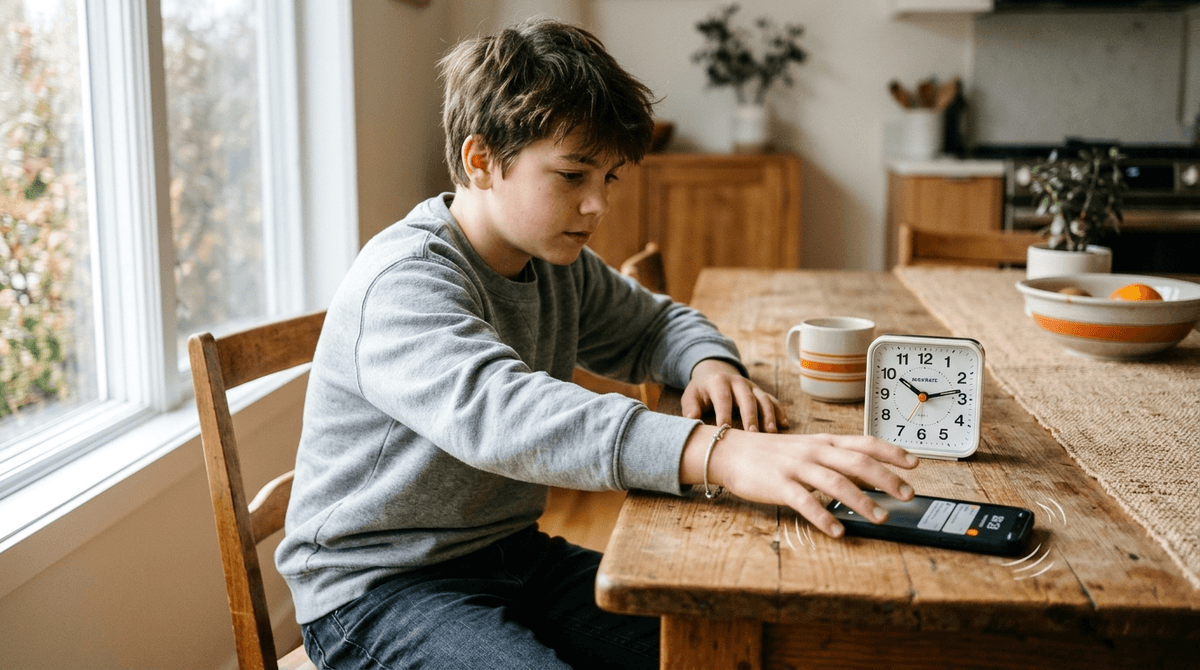

Counting minutes on an iPad tells you almost nothing about whether a screen is hurting your kid. What matters is how they use it—and whether they can stop.
Total screen time fails to predict mental health problems or emotional harm in children. Across 52 systematic reviews and meta-analyses, well-being dropped only when media use became "problematic"—meaning it crowded out sleep, sparked uncontrollable conflict, or replaced real-world relationships.
Rigid time limits spark daily family arguments, yet tracking hours won't protect your child from the real harms of tech. An hour spent face-timing a cousin or building a collaborative Minecraft world does not affect a child's brain the same way as an hour of compulsive, algorithm-driven video scrolling.
Dropping the stopwatch lets you focus on actual behavioral red flags rather than policing whether 60 minutes accidentally stretched to 75.
Decades of public health advice treated screen time like dietary sugar: a simple dose-response curve where every extra minute supposedly caused incremental harm. Researchers launched this umbrella review of 52 review papers to test whether that assumption holds up across modern media landscapes. It does not.
Across 52 reviews synthesizing hundreds of individual studies, pure screen duration showed weak, inconsistent, and often negligible links to poor mental health.
- Time alone is not toxic: General digital media use showed mixed effects, meaning that for most kids, normal daily screen use carries no inherent psychological harm.
- Problematic use drives the damage: Distress reliably spikes when kids lose control over their devices, crave screens compulsively, or experience functional impairment like sneaking screens at 2 a.m.
- Context dictates impact: A child's underlying vulnerability, their emotional motives for logging on, and the content itself determine outcomes far more than raw screen hours.
Tech companies love time-limit debates because it shifts the entire burden of regulation onto parents' kitchen timers while deflecting scrutiny from addictive design. Focusing strictly on hours also wastes parental energy on the wrong battle: fighting over 15 extra minutes of a favorite video game while missing the isolated, compulsive scrolling that actually signals distress.
This paper is a narrative review synthesizing existing meta-analyses rather than a new controlled experiment. Most of the underlying research is observational, meaning scientists cannot prove whether problematic tech habits trigger emotional distress or whether anxious, lonely, and struggling kids simply turn to screens to cope.
- If your child powers down without a fight when called to dinner: do not sweat an extra 30 minutes of weekend play, because screen use without loss of control does not track with negative outcomes.
- If screen time routinely triggers explosive meltdowns or displaces bedtime: step in to reset boundaries immediately, as compulsive use and sleep loss are the primary drivers of screen-related harm.
- If your child uses screens to learn, create, or stay in touch with friends: treat those hours as purposeful engagement rather than deducting them from a rigid daily quota.
- If you notice your child turning to passive scrolling to escape negative emotions: address the underlying anxiety or social friction first, since screens frequently serve as a symptom of distress rather than the root cause.
Put away the stopwatch and start watching your kid's behavior instead. If their screens aren't stealing sleep, trashing family life, or triggering compulsive meltdowns, an extra hour online is not what is going to break their mental health.
Tølbøll KB (2026). Not All Screen Use is Equal: Shifting the Focus from Screen Time to Problematic Use in Child and Adolescent Well-Being Research. Clinical child and family psychology review. doi:10.1007/s10567-026-00577-3 — pubmed.ncbi.nlm.nih.gov