

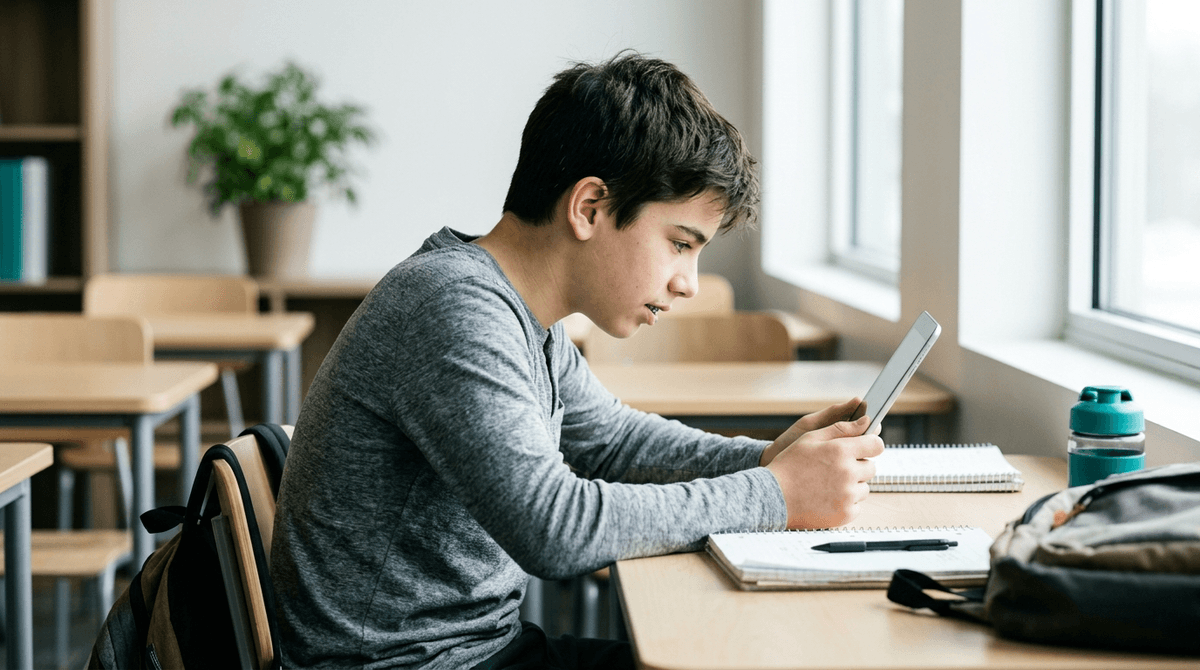

Children with vision problems are roughly three times more likely to develop spinal curvature than their peers with normal eyesight. A trial tracking nearly 6,000 students is testing whether treating posture and eyesight as the exact same lifestyle problem can prevent both at once.
Slouching over screens threatens both your child’s retinas and their spine through identical daily habits: cramped indoor lighting, near-work visual fatigue, and hours of immobile sitting.
Most families treat eye exams and pediatric spine checks as completely separate medical tracks. You buy blue-light glasses from an optometrist and worry about heavy backpacks with an orthopedist.
Dividing them is a mistake. The daily behaviors accelerating childhood nearsightedness—prolonged tablet reading, zero natural daylight, and hunching over desks—are the exact same forces that deform developing spines. Protecting your child's posture and protecting their vision require the same daily intervention.
Rates of both myopia and idiopathic scoliosis have climbed alongside intense schooling and ubiquitous handheld devices. Researchers realized these are not isolated conditions developing in a vacuum. When kids spend their waking hours hunched ten inches from glass or paper without movement breaks, their paraspinal muscles fatigue unevenly while their eyeballs physically elongate from lack of outdoor sunlight.
The intervention targets the shared roots of vision loss and spinal deformities across 30 schools:
- Vision and spine health are directly linked: Children with uncorrected or deteriorating vision conditions are approximately three times more likely to develop idiopathic scoliosis than peers with normal eyesight.
- Every close-up hour compounds the damage: Each additional "diopter-hour" of near-work (focusing up close on tablets, phones, or books) per week increases myopia risk by 2%.
- Daily sweat acts as a shield: Mandating 60 minutes of daily moderate-to-vigorous exercise and regular classroom posture resets helps rebuild the core muscle symmetry needed to keep spines straight.
When a child strains to see small text on a screen, they instinctively lean forward, tilt their head, and contort their torso to compensate. Weeks of that compensatory squint turn into months of asymmetrical muscle strain, permanently altering how the spine grows during rapid adolescent growth spurts. Eye strain does not stay in the eyes; it cascades directly down the neck and back.
This paper is a study protocol, meaning the researchers have laid out their methodology and enrolled 5,964 students, but the long-term clinical results are not yet published. The data also relies partly on self-reported questionnaires for screen time and activity, which are vulnerable to recall errors. Furthermore, the cohort is based entirely in Shanghai, where academic desk hours and indoor study routines are far higher than in many Western regions.
- If your child spends hours doing close-up tablet work or reading: Enforce a 20-minute break rule where they look 20 feet away and stretch their torso to relax both the focusing muscles in their eyes and the paraspinal muscles in their back.
- If your child frequently complains of eye strain or squinting: Schedule an eye exam immediately, because untreated vision deficits force kids into asymmetric, hunched postures that increase the risk of spinal curvature.
- If your child's schedule forces a choice between extra indoor study and outdoor play: Prioritize the outdoors, because an hour of daily natural sunlight and active movement protects against eyeball elongation while strengthening the postural muscles supporting the spine.
Screen slouch is not just poor manners; it is a dual threat linking failing eyesight directly to spinal curvature. Cut the marathon near-work sessions, get your child outside into natural light for an hour each day, and fix their desk ergonomics before adolescent growth spurts lock poor posture into bone.
Zhang T, Li X, Liang J et al. (2026). Effectiveness and implementation of an intervention strategy-based health promoting schools framework to reduce idiopathic scoliosis and myopia among children and adolescents in Shanghai, China: study protocol. BMC public health. doi:10.1186/s12889-026-28184-5 — pubmed.ncbi.nlm.nih.gov