

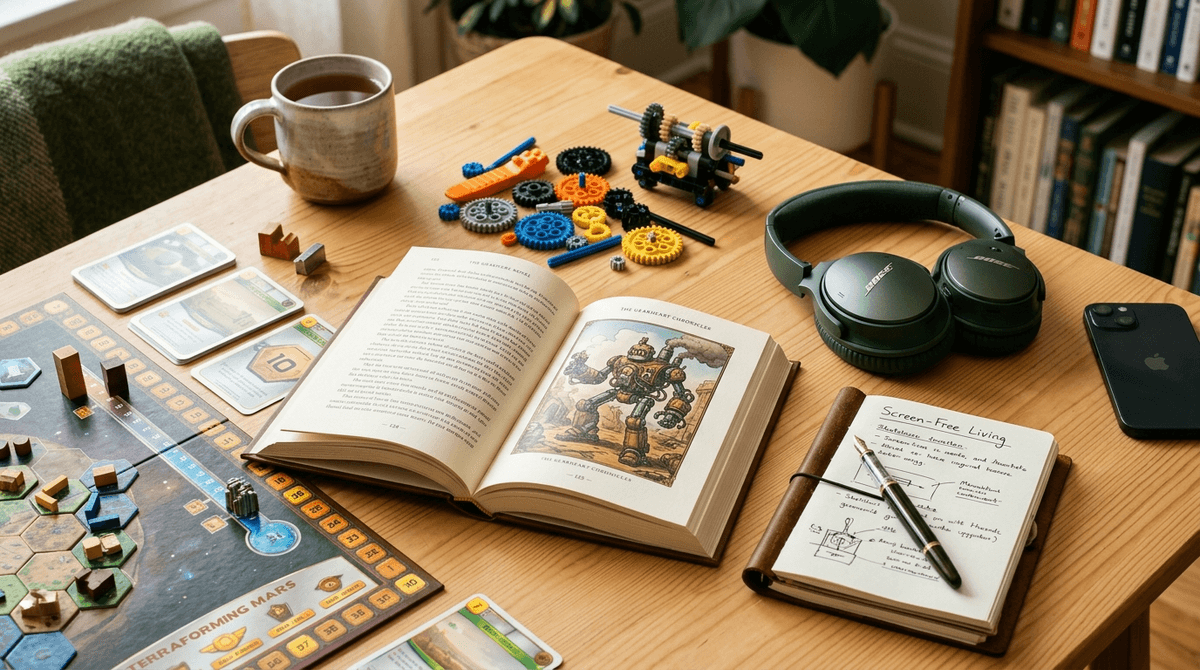
TL;DR: The Quick Hits
If you’re in the middle of a "just five more minutes" battle right now, here are the top-tier, high-engagement alternatives that actually satisfy the same itch as a Roblox marathon:
- The "Bridge" Activity: Brains On! or Wow in the World. Audio keeps the brain busy while the hands move.
- The Strategy Fix: Exploding Kittens or Catan. High stakes, quick turns, zero screens.
- The Deep Flow: The Wild Robot by Peter Brown (book) or a massive LEGO project.
- The Competitive Edge: Unmatched or Ticket to Ride.
We’ve all been there. You tell them it’s time to get off YouTube, and suddenly your sweet child transforms into a "skibidi" nightmare. They’re irritable, they’re calling everything "Ohio" (which, for the uninitiated, is Gen Alpha shorthand for "weird" or "cringe"), and they act like they’ve forgotten how to use their own limbs.
This isn't just "kids being kids." It’s a dopamine crash.
When kids play Fortnite or scroll through TikTok, their brains are flooded with cheap, easy dopamine. When the screen goes black, the supply cuts off, and the brain goes into a mini-withdrawal. To fix this, we don't need "quiet time"—we need high-dopamine alternatives. We need activities that trigger a "flow state"—that magical zone where you lose track of time because you’re so genuinely engaged.
In the Screenwise community, we talk a lot about the difference between passive consumption (zombie-staring at a screen) and active engagement. Passive consumption is like eating candy; it’s a quick hit but leaves you feeling gross. Active engagement is the steak and potatoes.
Activities that induce flow—like building a complex GraviTrax circuit or getting lost in a Percy Jackson novel—require the brain to work, which actually regulates dopamine rather than just spiking it.
The hardest part of going screen-free is the transition. Going from the high-octane visuals of MrBeast to total silence is too jarring. Audio is the perfect "bridge." It occupies the "language" part of the brain while allowing the body to do something else, like drawing or cleaning up those 4,000 pieces of LEGO.
This is essentially the "SpongeBob" of podcasts but in a way that won't make you want to pull your hair out. It’s fast-paced, funny, and genuinely educational. It satisfies that need for high-energy entertainment without the blue light.
For the kids who are always asking "why," this is the gold standard. It treats kids like the smart humans they are. If your kid is obsessed with Minecraft because they love "systems," they will love the way this podcast breaks down how the world works.
If your kid is a gamer, they probably crave competition and "leveling up." You aren't going to satisfy that with a game of Candy Land (which is, let’s be honest, a terrible "game" that requires zero skill and is basically a torture device for parents). You need games with mechanics.
It’s fast, it’s slightly irreverent, and it has that "gotcha" element that kids love in games like Among Us. It’s easy to learn but has enough strategy to keep an 11-year-old interested.
This is the ultimate "gateway" strategy game. It teaches resource management and negotiation—skills they claim they’re learning on Roblox but actually have to use here to win. It’s great for ages 10 and up.
If your kid loves the "battle" aspect of Super Smash Bros, this is the board game version. It uses miniatures and cards to simulate a tactical fight. It’s incredibly satisfying and highly replayable.
For the kids who spend hours in Creative Mode, you need to provide a physical outlet for that "world-building" urge.
Think of this as marble runs for the modern age. It’s modular, it involves physics, and it’s endlessly expandable. It’s the closest physical equivalent to building a complex redstone circuit in Minecraft.
Standard bricks are fine, but LEGO Technic adds motors, gears, and complexity. It moves the activity from "playing with toys" to "engineering," which hits a different part of the brain and keeps older kids (ages 9-14) engaged for much longer.
We often hear parents say their kids "don't like to read." Usually, that just means they haven't found a book that moves as fast as their digital life.
If your kid likes the "survival" aspect of games, this is a must-read. It’s about a robot stranded on an island. It’s punchy, has great illustrations, and the chapters are short—perfect for kids with "scrolling-length" attention spans.
This series is basically "Game of Thrones" for the middle-grade set (but, you know, appropriate). It has deep lore, different tribes, and plenty of action. Once a kid gets hooked on the lore of Wings of Fire, they’ll spend more time drawing dragons than they will watching YouTube.
Elementary (Grades K-3)
At this age, the goal is sensory engagement. They need to move their bodies and touch things.
- Recommendation: Magnatiles or Storyline Online (if you need a "low-stimulation" screen option).
- The Vibe: Keep it simple but high-frequency. Lots of small wins.
Middle Grade (Grades 4-6)
This is the "peak brain rot" era where Skibidi Toilet and Roblox memes are the social currency.
- Recommendation: Dungeons & Dragons. It’s the ultimate high-dopamine, screen-free social activity. It’s collaborative storytelling with dice.
- The Vibe: They want autonomy and social connection. Activities that they can do with friends are 10x more effective.
Middle School & Beyond (Grades 7+)
They are harder to impress. They need "real" things.
- Recommendation: High-level strategy games like Wingspan or learning a physical skill like beginner coding (yes, you can learn the logic of coding with cards and board games!).
- The Vibe: Respect their intelligence. If it feels like a "kid activity," they’ll opt for the phone every time.
Here is the no-BS truth: your kids will complain at first. They will say they are bored. They will say this is "mid."
Boredom is the gateway to creativity.
When a kid is bored, their brain eventually starts looking for its own stimulation. If you provide a high-quality alternative like a Catan board or a new Graphic Novel, they will eventually bite. But you have to weather the 15-minute storm of complaining first.
How to talk to your kids about why you're cutting back on screens
We aren't trying to live in 1950. Screens are a part of life, and Minecraft isn't the devil. But if your family's digital life is feeling "unbalanced"—if the bank account is draining into Robux and the meltdowns are becoming the norm—it's time to reintroduce high-dopamine, screen-free flow.
Start small. Pick one "bridge" podcast and one "strategy" board game this week. See what happens when the dopamine comes from a win on the table instead of a win on the screen.
- Audit the "Crash": Notice which apps cause the biggest meltdowns. (Hint: It’s usually TikTok or YouTube Shorts).
- Swap, Don't Stop: Don't just take the tablet away; hand them a Wings of Fire book or start an Exploding Kittens round immediately.
- Check the Data: Use the Screenwise survey to see how your kid's usage compares to other families in your community.