

TL;DR
Scrap Mechanic is a physics-based sandbox game where kids build vehicles, contraptions, and automated farms using real engineering principles. Think Minecraft meets actual mechanical engineering—with logic gates, bearings, pistons, and surprisingly accurate physics. Ages 8+ for Creative Mode, 10+ for Survival Mode. Multiplayer exists but is mostly co-op building with friends, not random online chaos.
Quick parent intel: This game has a legitimate learning curve. Your kid will need to understand concepts like gear ratios, weight distribution, and basic logic circuits. About 55% of families in our community have kids who game regularly, and for those looking for something more technical than Minecraft's block-stacking, this is the move.
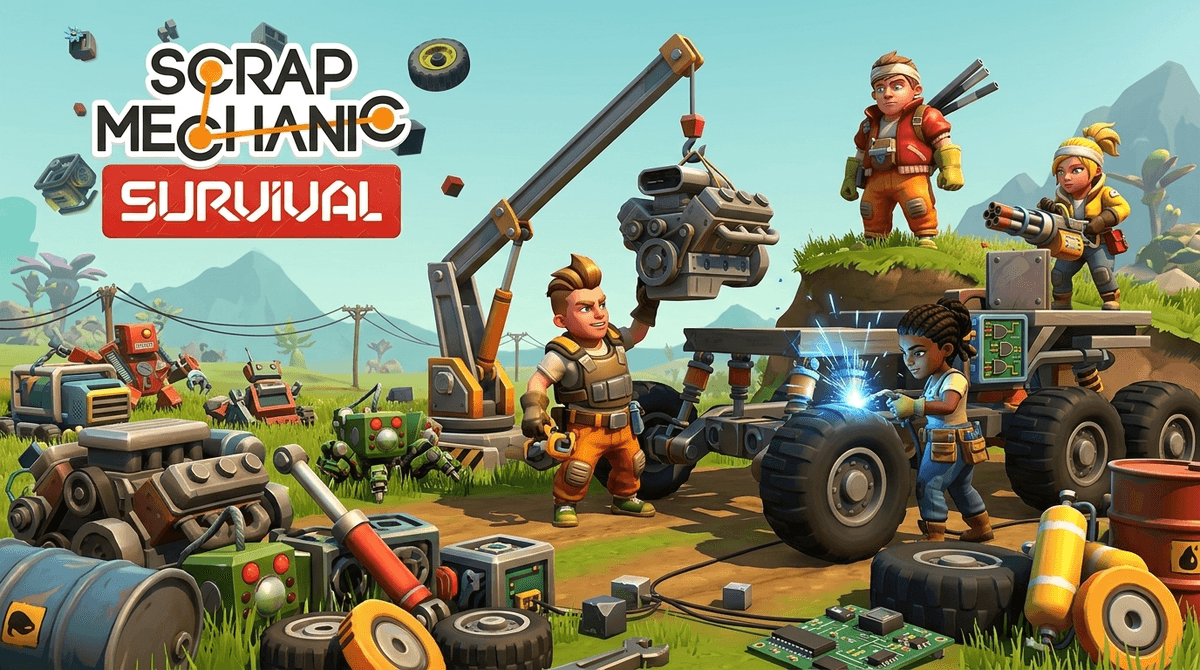
Scrap Mechanic is a Swedish-made building game where players are mechanics stranded on a planet full of rogue farming robots. In Creative Mode, you have unlimited parts to build whatever you can imagine—cars, planes, cranes, Rube Goldberg machines, working calculators (yes, really). In Survival Mode, you scavenge parts, grow crops, and defend your base from "Farmbots" that attack at night.
The hook? Everything operates on actual physics. Wheels need suspension or they bounce wildly. Engines need the right gear ratio or they stall. Build a car too top-heavy and it'll flip on the first turn. It's frustrating and brilliant in equal measure.
Released in 2016 and still actively updated, it's carved out a dedicated niche among kids (mostly ages 9-14) who find Minecraft too simple and Roblox too chaotic. The graphics are cartoony and colorful—think LEGO meets Wall-E—so it doesn't have the visual intensity of something like Fortnite.
The engineering is real. Kids aren't just stacking blocks—they're learning mechanical principles whether they realize it or not. Want to build a car? You need to understand:
- Power transmission: Engines connect to wheels via bearings and axles
- Gear ratios: Different sized wheels affect speed vs. torque
- Weight distribution: Put all your heavy parts on one side and enjoy your new barrel roll simulator
- Logic gates: AND, OR, NOT gates control sensors, lights, and automated systems
I've watched kids spend three hours troubleshooting why their car won't turn properly, only to discover they needed to adjust the steering angle or add a differential. That's legitimate problem-solving that translates to real STEM thinking.
The creative ceiling is absurdly high. YouTube is full of Scrap Mechanic builds that would make MIT students jealous: working calculators, musical instruments, fully automated farms with sorting systems. Your kid probably won't build those (at least not at first), but the fact that they can keeps them engaged. There's always another challenge.
Multiplayer is collaborative, not competitive. Unlike most online games, Scrap Mechanic multiplayer is primarily about building together. Kids join servers or play with friends to tackle bigger projects or Survival Mode challenges as a team. There's no kill-count, no battle royale, no trash talk. Just "hey, can you help me figure out why this piston keeps exploding?"
The learning curve is steep. This isn't a pick-up-and-play game. The tutorial covers basics, but actually building something functional requires experimentation, failure, and YouTube tutorials. Some kids love this challenge. Others rage-quit after their tenth failed car design. Know your kid's frustration tolerance.
If your child struggles with open-ended projects or gets upset when things don't work immediately, this might not be their jam. But if they're the type who takes apart household electronics or spends hours perfecting a LEGO creation, they'll thrive here.
Community data context: Our community shows about 40% of kids don't play Minecraft at all, 35% play offline only, and 25% venture onto servers. Scrap Mechanic appeals most to that middle group—kids who want creative building but are ready for more complexity than vanilla Minecraft offers.
Screen time reality check: Average screen time in our community is 4.2 hours daily. A focused Scrap Mechanic build session can easily eat 2-3 hours because you're genuinely problem-solving, not just grinding or scrolling. The question isn't just "how long" but "what are they doing?" Building a working elevator system using logic gates is cognitively different than watching YouTube shorts (which 42% of kids in our data do solo, by the way).
Desktop-first game: Only 18% of families in our community have kids using desktop computers regularly. Scrap Mechanic is PC-only (Windows), which might require some logistical planning if your household is all tablets and Chromebooks. The game does support controllers, but building is genuinely easier with mouse and keyboard.
Multiplayer safety: You can host private servers for friends or join public servers. Public servers vary wildly in quality and moderation. The game doesn't have built-in chat filters or robust reporting systems like Roblox. Recommendation: Stick to private servers with known friends, at least initially. Learn more about managing multiplayer gaming safely .
.
No microtransactions, no loot boxes, no nonsense. You buy the game once (usually $15-20 on Steam sales) and that's it. No battle passes, no premium currency, no "Dad, I need $10 for Scrap Coins." In an era where most games are designed to extract maximum dollars from kids, this is refreshingly old-school.
Ages 8-10 (Creative Mode): Perfect for experimenting with basic builds. They'll make lots of wonky cars and probably some elaborate traps. Don't expect engineering masterpieces yet—this age is about exploration and learning the tools. Multiplayer with siblings or supervised playdates works great.
Ages 10-13 (Survival Mode unlocked): This is the sweet spot. Kids have enough patience for complex builds and can handle Survival Mode's resource management and light combat (you hit robots with hammers, it's cartoonish). They'll start watching YouTube tutorials and actually implementing advanced techniques like logic gates and automated systems.
Ages 13+ (Full engineering mode): Teens who stick with Scrap Mechanic often go deep—building calculators, programmed robots, or recreating real vehicles with working suspension. Some use it as a gateway to actual CAD software or programming. If your teen is into this game, they're probably the type who should explore Scratch for coding or Kerbal Space Program for physics simulation.
Frustration factor: This game can be genuinely aggravating. Builds fail. Physics betrays you. That car you spent an hour on flips immediately. Some kids handle this well; others don't. Watch for rage-quitting patterns—if your kid is melting down every session, it might not be the right fit right now.
YouTube rabbit hole risk: To build anything advanced, kids will watch tutorials. That's fine and actually educational. The risk is the YouTube sidebar leading them from "how to build a Scrap Mechanic car" to "Minecraft manhunt EPIC FAIL compilation" to wherever the algorithm decides. About 42% of kids in our data use YouTube solo, unsupervised—just be aware of where tutorial-watching might lead. Check out our guide on YouTube vs. YouTube Kids.
Not much narrative or variety: Unlike story-driven games, Scrap Mechanic is pure sandbox. There's no campaign, no unlockable characters, no progression system beyond "build cooler stuff." Some kids need more structure and external goals. If your child gets bored easily without clear objectives, this might not hold their attention long-term.
The community is small: This isn't Minecraft or Roblox. The player base is modest, which means fewer public servers, less fresh content, and potentially limited multiplayer options. That's actually a feature for safety-conscious parents, but it might disappoint kids expecting a massive online world.
Scrap Mechanic is legitimately educational in a way most games aren't. It teaches engineering principles, problem-solving, and systems thinking through hands-on experimentation. The physics engine is accurate enough that skills learned here translate to real-world understanding of how machines work.
This game is ideal for:
- Kids who love building and tinkering
- Families looking for STEM-friendly screen time
- Children who find Minecraft too simple but aren't ready for mature-rated games
- Kids who enjoy solving puzzles and don't mind failure
Skip it if:
- Your child has low frustration tolerance
- You need something with quick pick-up-and-play appeal
- Your household doesn't have a gaming PC
- Your kid needs narrative structure and clear goals
The parent win: When your kid says "I've been playing Scrap Mechanic for two hours," they've probably been doing legitimate engineering problem-solving. That's a very different two hours than most gaming offers.
- Try Creative Mode first: Let them experiment with unlimited parts before tackling Survival Mode's resource constraints
- Build together: Especially for younger kids, co-op building is both safer and more educational—you can talk through why designs fail
- Set YouTube boundaries: Tutorials are helpful, but establish rules about where tutorial-watching happens (supervised devices, time limits, etc.)
- Connect to real-world learning: If they're into the game, leverage it—show them real engineering videos, visit science museums, explore books about game design or mechanical engineering
Ask our chatbot about other engineering-focused games for kids or explore alternatives to Minecraft if you're looking for more building games with educational value.
The game goes on sale frequently on Steam—wait for a 50% off deal and let them experiment. Worst case, you're out $10. Best case, you've unlocked a genuine interest in engineering that extends far beyond the screen.