

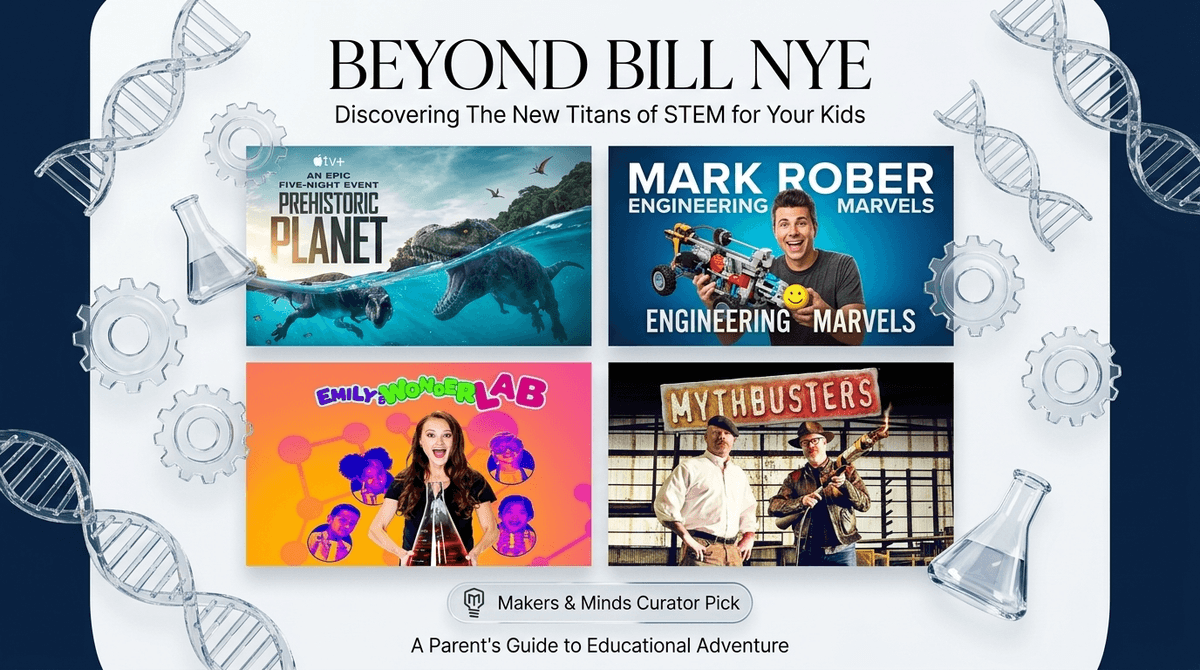
TL;DR: The "Too Long; Didn't Watch" List
If you’re looking to kill the "I'm bored" whines with something that isn't a 10-hour loop of Skibidi Toilet, here are the top picks for science content that actually holds a modern kid's attention span:
- For the Engineering Obsessed: Mark Rober (YouTube) — The undisputed king of "science but make it high-stakes."
- For Younger Chaos Agents: Emily's Wonder Lab (Netflix) — Neon colors, big messes, and actual chemistry.
- For Dino Nerds: Prehistoric Planet (Apple TV+) — If your kid likes CGI, this looks better than most Marvel movies.
- For the "How Does the World Work?" Kid: Connected (Netflix) — Fast-paced, quirky, and covers everything from bird migration to Tinder.
- The Classic Choice: MythBusters (Max/Hulu) — Explosions + scientific method. It still works.
Find science show recommendations for your kid's age
We’ve all been there. You put on a dry, slow-moving documentary about the tectonic plates of the mid-Atlantic ridge, and within four minutes, your kid is asking for your phone so they can play Roblox.
It’s not that kids don’t like science; it’s that they are used to the "MrBeast" style of editing. We’re talking fast cuts, high energy, personality-driven hosting, and—crucially—a sense of stakes. If the documentary feels like a substitute teacher put on a VHS tape from 1994, it’s going to be labeled "mid" (or "Ohio" if they’re feeling particularly judgmental) and ignored.
The shows below aren't just "good for them." They are actually entertaining. They compete with the dopamine hits of YouTube and TikTok by using the same storytelling tools: humor, suspense, and incredible visuals.
Mark Rober (Ages 7+)
If you haven't heard of Mark Rober, your kid definitely has. He’s a former NASA engineer who spent years building Mars rovers, but he’s most famous for building elaborate "glitter bombs" to prank porch pirates. Why it works: He breaks down the engineering process—prototyping, failure, and iteration—without it ever feeling like a lecture. It’s high-production, high-energy, and genuinely funny. It’s the gold standard for turning "screen time" into "I want to go build something in the garage" time.
Emily's Wonder Lab (Ages 4-10)
Emily Calandrelli is a literal rocket scientist (MIT grad), and she brings a manic, joyful energy to science. Each episode is short (about 12 minutes), features a group of kids doing a massive, messy experiment, and explains the "why" in a way that sticks. Why it works: It’s bright, it’s fast, and it treats kids like actual scientists. It’s the perfect antidote to the "pink-aisle" stereotypes in STEM.
MythBusters (Ages 8+)
The OG. While there are newer versions like MythBusters Jr., the original series with Adam Savage and Jamie Hyneman is still the best. They take urban legends—like "Can a penny dropped from the Empire State Building kill you?"—and test them with rigorous (and often explosive) methods. Why it works: It teaches the scientific method better than any textbook. They form a hypothesis, they test, they fail, they "scale up" the explosion, and they reach a conclusion.
Prehistoric Planet (Ages 5+)
Forget the clunky stop-motion dinosaurs of our youth. Narrated by David Attenborough (the voice of nature itself), this show uses the same CGI tech used in The Lion King remake to show dinosaurs living their lives like real animals. Why it works: It doesn't treat dinosaurs like monsters; it treats them like biology. Seeing a T-Rex go for a swim or a tiny pterosaur try to fly for the first time is mesmerizing for kids who are used to high-def gaming graphics.
The Secret Lives of Orangutans (Ages 6+)
This is a newer 2024 Netflix documentary that follows a specific family of orangutans. It’s shot like a drama, following the "story" of the characters, which helps younger kids stay engaged with the narrative rather than just looking at pretty trees. Why it works: It builds empathy. Kids start to care about the individuals, which makes the science of conservation and habitat loss feel personal rather than abstract.
Absurd Planet (Ages 8+)
If your kid has a weird sense of humor (and let's be honest, most do), this is the one. It’s a nature documentary that is intentionally "cringe" and hilarious. It features talking animals with funny voice-overs and focuses on the weirdest, grossest, and most "absurd" parts of nature. Why it works: It speaks the language of the internet. It’s self-aware, snarky, and highlights the stuff kids actually find interesting (like why certain animals poop the way they do).
Connected (Ages 10+)
Science journalist Latif Nasser travels the world to show how seemingly unrelated things are linked. One episode might link the dust in the Sahara desert to the health of the Amazon rainforest. Why it works: It’s built for the "curiosity gap." It starts with a weird question and follows the breadcrumbs to a massive scientific revelation. It’s great for middle schoolers who are starting to think about the bigger picture.
Science Max: Experiments at Large (Ages 6-12)
Think of this as "Science on Steroids." The host, Phil, takes a small-scale science experiment (like a baking soda volcano) and asks, "What if we made this huge?" Why it works: It’s pure spectacle. Kids love seeing things get "maxed out," and the show does a great job explaining the physics of why things change when you increase the scale.
Find space documentaries for kids
While "science" is generally a safe category, there are a few things to keep in mind:
- The "Circle of Life": In nature docs like Our Planet, things die. Predation is a real part of biology. If you have a particularly sensitive child, you might want to pre-screen or stick to engineering-based shows.
- The "Don't Try This at Home" Factor: Shows like MythBusters or Science Max are great, but they feature professionals with safety crews. Make sure your kid knows that just because Phil built a giant slingshot doesn't mean they should try it with the backyard fence.
- YouTube Rabbit Holes: If they start watching Mark Rober, the YouTube algorithm will inevitably suggest other "science" channels. Some are great (Veritasium is fantastic), but some are "junk science" or clickbait.
There’s a lot of talk lately about "brain rot"—content that is purely passive, hyper-stimulating, and offers zero cognitive value. Most science documentaries are the literal opposite of brain rot. They encourage active viewing.
When a kid watches Mark Rober build a squirrel obstacle course, their brain is actually working through the physics of the jumps alongside him.
How to talk about it: Instead of just "putting on a show," try asking a few questions during or after:
- "Why do you think that experiment failed the first time?"
- "What would you have done differently if you were the engineer?"
- "Is that animal's adaptation actually useful, or just weird?"
If they’re into it, lean into the "Maker" culture. If they loved Emily's Wonder Lab, maybe it’s time to buy a bulk bag of cornstarch and make some Oobleck in the kitchen.
You don't have to ban screens to have a "science-forward" household. You just have to upgrade the quality of the content. Moving a kid from a mindless gaming stream to a high-production engineering doc is a massive win for their digital wellness.
Most of these shows are so well-produced that you might actually find yourself sitting down to watch them, too. (Seriously, the CGI in Prehistoric Planet is better than anything I've seen in a theater lately.)
- Pick one show from the list above based on your kid's current obsession (Dinos? Building things? Gross facts?).
- Watch the first 10 minutes together. This is the "hook" period. If they aren't into it by then, move to the next one.
- Check out our guide on how to set up YouTube parental controls if you're letting them watch science content on the main YouTube app.
- Take the Screenwise Survey to see how your family's media consumption stacks up against your community and get more personalized recommendations.