

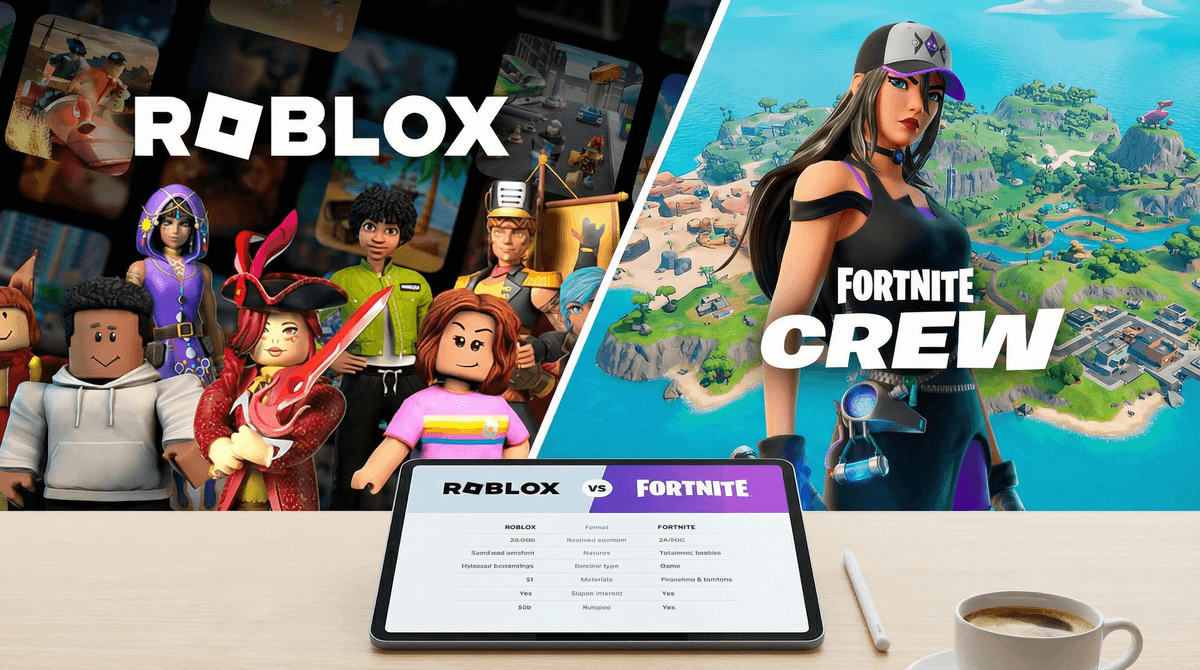
Roblox vs. Fortnite: Which Platform Is Best for Your Child?
Both Roblox and Fortnite dominate kids' screen time, but they're wildly different experiences. Roblox (ages 9+) is a creation platform with thousands of user-made games, strong social features, and a complex economy that can drain your wallet fast. Fortnite (ages 13+, though plenty of younger kids play) is primarily a battle royale shooter with creative modes, voice chat chaos, and less predatory monetization. Neither is inherently "better"—it depends on your kid's age, interests, and your family's comfort with online interaction and spending.
Quick links:
If you're trying to figure out which platform to allow (or which one to prioritize when your kid is begging for both), you're not alone. These are the two most-played games among kids right now, and the question comes up constantly at school pickup, in parenting groups, and in my inbox.
The honest answer? They're both fine with the right guardrails, and they're both potentially problematic without them. Let's break down what you actually need to know.
Roblox isn't a game—it's a platform where users create and play millions of games. Think of it as YouTube meets Minecraft, where kids can build entire worlds using Roblox Studio, publish them, and potentially earn real money through Robux (the in-game currency).
The experiences range from obstacle courses ("obbies") to role-playing games to full-on simulations. Some are genuinely creative and impressive. Others are low-effort cash grabs designed to extract Robux from kids who don't know better.
Age rating: 9+ (though there's content for all ages, and plenty of 6-year-olds are on it)
Fortnite started as a battle royale shooter—100 players drop onto an island, scavenge for weapons, and fight until one person (or team) remains. It's cartoony, not realistic, and there's no blood or gore. Over time, Epic Games added Creative Mode (where kids can build their own games), Party Royale (a social hangout space), and tons of branded collaborations (Marvel, Star Wars, you name it).
These days, many kids spend more time in Creative Mode or playing custom maps than in the actual battle royale.
Age rating: Teen (13+), though the ESRB notes it's for "Violence" which is cartoonish and bloodless
Social Interaction
Roblox is intensely social. Kids play with friends, join groups, chat via text, and increasingly via voice chat (if enabled). The platform is designed around multiplayer experiences, and most games require interaction with strangers. This is great for socialization and collaboration, but it's also where safety concerns come in—predators, scammers, and inappropriate conversations happen.
Fortnite has voice chat, but you can disable it entirely or limit it to friends only. The battle royale mode doesn't require much coordination with strangers (you can play solo or with friends), and Creative Mode can be played privately. The social pressure is there, but it's more contained.
Winner for younger kids: Fortnite, if you disable voice chat and limit who they can play with. Roblox requires more active monitoring.
Money, Money, Money
Roblox has a reputation for being expensive, and it's earned. Robux is required for almost everything—avatar items, game passes, private servers. The platform is designed to make kids feel like they need to spend constantly. Limited-time items create FOMO, and the peer pressure around avatar appearance is real. You can read more about how Robux works and why it feels like a black hole .
.
Many parents set up monthly allowances or use gift cards, but even then, kids can blow through Robux shockingly fast. The "premium" subscription ($4.99-$19.99/month) gives a monthly Robux stipend, but it's still easy to overspend.
Fortnite sells cosmetics (skins, emotes, battle passes) but the core game is 100% free. You don't need to spend a dime to compete or enjoy the experience. The Battle Pass ($10-ish per season, roughly every 3 months) is the main recurring expense, and it's entirely optional. There's still peer pressure around skins, but it's not as pervasive as Roblox.
Winner: Fortnite, hands down. It's free-to-play without feeling pay-to-win.
Creativity and Learning
Roblox offers real opportunities to learn game design, coding (via Lua scripting), and even entrepreneurship. Roblox Studio is a legitimate development tool, and some teens have made serious money creating popular games. For a kid interested in game development, it's an incredible sandbox.
That said, most kids are just playing, not creating. And the barrier to entry for actually making something good is high.
Fortnite's Creative Mode is easier to use than Roblox Studio—more like Minecraft's creative mode—but it's less robust. Kids can build maps, design mini-games, and share them, but it's not teaching coding in the same way.
Winner: Roblox, if your kid is genuinely interested in creating. Otherwise, it's a wash.
Content Moderation and Safety
Both platforms have issues, but they're different flavors of problematic.
Roblox struggles with user-generated content. Despite AI moderation and human reviewers, inappropriate games, scams, and predatory behavior slip through. The chat filters are aggressive but not foolproof. Kids can be exposed to sexual content, gambling mechanics, and scams designed to steal account info. The platform has made improvements (verified badges, better parental controls), but it's still the Wild West in places.
Fortnite has less user-generated content to moderate, so the risks are more contained. The main concerns are voice chat toxicity (easily solved by disabling it) and the occasional inappropriate custom map that sneaks through. Epic Games is generally faster to respond to issues than Roblox.
Winner: Fortnite, barely. Both require parental involvement, but Fortnite's more controlled environment is easier to manage.
For ages 6-8: Neither is ideal, honestly. If you're going to allow one, Roblox with heavy restrictions (account PIN, disable chat, only play pre-approved games together) is the safer bet. Minecraft is a better choice for this age group.
For ages 9-11: Roblox is more age-appropriate and socially relevant. Set up parental controls, limit spending, and check in regularly on what games they're playing. Fortnite is fine too, but the shooting mechanics and faster pace can be overwhelming.
For ages 12+: Both are fair game. Fortnite's battle royale is more engaging for this age, and the social dynamics shift from "everyone plays Roblox" to "everyone plays Fortnite." Roblox is still popular, especially for kids interested in creation or specific game genres (roleplay, tycoons, etc.).
The Social Pressure Is Real
Your kid isn't exaggerating when they say "everyone" plays one of these. In most U.S. schools, 60-80% of kids in grades 3-8 are on Roblox or Fortnite (or both). Opting out entirely can feel isolating, especially if their friend group coordinates hangouts via these platforms.
That doesn't mean you have to allow it, but it's worth understanding what they're missing if you don't.
Voice Chat Is the Biggest Wildcard
Text chat is easier to monitor (you can review logs). Voice chat is real-time and often toxic. Older kids, teens, and adults say things that no 9-year-old should hear. Both platforms let you disable or restrict voice chat—do it unless your kid is older and you trust their judgment.
Screen Time Adds Up Fast
Both games are designed to keep kids playing. Roblox has no natural stopping point (games are endless). Fortnite matches last 15-25 minutes, which sounds manageable, but "just one more game" turns into two hours. Set clear time limits and use tools like Screen Time (iOS) or Family Link (Android) to enforce them.
You Can't Set It and Forget It
Parental controls are great, but they're not foolproof. Kids will find workarounds, new games will pop up with sketchy content, and the platforms will change features. Check in regularly. Ask what games they're playing. Watch over their shoulder occasionally. It's annoying, but it's necessary.
If your kid is under 10 and you're choosing one, Roblox is more age-appropriate if you set up strong parental controls and monitor actively. It's also where their friends are most likely to be.
If your kid is 10+, Fortnite is often the better choice—it's free, easier to manage, and less of a money pit. The shooting mechanics are a sticking point for some parents, but the violence is cartoony and there's no blood.
Honestly? Most kids will end up playing both eventually. The better question isn't "which one should I allow?" but "how do I set this up safely and teach my kid to navigate online spaces responsibly?"
-
Set up parental controls immediately. Don't wait. Both platforms have robust options, but they're not enabled by default.
-
Establish spending limits. Use gift cards instead of linking a credit card. Set a monthly budget and stick to it.
-
Disable or restrict voice chat unless your kid is 13+ and you've had conversations about online safety.
-
Play with them. Seriously. You don't need to become a gamer, but spending 20 minutes in their world will teach you more than any article.
-
Check in regularly. Ask what games they're playing, who they're talking to, and if anything has made them uncomfortable. Keep the conversation open and judgment-free.
If you're still on the fence, talk to other parents in your community about what's working for them. Every family is different, but you're not figuring this out alone.