

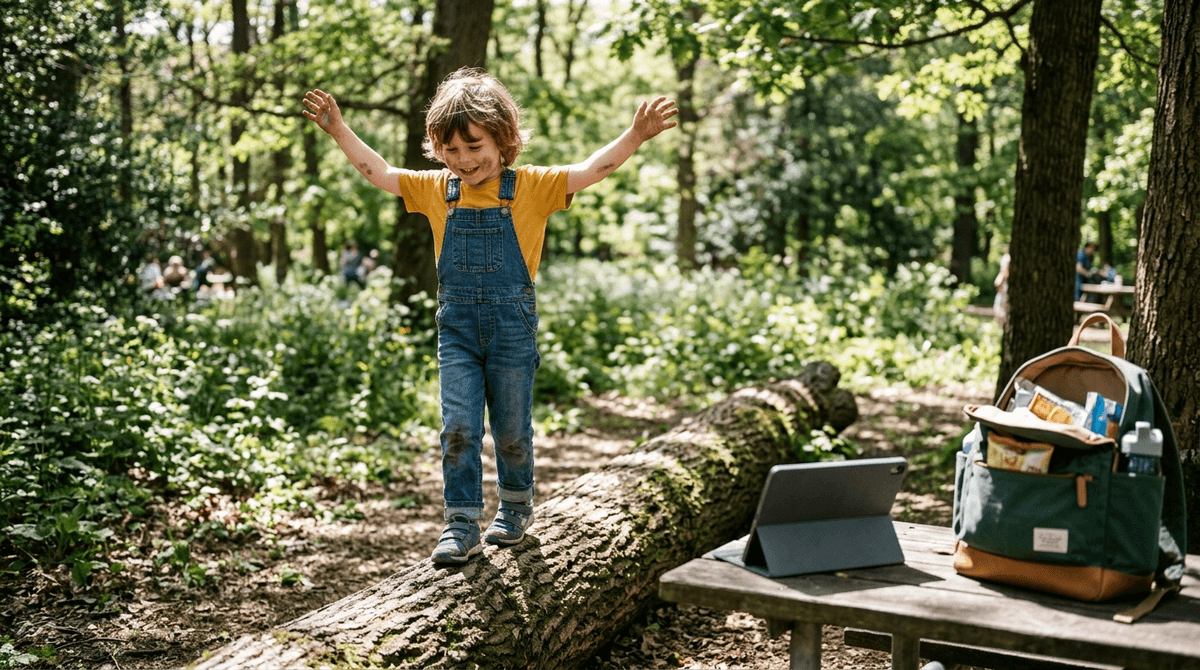

Letting young kids climb trees and ride fast protects against developmental delays in kindergarten, while heavy screen use pushes vulnerability sharply in the opposite direction.
Kids who get regular opportunities for thrilling, "risky" outdoor play are significantly less likely to struggle when they enter kindergarten, while high screen time increases developmental vulnerability by 38%.
Kindergarten readiness assessments track far more than letters and numbers. They measure whether a five-year-old can regulate emotions, navigate social friction, communicate needs, and sustain focus in a classroom.
This study reveals a tangible trade-off parents can control during the critical preschool years. Swapping passive tablet sessions for limit-testing outdoor play directly correlates with whether a teacher flags a child as developmentally behind.
Kindergarten teachers have reported rising rates of developmental delays in recent years, particularly around emotional regulation and classroom focus. Researchers wanted to understand how two competing forces of modern childhood—surging screen hours and increasingly sanitized, bubble-wrapped play environments—affect children right before they cross the kindergarten threshold.
Screen time took the heaviest toll on school readiness, but the type of outdoor play mattered just as much as being outside:
- Screens carried the steepest penalty: High screen use in the six months before kindergarten was tied to a 38% increase in developmental vulnerability across physical, emotional, social, and communication domains.
- Risk-taking protected kids: Children who engaged frequently in thrilling play—climbing to heights, running at top speed, or exploring challenging environments—saw an 8% drop in overall developmental delays.
- Not all outdoor time acted the same: Basic outdoor play supported physical health and communication skills, but limit-testing, thrilling play was the specific factor that reduced broader developmental vulnerability.
- Vulnerability is common: About a third of children entered kindergarten developmentally behind in at least one core area.
Sanitized playgrounds and hyper-vigilant supervision may be counterproductive. While parents often view physical risk as something to eliminate, mild thrills are how a child's nervous system learns to manage stress, uncertainty, and fear.
When a preschooler balances on a high log, they practice emotional regulation and spatial problem-solving in real time. Screens do the reverse: they provide rapid digital stimulation without requiring the child to manage physical arousal, balance frustration, or test real-world limits.
This study followed nearly 5,000 children across British Columbia. While the sample size is large and robust, the design is observational, meaning it reveals strong associations rather than ironclad proof that screens cause the delays.
Parents self-reported both play habits and screen time, leaving room for recall errors or underreporting. Families with easy access to safe, natural play spaces may also have other socioeconomic advantages that help children thrive in school.
-
If you find yourself constantly yelling "be careful" at the park:
Count to ten before stepping in, giving your child space to calibrate their own grip, balance, and physical boundaries. -
If screen time has crept up in the year before kindergarten:
Scale back recreational tablet and television hours immediately, prioritizing an intentional swap for active, unstructured play before school starts. -
If your neighborhood playground is too sterile or padded to challenge your child:
Take them to uneven natural settings—woods, rocky trails, or creek beds—where the terrain naturally forces them to navigate physical risk. -
If you want to build classroom resilience before kindergarten:
Prioritize loose-parts and adventurous play with peers, which gives children daily practice negotiating rules, taking turns, and recovering from minor falls.
Step back and let them climb. Swapping screen time for slightly hair-raising, limit-testing play is one of the most effective ways to prepare a young child for the classroom.
Ramsden R, Gill R, Brussoni M (2026). Associations between early childhood experiences in outdoor play, risky play and screen time, and children's developmental health outcomes in kindergarten in British Columbia. Early human development. doi:10.1016/j.earlhumdev.2026.106621 — pubmed.ncbi.nlm.nih.gov