

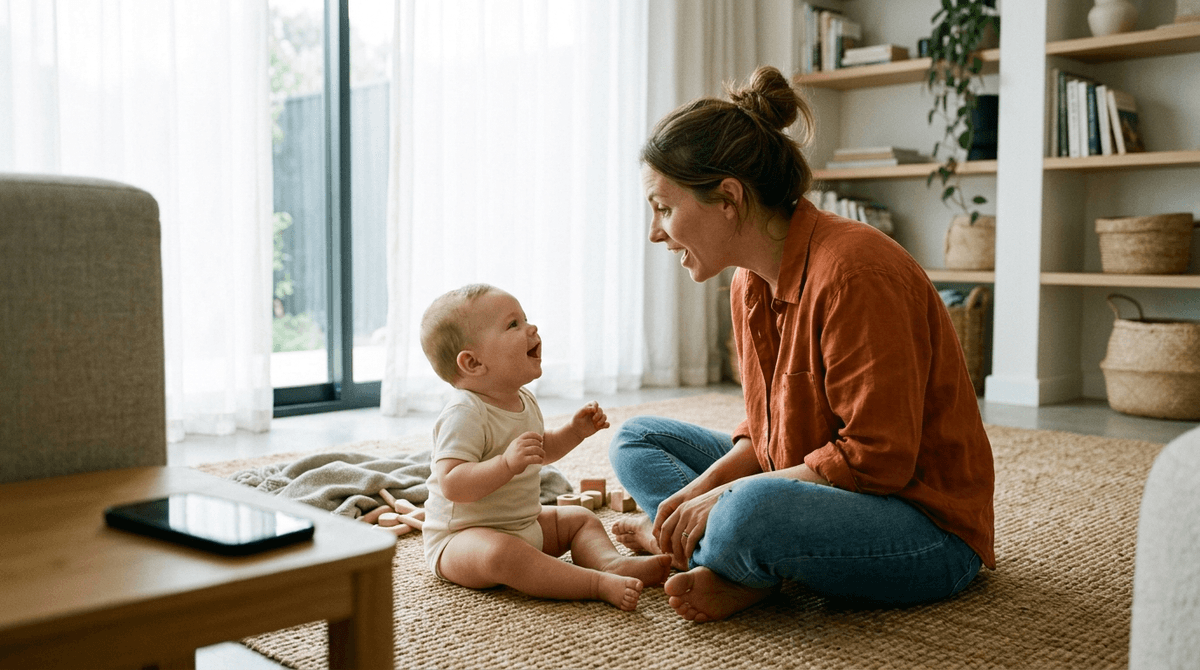

Turning off the TV gives an infant quiet, but speaking directly to them builds their brain. Infants whose parents replaced screen time with interactive talking, singing, and reading gained more than twice the developmental ground of infants who simply had screens removed.
Cutting screen time protects infant development, but replacing that screen time with active conversation and play delivers more than double the cognitive and social gains. For infants under 18 months, simply turning off the device leaves a developmental vacuum; filling that void with responsive human interaction drives rapid language catch-up.
Telling tired parents to eliminate screens rarely works when devices serve as the default babysitter during frantic household moments. Without an easy replacement, screen time inevitably creeps back up.
Swapping screens for simple, built-in interactions—like narrating dinner prep or singing during a bath—makes low-screen routines significantly easier to sustain. It also directly repairs the communication and social milestones that passive media delays.
Pediatric guidelines urge parents to avoid digital media before 18 to 24 months, yet many infants still log multiple hours of daily screen viewing. Pediatric researchers wanted to test whether cutting screens is enough to reverse developmental lags on its own, or if infants require structured, real-time verbal stimulation to restart stalled milestones.
Babies whose families swapped screen exposure for active engagement pulled dramatically ahead of peers who only eliminated screens:
- Double the milestone gains: Children whose parents replaced screens with interactive play improved their overall development scores by 16.3 points over six months, compared to just 7.4 points for kids whose parents simply removed devices.
- Clear language and social margins: After six months, infants receiving active stimulation achieved substantially higher language scores (30.2 vs. 24.8) and social communication scores (28.2 vs. 24.4).
- Better family follow-through: Over eight in ten families who actively replaced screen time with play sustained their new habits, compared to about six in ten families who tried to cut screens without a substitute.
- Independent of demographics: These developmental jumps held true regardless of household income or parental education levels.
A silent room does not build language skills on its own. When a screen goes dark, babies do not automatically absorb vocabulary; they require "serve-and-return" exchanges where a parent mirrors their babbling, points to objects, and makes direct eye contact.
A behavioral void creates parental exhaustion. Parents who keep a mental list of low-effort verbal activities encounter far less friction than those trying to enforce screen bans through willpower alone.
The trial tracked 72 infants between 9 and 18 months in Tamil Nadu, India, which is a relatively small group.
The study design was observational rather than a randomized trial. Parents who successfully added frequent language stimulation may have had unmeasured advantages, such as lower baseline stress or broader family support at home.
Finally, the findings relied on parental logs and phone check-ins over a six-month window, meaning these early gains cannot yet be linked to long-term academic performance in school.
- If you are turning off the television during evening meltdowns... Narrate your routine out loud, describing the colors, textures, and temperatures of whatever you are preparing or cleaning.
- If you find yourself handing over a phone to buy ten minutes of peace... Set up a dedicated bin of tactile household items (whisks, nesting cups, plastic containers) near your work area and comment on what your baby does with them.
- If your infant has had regular screen exposure and seems slow to talk... Dedicate 15 minutes to face-to-face nursery rhymes and pointing games each day to rebuild the joint attention pathways screens interrupt.
Do not just take away the tablet and leave an empty room; fill that reclaimed time with the sound of your voice. Even short, casual bursts of back-and-forth chatter during your regular daily chores give your baby's language and social development an immediate boost.
Vijayakumar V, T A, R KP et al. (2026). The Effect of Screen Exposure and Early Language Stimulation on Language and Social Development of Children. Cureus. doi:10.7759/cureus.113133 — pubmed.ncbi.nlm.nih.gov