

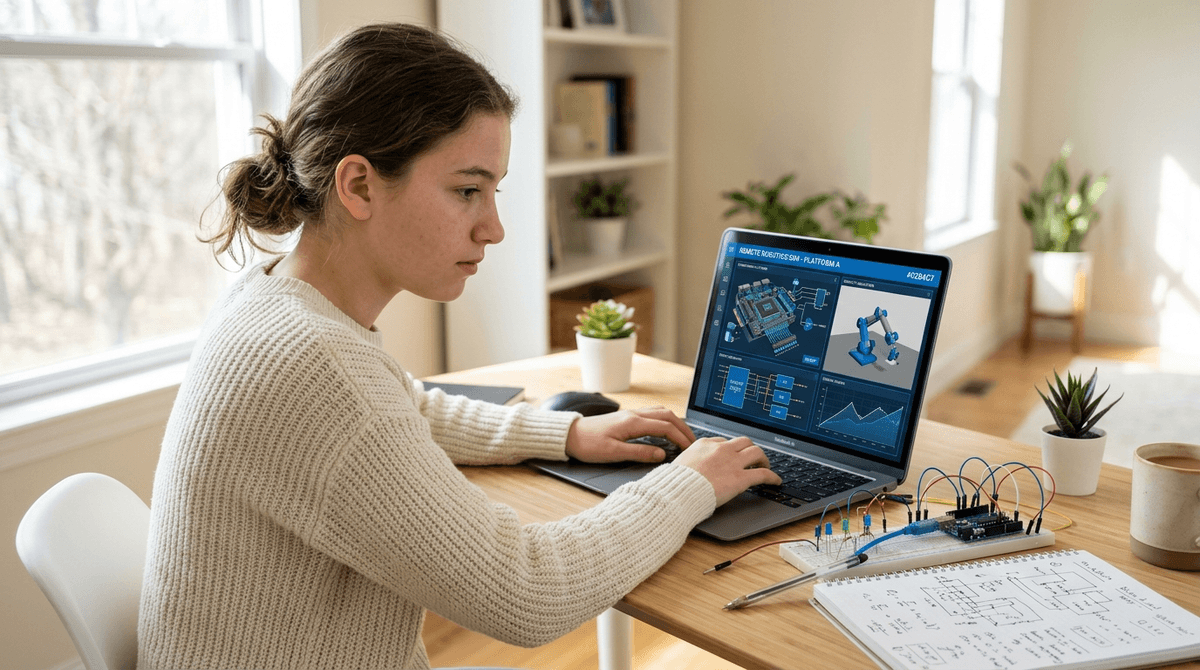

Remote college engineering labs that swap physical workbenches for virtual simulation tools do not cut corners on learning. Training students on cloud-connected hardware teaches the exact verification skills tech employers prioritize over tinkering with physical wires.
Engineering programs that use remote hardware and virtual breadboards prepare students for modern engineering jobs just as effectively as traditional campus labs—while teaching the exact digital verification tools modern employers prioritize.
When choosing colleges, summer STEM programs, or dual-enrollment classes, families often assume virtual or hybrid labs are an inferior compromise born out of budget cuts.
They are not. In modern microchip and hardware design, practicing engineers rarely sit with soldering irons; they work on cloud-based simulation software to test designs before sending them to fabrication plants. Seeing virtual lab work on a syllabus means your student is learning contemporary industrial workflow, not getting shortchanged.
University engineering departments face a bottleneck: cutting-edge microchips are wildly expensive, physical lab space is constrained, and students can only access bench equipment during strict campus hours.
At the same time, hardware companies told researchers that recent college graduates consistently lack practical experience in digital simulation and verification—the software-based stress-testing required to ensure microchip designs work before manufacturing.
Moving hardware labs to the cloud closes the gap between college coursework and what tech companies actually do every day.
- Remote setups work: Students used a virtual breadboard interface to remotely control and program real physical hardware over the internet, successfully completing projects traditionally tied to campus lab rooms.
- Industry wants simulation: Surveyed hardware engineering employers ranked software verification and simulation fluency at the very top of their hiring priorities for entry-level roles.
- Better scalability: Centralized, remotely accessible hardware allows schools to give hundreds of students round-the-clock access to advanced microelectronics without forcing families to buy costly specialized equipment at home.
The cultural bias toward "hands-on" learning in STEM often confuses physical tactile work with rigorous technical training.
Tinkering with physical components feels tangible and serious, but modern engineering design has moved almost entirely into software abstraction. When a program insists on students sitting at a physical bench every week, it may be clinging to nostalgic pedagogy rather than reflecting how modern semiconductor design actually operates.
This paper is an early preprint that has not yet completed formal peer review, and the authors do not publish the specific sample sizes of students or companies surveyed.
The findings also apply specifically to digital hardware and microchip programming. They cannot be generalized to hands-on fields where physical tactile manipulation remains non-negotiable, such as wet chemistry, physical robotics assembly, or machining.
- If your teen is vetting college engineering or computer science programs, look for coursework that features remote lab access and industry-standard simulation software alongside traditional lab rooms.
- If your student worries that remote or hybrid STEM courses look weak on a college transcript or résumé, encourage them to highlight the specific verification tools and remote hardware platforms they mastered rather than focusing on the course format.
- If you are budgeting for a STEM-focused high school or college student, hold off on buying expensive, specialized hardware kits for home use until you check whether their program offers cloud-based remote lab infrastructure.
Virtual engineering labs are an upgrade to modern industry workflows, not a second-rate substitute for campus workbenches. You can stop worrying that hybrid or remote lab courses are shortchanging your student's STEM education.
Shuowei Li, Rania Hussein (2026). Effectiveness of Using Remote Laboratory in Promoting Simulation and Verification Tools. arXiv (preprint). doi:10.1007/978-3-031-42467-0_8 — arxiv.org