

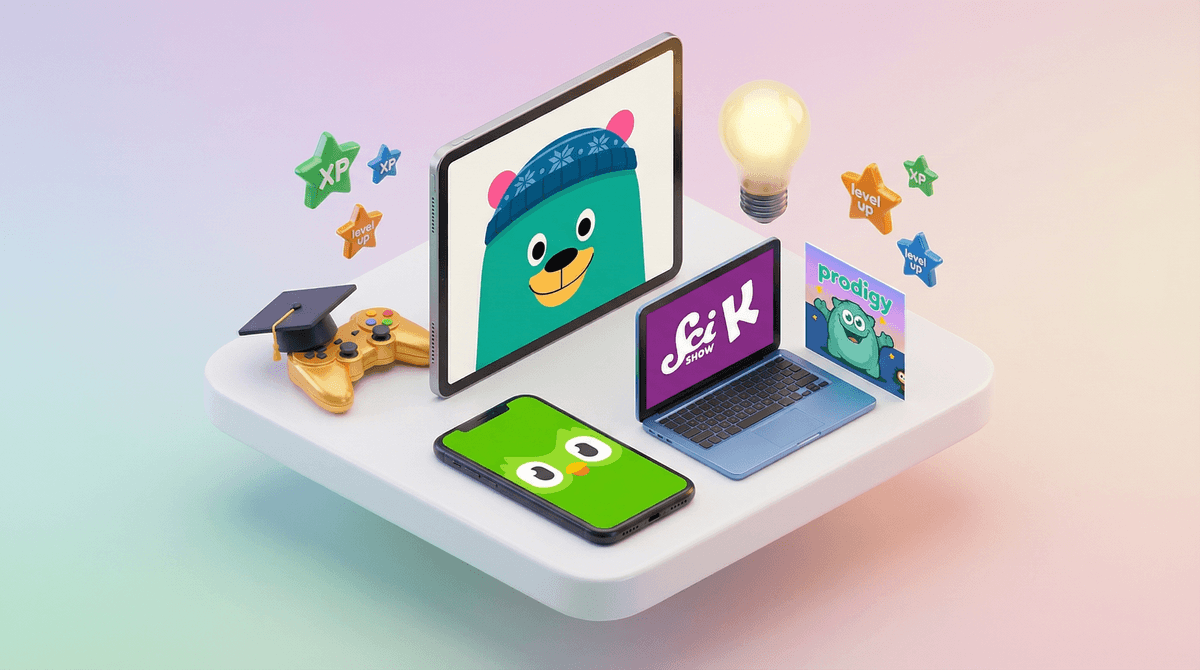
Look, we've all been there. Your kid asks for "just five more minutes" on their iPad, and you're trying to figure out if what they're doing counts as educational or if you're just telling yourself that to feel better about the screen time.
Quirky learning apps are the ones that don't look like traditional education—no boring flashcards or obvious "this is a lesson" vibes. They're the apps with weird mascots, gamified everything, and enough personality that kids actually want to open them. Think Duolingo with its passive-aggressive owl, or math apps that look more like RPGs than homework.
The big question: Are these apps actually teaching something, or are they just screen time in a graduation cap?
Duolingo (Ages 8+)
Let's start with the elephant—or owl—in the room. Duolingo is genuinely effective for language learning, backed by actual research. Yes, the owl guilt-trips your kid with notifications. Yes, the streak system is manipulative. But also? Kids are learning real vocabulary and grammar patterns through spaced repetition that actually works.
The catch: The free version is ad-heavy and has limited lives (which creates that "I can't fail or I'll lose progress" anxiety). The paid version removes these friction points. Also, language learning requires real-world practice—Duolingo alone won't make your kid fluent.
Prodigy Math (Ages 6-14)
Prodigy is basically a Pokemon-style RPG where kids battle monsters by solving math problems. The math curriculum aligns with standards, and it adapts to your kid's level. Kids legitimately enjoy it—which is wild for a math app.
The catch: The free version constantly dangles premium content in front of kids. They'll see other players with cool pets and items they can't access. It's designed to make kids beg for the membership. If you can afford it, the paid version removes this pressure. If not, have a conversation about why some games try to make you want things you don't need.
Khan Academy Kids (Ages 2-8)
This one's free, ad-free, and legitimately educational. It covers reading, math, social-emotional learning, and creative activities. The characters are cute but not annoying, and there's no manipulative monetization.
The catch: There isn't really one? It's maybe too educational-looking for some kids who are used to flashier apps. Younger kids (2-5) love it; older kids might find it babyish.
Roblox "Educational" Games
Yes, Roblox has educational games. Some teach typing, some teach coding basics, some are history simulations. And sure, your kid might stumble into one. But let's be real—they're probably playing Adopt Me or some horror game, not the typing tutor.
The verdict: Roblox can teach problem-solving and even basic game design, but calling it an educational app is a stretch. It's a game platform. Treat it like one.
YouTube Kids "Educational Channels"
The algorithm serves up a lot of content labeled "educational"—alphabet songs, science experiments, history videos. Some of it is great (Crash Course Kids, SciShow Kids). Some of it is... people in mascot costumes doing weird stuff with numbers.
The verdict: Curate this heavily. YouTube Kids is not automatically safe or educational just because it has "Kids" in the name. The autoplay feature will take your kid from legitimate science content to bizarre unboxing videos faster than you can say "algorithm."
Manipulative Monetization
If an app constantly shows your kid locked content, limited lives, or countdown timers to "get more energy," it's using the same psychological tricks as gambling. Even if the core content is educational, these mechanics teach kids to associate learning with artificial scarcity and FOMO.
Data Collection
Free educational apps often make money by collecting data. Read the privacy policy (or at least skim it). What are they tracking? Who are they selling it to? Common Sense Media reviews include privacy ratings if you want a shortcut.
Passive Consumption vs. Active Learning
Watching educational videos isn't the same as doing educational activities. If your kid is just watching someone else solve problems or play games, they're not learning much. Look for apps that require active participation—answering questions, creating things, solving puzzles.
"Educational" Violence or Mature Content
Some apps slap "educational" on games that include violence or mature themes. A history game where you shoot people isn't automatically educational just because it's set in World War II. Age ratings matter.
Screen Time Is Screen Time
Even the best educational app is still screen time. A kid doing math problems on Prodigy for an hour isn't necessarily better than a kid doing 30 minutes of Prodigy and 30 minutes of playing outside. Balance matters.
The Best Learning Apps Are Supplemental
No app replaces reading books, playing with physical toys, having conversations, or doing hands-on activities. Educational apps work best as one tool among many—not the primary teaching method.
Your Kid's Opinion Matters
If your kid hates an app, forcing it won't create a love of learning. It'll create resentment toward both the app and the subject. Try different options and see what clicks.
Free Doesn't Always Mean Good (or Bad)
Khan Academy Kids is free and excellent. Lots of "free" apps are manipulative cash grabs. Price isn't the only indicator of quality—look at who made it, how it's monetized, and what other parents say.
Quirky learning apps can be genuinely valuable—but only if you're choosing thoughtfully and not treating them as a substitute for actual teaching or parenting. Duolingo works for language learning. Prodigy makes math practice more tolerable. Khan Academy Kids is solid for younger children.
But if an app is free, covered in ads, constantly pushing purchases, or feels more like a slot machine than a learning tool? It's probably dressed-up screen time.
Next Steps:
- Try one or two apps that align with what your kid is learning in school
- Set time limits (even for "educational" apps)
- Check in regularly—sit with your kid and see what they're actually doing
- Remember that boredom is okay and sometimes leads to better learning than any app
And if you're wondering whether Roblox counts as teaching entrepreneurship or how much educational content is actually on YouTube Kids, those are great questions worth exploring.