

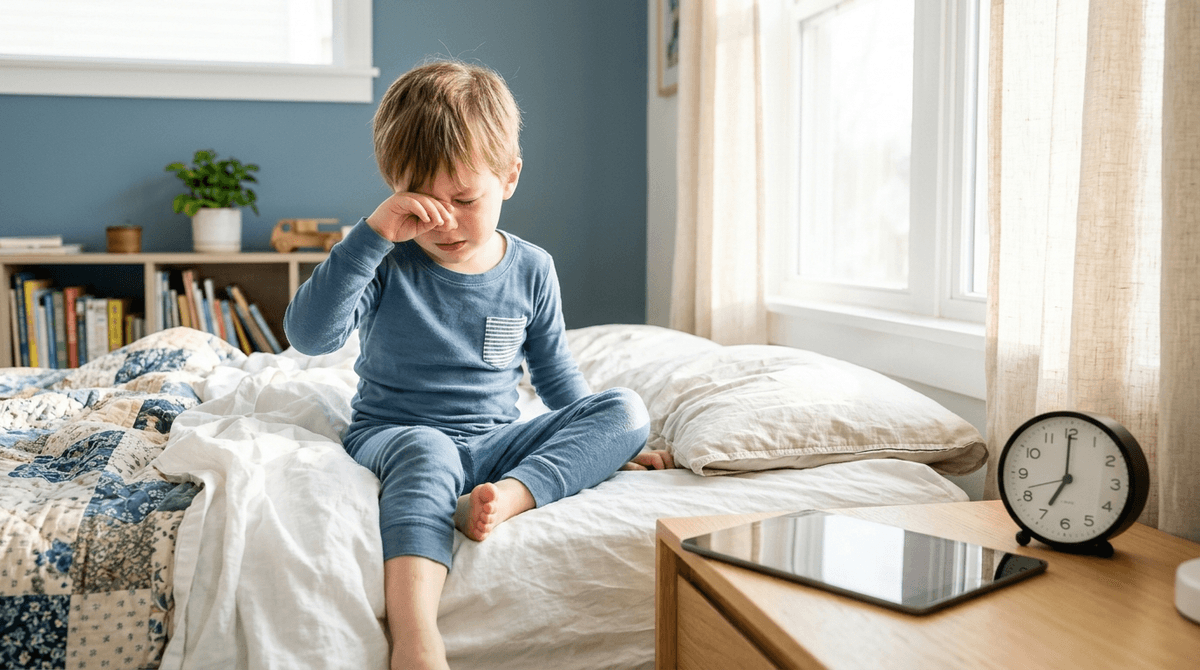

A child who clocks ten hours of sleep a night can still be chronically exhausted. New clinical data shows more than one-third of preschoolers suffer from poor sleep quality, driven primarily by late bedtimes and evening screen use rather than a lack of total hours in bed.
Total sleep duration masks hidden sleep debt: more than 36% of preschoolers qualify as poor sleepers, with late bedtimes and screen exposure driving fragmented, low-quality rest even when children hit official sleep duration targets.
Most pediatric sleep guidance focuses almost entirely on one number: total hours. Parents routinely assume that putting a four-year-old down at 9:30 p.m. is fine as long as they sleep until 7:30 a.m.
This research shows that sleep timing and sleep continuity matter just as much as sleep duration. Late nights disrupt the architecture of early childhood sleep, increasing night wakings, bedtime battles, and daytime emotional meltdowns. Shifting bedtime earlier resolves behavioral friction far more effectively than letting a child sleep in.
Pediatricians usually ask parents a single check-the-box question: "Is your child sleeping 10 to 13 hours?" Researchers tracking the CoAlHaS birth cohort in Spain wanted to look past that surface metric.
They set out to map how lifestyle habits, birth history, and home routines interact to shape sleep quality across early childhood, evaluating whether children who appear to sleep enough on paper are actually resting well.
Sleep disturbances in early childhood are widespread, but specific family habits and biological factors heavily tilt the odds:
- More than a third struggle: 36% of preschoolers met the threshold for clinically meaningful sleep disturbances based on standardized diagnostic assessments.
- Late bedtimes drive disruptions: Pushing bedtime later was linked to a 46% surge in sleep disturbances, making it one of the strongest lifestyle predictors of poor rest.
- Screen time chips away at rest: Increased screen exposure was associated with a 6% increase in the risk of being a poor sleeper.
- Prematurity doubles baseline vulnerability: Children born prematurely had more than double the odds (a 110% increase) of chronic sleep disturbances compared to full-term peers.
- Household routines protect rest: Higher maternal education was linked to 38% lower odds of sleep problems, an effect researchers largely attribute to more structured bedtime routines and tighter media limits.
The hour on the wall matters more than the tally on the sleep tracker.
When a preschooler stays up late, their natural circadian rhythm falls out of alignment with their biological drive for sleep. Even if they sleep late the next morning, that delayed sleep is lighter, more fragmented, and less restorative. Screens compound the issue by delaying melatonin release and ramping up neurological arousal right when the brain needs to downshift.
The study relied on standardized parent questionnaires (the Children's Sleep Habits Questionnaire) rather than objective wearable sensors like actigraphy bands or in-lab sleep studies. Parent reporting can introduce recall bias.
The cohort was based in Cantabria, Spain, where cultural dinner and bedtime schedules tend to run later than in North American households. However, the biological friction caused by delayed bedtimes applies universally across cultures. Finally, the observational design demonstrates strong associations, not direct causation.
- If your child gets 10+ hours of sleep but still wakes up irritable: Move bedtime earlier by 30 to 45 minutes rather than extending morning wake times, aiming to deepen sleep architecture rather than stretching duration.
- If your child was born prematurely: Treat consistent sleep routines as essential preventive care, since preterm nervous systems carry a significantly higher baseline vulnerability to fragmented sleep.
- If evening screens are part of the wind-down routine: Cut off televisions, tablets, and phones at least 60 minutes before lights-out to eliminate the blue light and cognitive stimulation linked to poor preschool sleep.
Stop evaluating your preschooler's rest purely by the total hours on the clock. Anchoring an early, consistent bedtime and clearing screens out of the evening wind-down will do far more to end night wakings and morning meltdowns than simply letting your child sleep in.
Sanchez-Piorno L, Gomez-Acebo I, Alonso-Molero J et al. (2026). Sleep patterns and determinants of sleep disturbances in preschool children in the CoAlHaS cohort. Sleep medicine. doi:10.1016/j.sleep.2026.109143 — pubmed.ncbi.nlm.nih.gov