

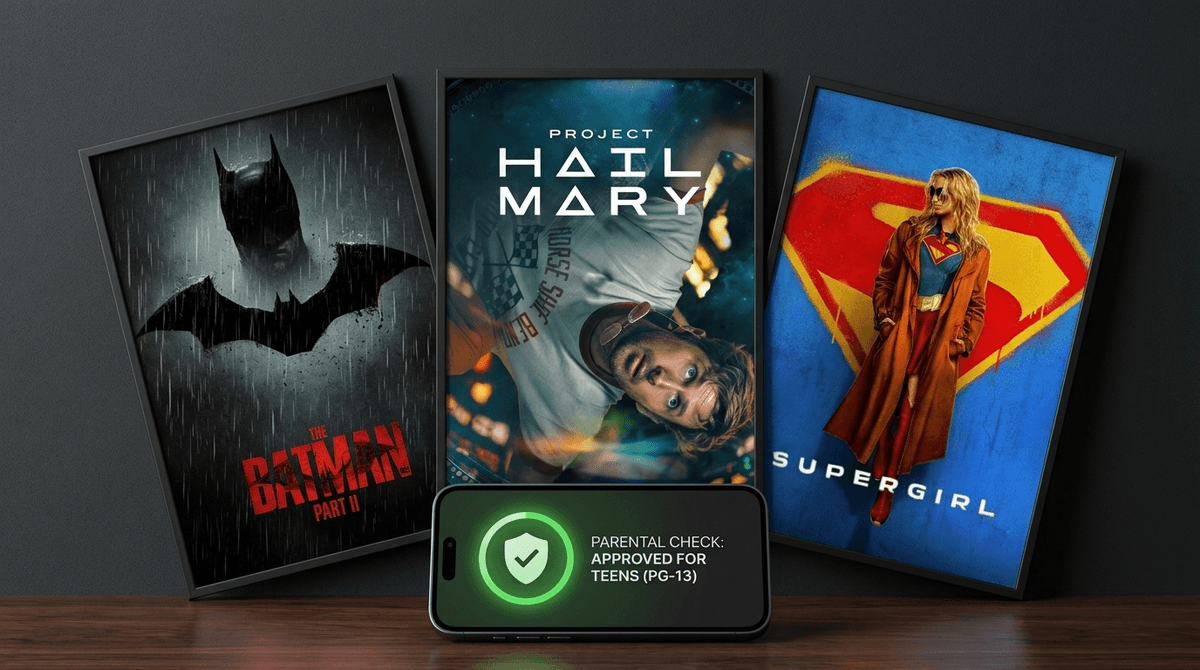
TL;DR: Transitioning from the safety of PG to the wild west of PG-13 is the biggest "level up" in a tween’s media life. It’s the difference between Despicable Me and the high-stakes intensity of Avengers: Doomsday. This year, the jump is even more pronounced with gritty reboots and complex sci-fi hitting theaters.
Quick Picks for the 2026 PG-13 Jump:
- The "Safe" Entry: Supergirl: Woman of Tomorrow — Emotional, epic, but manageable.
- The Brainy Choice: Project Hail Mary — For the kid who loved The Martian.
- Proceed with Caution: The Batman Part II — It’s basically a horror movie in a cape.
- The Cultural Milestone: Avengers: Doomsday — You can’t avoid this one; just be ready for the "dark turn."
If you feel like your 11-year-old suddenly thinks SpongeBob SquarePants is "for babies" and is obsessed with having "aura," you aren't alone. In the world of 2026, the gap between PG and PG-13 has become a massive cultural chasm.
PG movies are increasingly being designed for the "iPad kid" demographic—lots of bright colors, fast cuts, and slapstick. But PG-13? That’s where the "real" stories live. For a tween, watching a PG-13 movie isn't just about the content; it’s a status symbol. It says, "I’m not a kid anymore."
But as parents, we know that "PG-13" is a catch-all that is wildly inconsistent. One PG-13 movie might have a single "F-bomb" and some mild flirting, while another features a psychological breakdown and enough explosions to rattle your teeth. Navigating this without being the "lame parent" who says no to everything requires a bit of strategy.
Get a movie comparison for your tween
It’s not just about seeing "mature" stuff. It’s about the shift in storytelling.
- Stakes that Matter: In PG movies, the world is usually saved with a hug or a joke. In PG-13, characters actually lose things. They fail. They die. Tweens are at an age where they are starting to realize the world is complicated, and they want media that reflects that.
- The "Ohio" Factor: Everything weird or cringey is "Ohio" now, but PG-13 movies are seen as "Sigma." Being able to discuss the latest Marvel plot or a viral horror movie on Discord or Roblox is social currency.
- Complex Heroes: They are moving past "good vs. evil" and into "flawed vs. misunderstood." They want to see themselves in characters who struggle with their identity—something Supergirl: Woman of Tomorrow is going to lean into heavily this summer.
Here is the breakdown of what is hitting screens this year and how to handle the "Can I see it?" conversation.
The Vibe: The return of Robert Downey Jr. to the MCU, but as the villain Doctor Doom. The Tween Appeal: Massive. This is the "Endgame" level event of 2026. The Parent Reality: Marvel has been getting darker. Expect high-intensity action and probably some existential dread. If your kid handled Guardians of the Galaxy Vol. 3, they’ll be fine here, but be prepared to discuss the "villain's journey." Read our full guide on Marvel's shift to darker themes
The Vibe: Based on the Andy Weir book. A guy wakes up on a spaceship with no memory and has to save humanity using science. The Tween Appeal: For the "science is cool" kids and the Minecraft engineers, this is pure gold. The Parent Reality: This is the "gold standard" of PG-13. It’s intense because of the life-or-death stakes, but the "bad stuff" is mostly just some salty language. It’s a great "first PG-13" for a smart 10 or 11-year-old.
The Vibe: Not your older sister’s Supergirl. This is a gritty, sci-fi space western. The Tween Appeal: It looks "cool" in a way female-led superhero movies haven't always nailed. It’s got "aura." The Parent Reality: This movie deals with some heavier themes of trauma and revenge. It’s visually stunning but definitely leans into the "13" part of PG-13.
The Vibe: Dark, rainy, moody, and borderline terrifying. The Tween Appeal: Every 12-year-old boy wants to see this. The Parent Reality: This is the one to watch out for. The first movie was basically a serial killer thriller. If your kid is sensitive to "scary" stuff, this isn't a "superhero movie"—it’s a crime drama. I’d suggest a "parents watch first" policy on this one. Check out our guide on the differences between Marvel and DC intensity
According to our latest Screenwise community data, the "jump" usually happens in 6th grade.
- 65% of 6th graders have seen at least three PG-13 movies.
- By 8th grade, that number jumps to 92%.
If you’re the only parent saying "no," you’re fighting an uphill battle. Instead of a hard ban, consider the "Contextual Yes."
- Ages 10-11: PG-13 is a "co-watch" only. You’re on the couch, you’ve got the remote, and you can pause to say, "Okay, that was a lot, you good?"
- Ages 12-13: They can go with friends, but only to "vetted" movies. No 2026 horror reboots like M3GAN 2.0 unless you’ve checked the "gore factor" first.
When a movie gets a PG-13 rating, it’s usually for one of these three reasons. Here is how to navigate them in 2026:
1. The "F-Bomb" and Language
The MPAA usually allows one non-sexual "F-word" in a PG-13 movie. In 2026, language has become almost a non-issue for many parents because kids are hearing much worse on YouTube or in Fortnite lobbies. The Screenwise Take: Focus less on the words and more on the attitude. Is the language used to be cruel, or is it just "spicy" dialogue?
2. Violence vs. "Impact"
We’ve become desensitized to explosions. What actually messes with tweens in 2026 is "impact" violence—seeing a character they like suffer or seeing realistic injuries. The Screenwise Take: Modern CGI is too good. The Batman Part II looks incredibly real. If your kid still has nightmares, stick to the "cosmic" violence of Avengers where things just turn into purple dust.
3. Sexual Content and "The Gaze"
PG-13 movies in 2026 are actually cleaner regarding "sex scenes" than they were in the 90s, but they are much more focused on "suggestive themes." The Screenwise Take: This is actually a great time to talk about unrealistic body standards. When every actor in Supergirl looks like a fitness model, it’s worth a 30-second chat about lighting, trainers, and protein shakes.
Don't give a lecture. Just ask questions that make them think.
- "Why do you think the villain is doing this? Is he just 'evil' or does he have a point?"
- "That fight scene was cool, but do you think anyone could actually survive that?"
- "I heard this movie has a lot of Skibidi Toilet energy—is it actually good or just loud?" (Okay, maybe don't say that last one if you want to keep your dignity).
Learn more about how to talk to your tween about media influence
The jump to PG-13 is a rite of passage. In 2026, the movies are bigger, louder, and more complex than ever. You don't need to be a gatekeeper who keeps the gate locked; you just need to be the one holding the map.
Start with the "safe" hits like Project Hail Mary, use the Screenwise community data to see what other parents in your kid's grade are allowing, and remember: if a movie is "unwatchable" or "brain rot," you have every right to say so.
- Check the Survey: Take the Screenwise Family Tech Survey to see how your movie boundaries compare to your local community.
- Set a "Co-Watch" Date: Pick one PG-13 movie this month to watch with your tween.
- Vetting: Before you drop them off at the theater for The Batman Part II, check the "Parental Guidance" section on the Screenwise media page.