

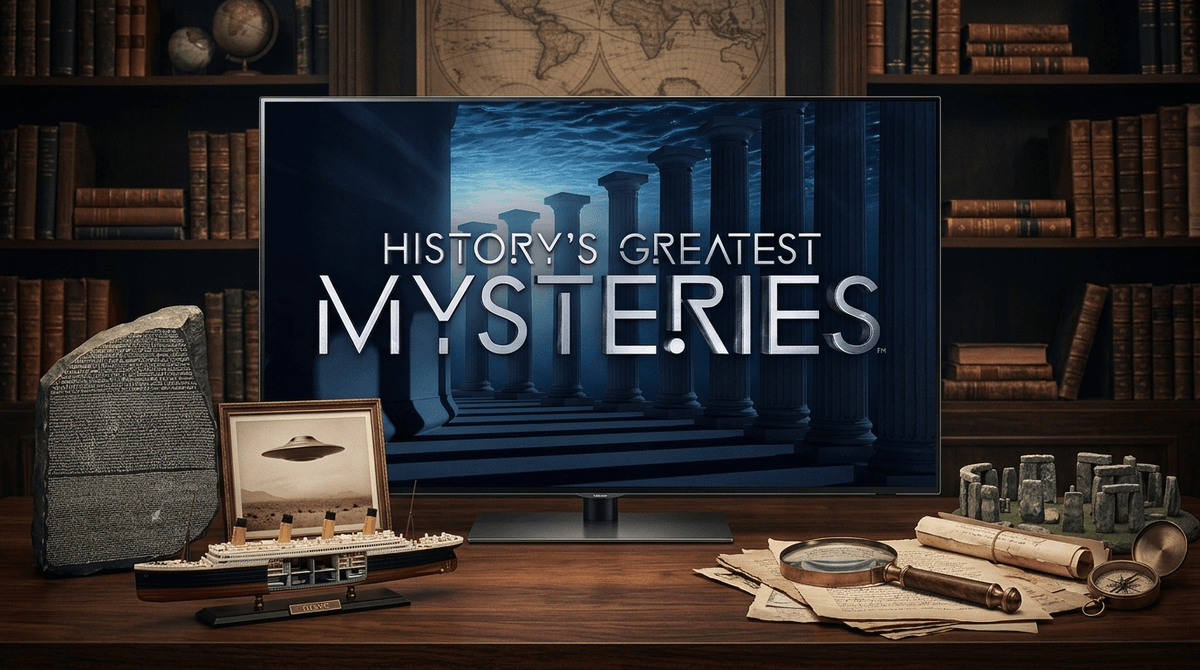
History's Greatest Mysteries is exactly what it sounds like: a high-production, Laurence Fishburne-narrated deep dive into the stuff that keeps historians up at night. It’s not a dry classroom lecture, but it’s also not quite a horror movie—it sits in that middle ground where "educational" meets "creepy." Whether it’s a fit for your afternoon depends entirely on whether your kid is looking for facts about the Rosetta Stone or wants to speculate about the identity of the Zodiac Killer.
TL;DR
History's Greatest Mysteries is a compelling docuseries that works best for middle schoolers and up who have moved past the National Geographic Kids phase and want something with more "true crime" energy. While episodes on the Titanic or the Rosetta Stone are solid historical deep dives, others like Jack the Ripper or the Zodiac Killer lean into suspense and re-enactments that can feel pretty intense. It’s a top-tier choice for sparking a "how do we actually know what happened?" conversation, but you’ll want to pick your episodes based on your kid’s tolerance for unsolved tension.
First things first: Laurence Fishburne could read a grocery list and make it sound like a matter of national security. His narration gives this show a weight that other "mystery" shows lack. It feels serious. It feels authoritative. For a kid who is used to the frantic energy of YouTube, the slow-burn, cinematic pace of this show is a total vibe shift. It’s history presented as a cold-case file, which is a very effective way to get a ten-year-old interested in the 19th century.
When the show sticks to archaeological or maritime mysteries, it’s a goldmine. These episodes are the "safe" entries that feel more like a high-budget museum exhibit than a thriller.
- The Titanic: Everyone knows the ship hit an iceberg, but this episode digs into the "why" and the "how" with new technology. If your kid has already watched the Titanic movie or read every book in the school library about it, this is the logical next step.
- The Rosetta Stone: This is pure "Indiana Jones" energy without the supernatural stuff. It’s about linguistics, discovery, and how we actually unlocked the secrets of Ancient Egypt. It’s a great companion piece if they’re already browsing books for kids about Ancient Egypt.
- The Hindenburg: This one is a masterclass in forensic engineering. It’s less about "spooky ghosts" and more about "why did this giant hydrogen balloon explode?" It’s great for kids who are into STEM-focused shows.
Then there are the episodes that lean into the "Greatest Mysteries" title by focusing on people who did very bad things and got away with it. This is where the show shifts into true-crime territory.
- Jack the Ripper: This is the one most parents ask about. It’s set in Victorian London, it’s dark, it’s foggy, and the re-enactments are moody. While it’s not graphic in a "slasher movie" way, the subject matter is inherently heavy. It’s less about the history of London and more about the psychology of a serial killer.
- The Zodiac Killer: Similar energy. It deals with 1960s/70s police work and cryptic codes. If your kid is into escape rooms or puzzles, the code-breaking aspect is fascinating, but the "unsolved killer" element is the primary driver.
- The Escape from Alcatraz: This is the "fun" kind of suspense. It’s a prison break story. It’s tense, but it’s more about the ingenuity of the inmates than anything truly disturbing.
A few episodes tackle the "legend" side of history—think DB Cooper or Roswell. These are fantastic for teaching media literacy and the difference between a "theory" and "documented fact."
The show does a decent job of bringing in experts (archaeologists, historians, forensic scientists) to debunk the wilder claims, but it still loves to linger on the "what if." If your kid is watching the Roswell episode, it’s the perfect time to talk about what constitutes real scientific evidence versus a good story.

The best thing about History's Greatest Mysteries is that it doesn't give you all the answers—mostly because nobody has them. This is a feature, not a bug.
- The "Google It" Challenge: After an episode ends, ask your kid: "Do you think they missed anything?" or "What’s the most recent discovery about this?" History isn't static; we’re finding new stuff about the Titanic and the Maya civilization every year.
- The Forensic Angle: The show spends a lot of time on DNA testing and LIDAR scanning. If your kid is more into the tech than the dates, lean into that. It shows that being a historian in 2026 often means being a data scientist.
- Compare the Narrative: If they watch the episode on the Princes in the Tower, maybe find a history podcast for kids that covers the same topic. Seeing how different creators handle the same "mystery" is a great way to show how history is interpreted.
The main friction point isn't the "history"—it's the unsolved nature of the show. Some kids find the lack of a tidy ending frustrating or even a little unsettling. If your kid is the type who needs the "bad guy" caught at the end of the 44-minute runtime, they might find the Zodiac or Jack the Ripper episodes more annoying than entertaining.
Also, the show uses a lot of "dramatic recreations." These are actors in costumes doing dramatic things in slow motion. They are high quality, but they are designed to be atmospheric. If you have a younger kid who is sensitive to "spooky" vibes (even if it's just a guy in a trench coat walking through fog), maybe stick to the shipwreck episodes first.
Q: Is History's Greatest Mysteries appropriate for an 8-year-old? It depends on the episode. The Titanic or Rosetta Stone episodes are generally fine and very educational. However, the show’s overall tone is dark and serious, and episodes involving serial killers (Jack the Ripper, Zodiac) might be too intense or simply too mature in theme for most 8-year-olds.
Q: Is the show historically accurate? For the most part, yes. It uses real historians and scientists. However, because it focuses on mysteries, it naturally spends a lot of time on theories that haven't been proven. It’s a great way to discuss the difference between a "proven fact" and a "compelling theory."
Q: Which episodes are the best for a school project? The episodes on the Titanic, the Rosetta Stone, and the Hindenburg are the most "fact-heavy" and provide great visual context for school reports. They focus more on engineering and archaeology than on speculative legends.
Q: Is it better than other history shows on Netflix or Disney+? It’s more "prestige" than your average History Channel show. It avoids the "aliens built the pyramids" tropes and stays grounded in actual research. If you want something a bit lighter or more fast-paced, check out our best shows for kids list for other options.
History's Greatest Mysteries is a winner for the "middle grade" sweet spot—kids aged 10 to 14 who are starting to realize that the world is a lot weirder and more complicated than their textbooks let on. It treats the audience like adults, which kids usually love. Just be prepared to skip the Ripper episode if you're not ready for a "how did forensic science work in 1888?" conversation at dinner.
- If they loved the tech/engineering side: Check out our best games for kids for titles that involve building and problem-solving.
- If they loved the mystery side: Look at our best books for kids for some classic mystery novels.
- If they want more history: Explore our digital guide for middle school for more age-appropriate documentary recs.