

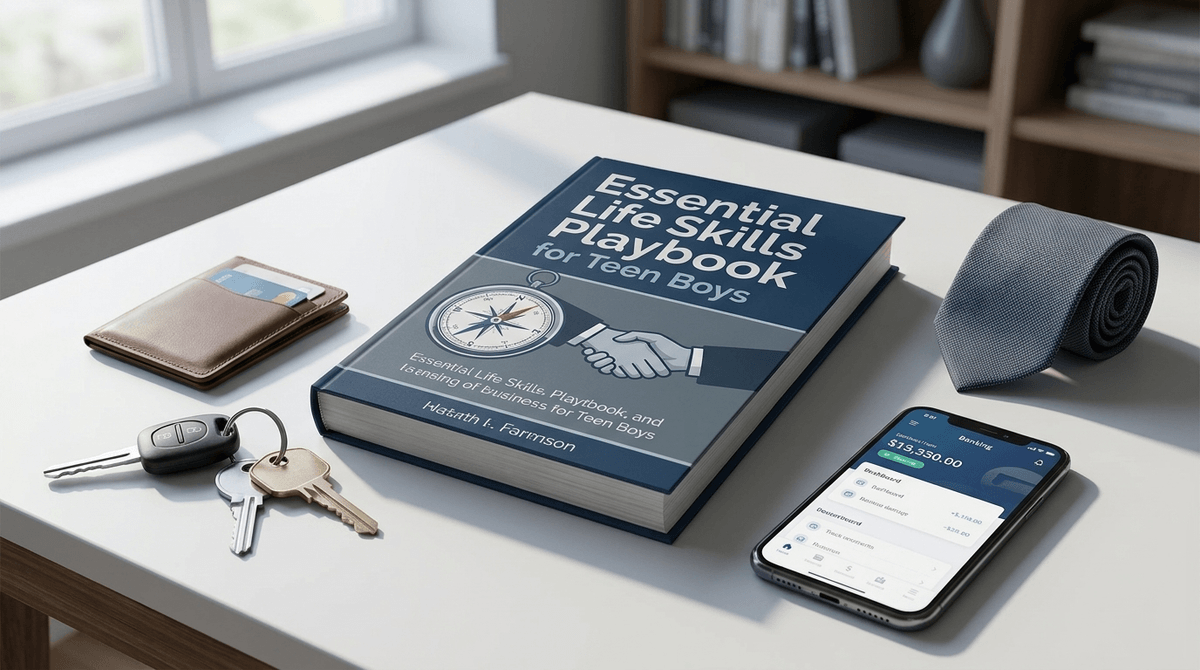
If your son is staring down the barrel of graduation and still thinks laundry is a magic trick performed by the floor, the Essential Life Skills Playbook for Teen Boys is the tactical manual you both need. It’s a no-nonsense bridge between "kid who needs a ride" and "adult who has a plan," written without the condescending "hey fellow kids" energy that usually kills these books on arrival.
TL;DR
The Essential Life Skills Playbook for Teen Boys is a practical, high-impact guide to the "adulting" basics—money, social confidence, and organization—written for the modern attention span. It’s perfect for teens heading toward independence who need a roadmap for the stuff school doesn't teach. For more resources on launching teens, check out our digital guide for high schoolers.
Let’s be real: most "guidebooks" for teens are written by people who haven't spoken to a teenager since the Bush administration. They’re heavy on the "just say no" and light on "how do I actually dispute a charge on my credit card?"
This playbook from Next Chapter Parenting works because it treats the reader like an adult-in-training. It’s formatted for quick scanning, with actionable "plays" rather than long-winded philosophy. It hits the three pillars that actually matter for a kid leaving the nest: financial literacy, social confidence, and personal organization.
The book is organized into sections that map to the biggest friction points of early adulthood. It doesn’t just say "save money"; it explains why your future self will hate you if you don't.
The Money Playbook
This is usually where kids tune out, but the guide keeps it tactical. It covers the basics of budgeting, understanding credit (the "invisible score" that determines their life), and the reality of taxes.
- Pair it with: YNAB (You Need A Budget) or Greenlight to turn the theory into actual practice.
The Confidence Playbook
For a lot of teen boys, "confidence" is a vague concept. This book breaks it down into social mechanics: how to handle a job interview, how to speak to people in authority, and how to navigate peer pressure without being a jerk. It’s about building a "social toolbox" so they aren't winging it in high-stakes moments.
- Deep Cut Recommendation: If they find the social stuff interesting, have them watch Hunt for the Wilderpeople. It’s a masterclass in the "unlikely mentorship" and finding your footing when you're out of your element.
The Independence Playbook
This covers the "organizes plans" and "manages homework" metrics Screenwise tracks. It’s about the boring stuff that makes life work—cooking a basic meal, basic car maintenance, and managing a calendar. It’s the "how not to be a burden on your future roommates" section.
- Pair it with: Atomic Habits by James Clear for a deeper dive into how small systems beat "willpower" every time.
This isn't for the kid who already has a 4.0 and a five-year plan. It’s for the "reluctant launcher." It’s for the kid who is capable but maybe a little overwhelmed by the sheer volume of "stuff" adults have to know.
The book excels at independence—giving a kid the "why" behind the "how." It’s a great gift for a 16th birthday or a high school graduation, but honestly, starting at 14 isn't a bad move. The earlier they realize that these skills are learnable, the less anxiety they’ll have about the "Road Ahead."
Don't just drop this on his nightstand and walk away. That’s a recipe for it becoming a very expensive coaster.
The "Consultant" Move: Treat yourself as the consultant, not the teacher. When he’s reading the money section, show him your actual (redacted) budget or how you use an app to track spending. When he reads about car maintenance, have him change the wiper blades on your car. The book provides the "what," but you provide the "where."
The biggest friction point with a book like this is the "I already know this" defense. Teen boys are biologically programmed to act like they have it all figured out while secretly Googling "how to boil an egg."
Pro-tip: If he’s a reluctant reader, don't make him read it cover-to-cover. Tell him to pick one "play" a week that he thinks is actually useful. Low pressure, high utility.
Q: What age is the Essential Life Skills Playbook for Teen Boys appropriate for? The sweet spot is 14 to 19. Younger kids (12-13) might find the talk about credit scores and job interviews a bit abstract, while 20-year-olds might already be learning these lessons the hard way.
Q: Is this book better than The 7 Habits of Highly Effective Teens? The 7 Habits of Highly Effective Teens is a classic for a reason—it’s great for mindset. This playbook is better for mechanics. If you want them to think better, go with 7 Habits. If you want them to know how to change a tire and manage a bank account, go with the Playbook.
Q: Does it cover digital safety or social media? It touches on the "reputation" aspect of the digital road ahead, but for a deep dive into navigating the internet specifically, you’ll want to check out our digital guide for middle school or the high school equivalent.
Q: Is there a version for girls? While the principles of money and organization are universal, this specific "Playbook" is voiced and marketed toward boys. There are similar titles for teen girls, but the tactical advice here (like basic repairs and social confidence) is solid for anyone.
The Essential Life Skills Playbook for Teen Boys is a solid, practical investment in his independence. It’s not a literary masterpiece, and it’s not trying to be. It’s a manual. And for a teen boy looking at the "Road Ahead," a good manual is worth its weight in gold.
- Check out our best books for kids list for more non-fiction picks that don't suck.
- Explore our digital guide for high school for the tech side of independence.
- Get help picking a next book series
