

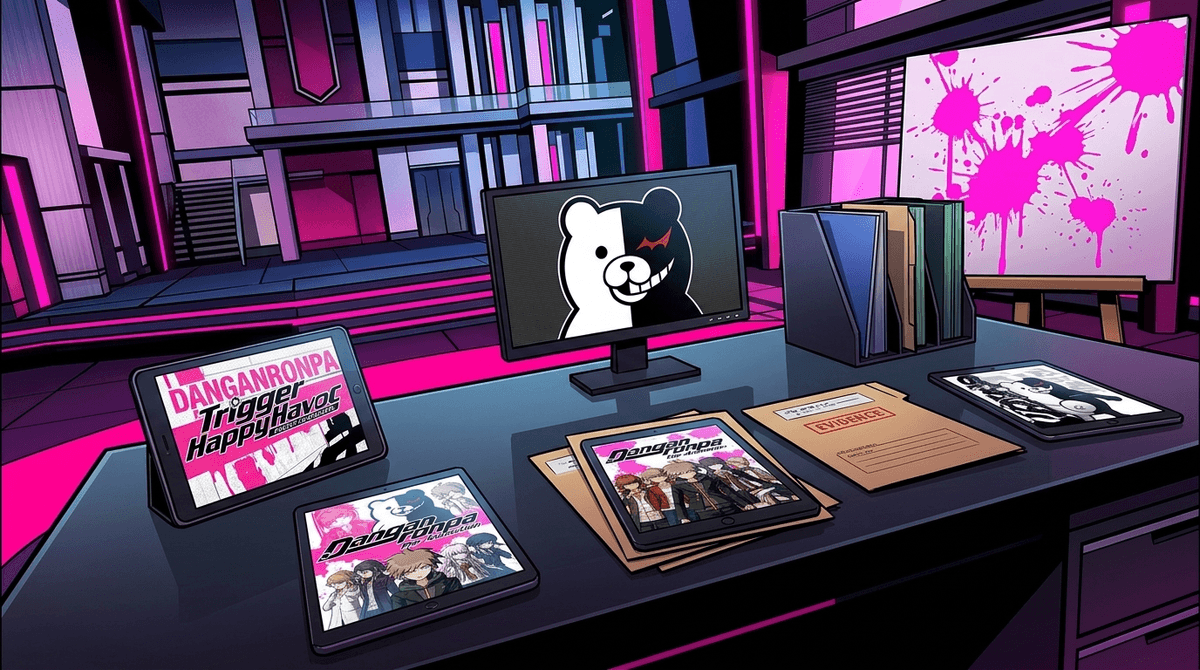
If you’ve seen a half-white, half-black robotic bear with a jagged red eye staring at you from your teen’s laptop stickers or lock screen, you’ve officially entered the orbit of Danganronpa.
Danganronpa: Trigger Happy Havoc is a high-stakes visual novel where elite high schoolers are trapped in a school and told the only way to "graduate" is to kill a classmate and get away with it. It sounds grim—and it is—but it’s also wrapped in neon colors, pop-art aesthetics, and a "pink blood" stylistic choice that keeps it from feeling like a standard slasher flick. It’s less about the gore and more about the "whodunnit" logic puzzles that follow every crime.
TL;DR
Danganronpa: Trigger Happy Havoc is a murder-mystery visual novel that trades traditional gore for stylized violence (neon pink blood) and intense courtroom-style logic puzzles. It’s a massive hit for teens who enjoy complex character dramas and "social deduction" games like Among Us, but with a much darker, psychological edge. For the full breakdown of how it stacks up against other titles, check out our best games for kids list.
The setup is pure psychological thriller: 15 "Ultimate" students (the Ultimate Lucky Student, the Ultimate Fashionista, etc.) are locked in Hope’s Peak Academy. A sadistic bear named Monokuma informs them they’re stuck there forever unless they commit a murder. If the other students catch the killer in a "Class Trial," the killer is executed. If they pick the wrong person, the killer goes free and everyone else dies.
It’s a pressure cooker. Your teen isn't just playing a game; they’re reading a massive interactive novel. There is a lot of text. If your kid isn't a fan of reading, this won't be the one that converts them—but if they love lore, character backstories, and plotting, they’ll be hooked for 40+ hours.
The first thing you’ll notice if you look over their shoulder is that the blood in Danganronpa is bright, fluorescent pink.
This wasn't an accident. The developers did it to get past censors, but it ended up becoming the series' trademark. It creates a "psycho-pop" aesthetic that creates distance between the player and the violence. It feels more like an art piece than a crime scene. That said, the executions—the cinematic sequences where the "guilty" party is punished—are creative, dark, and often ironic based on the character’s talent. They aren't realistic, but they are intense.
Once a body is found, the game turns into a full-blown investigation. This is where Danganronpa actually shines as a mental exercise.
During the Class Trials, players have to use "Truth Bullets" (evidence) to literally shoot down contradictions in other characters' arguments. It requires:
- Critical Thinking: Connecting a piece of evidence found in the kitchen to a statement made about the gym.
- Reading Comprehension: Paying close attention to dialogue for subtle slips in logic.
- Pattern Recognition: Figuring out the "how" and "why" before the game spells it out.
If they love the logic puzzles here, they’d probably also get a kick out of the Phoenix Wright: Ace Attorney series, which has similar "OBJECTION!" energy but with a much lighter, more comedic tone.
While the violence is stylized, there are a few other things that usually matter more to Screenwise parents:
- The Language: It’s a game about high schoolers in a life-or-death situation; they talk like it. Expect frequent use of "hell," "damn," and the occasional F-bomb.
- Suggestive Themes: There’s some "fan service" (characters in bikinis, suggestive jokes, and "panty shots"). It’s a common trope in Japanese media of this era, and while it’s mostly peripheral to the plot, it’s definitely there.
- Dark Themes: The game deals with betrayal, despair, and suicide. It’s a heavy emotional lift. If your kid is in a headspace where "everyone is out to get you" feels too real, this might be a lot to process.
If your teen is obsessed with Danganronpa, they’re likely already looking at fan art or thinking about cosplay. This series has one of the most active "fandoms" in gaming.
Conversations to Start:
- "Which 'Ultimate' talent would you have if you were in that school?"
- "Who was the hardest killer to catch? What was the piece of evidence that finally gave them away?"
- "Monokuma is a pretty messed up character. Why do you think the creators made him a cute bear instead of a scary monster?"
If the "killing game" genre has them hooked, there are ways to pivot that interest into other great experiences:
- For the Mystery Solvers: Return of the Obra Dinn. It’s a black-and-white masterpiece where you have to figure out how everyone on a ghost ship died. It’s pure logic, zero "fan service," and incredibly rewarding.
- For the Social Deduction Fans: Among Us or Gnosia. Gnosia is particularly close to Danganronpa—it’s a visual novel where you have to find the "alien" among a crew of humans on a spaceship.
- For the Narrative Junkies: Zero Escape: The Nonary Games. This is the spiritual cousin to Danganronpa. Nine people, trapped, forced to play a game to escape. It leans harder into "escape room" puzzles.
Q: What age is Danganronpa appropriate for? Most intentional parents find that 14+ is the sweet spot. The ESRB gives it an "M" rating, but it’s mostly for the themes and language rather than graphic realism. If they can handle a PG-13 thriller or a darker anime like Death Note, they’re ready for this. For more context on age-appropriate gaming, see our digital guide for high schoolers.
Q: Is Danganronpa too scary for a 12-year-old? It’s not "jump-scare" scary, but it is psychologically tense. The "punishments" (executions) can be disturbing because you’ve spent hours getting to know the characters before they are killed. If your 12-year-old is sensitive to character deaths, maybe hold off.
Q: Why is the blood pink in Danganronpa? It’s a stylistic choice called "Psycho-Pop." It keeps the game from looking like a realistic crime scene and helps maintain a surreal, almost "game-show" vibe that matches the villain’s personality.
Q: Is there an anime version of the game? Yes, there is a Danganronpa: The Animation, but most fans agree the game is better because you actually have to solve the mysteries yourself rather than just watching the protagonist do it.
Danganronpa: Trigger Happy Havoc is a dark, stylish, and genuinely smart piece of interactive fiction. It’s not "mindless" screen time—it’s a 40-hour logic puzzle that rewards attention to detail and critical thinking. If you can get past the "killing game" premise and the occasional anime trope, it’s a masterclass in narrative tension.
