

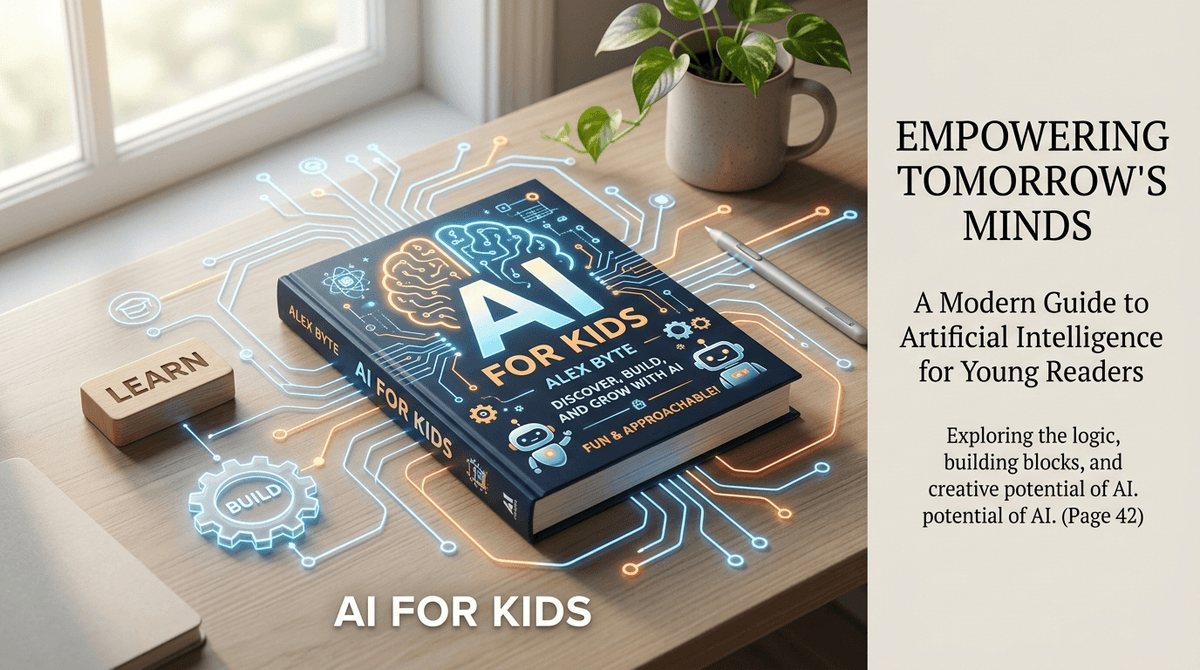
Yes, an 8-year-old can understand neural networks—but only if you stop explaining them like a college professor and start explaining them like a game of "hot or cold." Most AI books for kids are glorified picture books that treat "The Cloud" like a magical kingdom. AI for Kids by Alex Byte is the rare exception that actually respects a middle-grader's intelligence, skipping the "robots are our friends" fluff to show them how machine learning actually functions under the hood.
If you want your kid to move from being a consumer of AI to someone who understands the logic behind it, AI for Kids is a legit STEM win. It’s a project-based introduction that handles complex topics like data sets and neural networks through clear metaphors and hands-on logic, making it a perfect companion for kids already into Scratch or Code.org.
Most "tech for kids" books fall into two traps: they are either so simplified they’re useless, or so dry they end up as expensive coasters. Alex Byte manages to thread the needle. This isn't a book about the history of computers; it’s a manual for how machines "think."
The guide is broken down into three main phases: Discover (the concepts), Learn (the math/logic without the tears), and Build (the application). It covers the heavy hitters: supervised vs. unsupervised learning, neural networks, and how data bias happens. It’s written for the 8–12 crowd, which is the sweet spot where they’re old enough to grasp abstract logic but young enough to still be genuinely curious about how a self-driving car doesn't hit a mailbox.
The "Screenwise" take on this is simple: literacy is better than restriction. You can spend your life worrying about what ChatGPT is doing to their homework, or you can show them that ChatGPT is basically just a very sophisticated version of autocomplete. This book does the latter.
The "No-Magic" Zone
Byte is great at demystifying the "black box." He explains neural networks using a "brain" metaphor that actually makes sense—layers of "deciders" passing information along. When a kid realizes that AI is just a series of "if/then" statements and probability scores on steroids, the "scary" or "magical" element disappears. That’s when real learning starts.
Project-Based, Not Just Theory
The book encourages kids to actually do things. While it’s not a pure coding manual (you won't be writing 500 lines of Python on day one), it uses conceptual projects to reinforce the ideas. It’s about building the mental models first. If your kid is already a fan of Roblox Studio or tinkering with Minecraft Redstone, they’ll recognize the logic immediately.
Tackling the "Why" and the "Oops"
One of the best sections covers algorithmic bias. It explains how, if you only show a computer pictures of golden retrievers and tell it "this is a dog," it will think a chihuahua is a cat. For a 10-year-old, this is a lightbulb moment. It turns AI from an objective truth-teller into a tool that is only as good as the data we give it.
No book is perfect. If your kid is on the younger end of the 8–12 spectrum and isn't already a "math kid" or a "Lego kid," some of the neural network diagrams might feel like a bit much. This isn't a book they’ll necessarily devour under the covers with a flashlight; it’s a "kitchen table" book. You’ll probably want to be nearby to talk through the "hidden layers" section, not because it’s poorly written, but because the concept is inherently trippy.
Also, keep in mind that this is a foundation-builder. It won't turn them into an AI engineer by Chapter 4. It’s meant to spark the interest that leads them to our best coding apps for kids list or deeper dives into Khan Academy.
If your kid is vibing with the book, don't just let it sit on the shelf. Use it to audit the tech you already use.
- The "Identify the AI" Game: Next time you're on Netflix or YouTube, ask them: "How did the computer decide to show us this specific movie?" Let them use the terms from the book (data sets, recommendations, bias).
- Pair it with Scratch: There are some incredible AI extensions for Scratch that allow kids to train their own simple models (like recognizing a "happy face" vs. a "sad face" via webcam). Seeing the book's theory meet the webcam's reality is the ultimate "aha!" moment.
- Talk about the "Hallucinations": When an AI gets something hilariously wrong, don't just laugh—ask them why based on what they read. Did it lack enough data? Was the "neural network" too simple?
The biggest takeaway is that this book isn't about "screen time"—it's about "tool time." It treats the computer as a hammer or a saw—something to be understood and used, not just something that happens to you. If you’ve been looking for a way to bridge the gap between "my kid plays games all day" and "my kid understands technology," this is your bridge.
Q: Is "AI for Kids" too hard for an 8-year-old? It depends on the kid, but the 8-year-old mark is the "with help" age. If they can handle the logic of Pokemon stats or basic Scratch blocks, they can handle the concepts here, though they might need you to read it with them.
Q: Does my kid need to know how to code before reading this? No. This is a conceptual introduction. It explains the logic of machine learning, which actually makes learning to code much easier later on because they understand the "why" before the "how."
Q: Is this book just about ChatGPT? Not at all. It covers the broad spectrum of machine learning—from image recognition to self-driving cars and recommendation engines. It's about the technology, not just one specific app.
Q: Will this book be outdated in six months? While the specific apps mentioned might change, the core principles of neural networks and data sets haven't changed in decades. This book focuses on those fundamentals, so it has a much longer shelf life than a "how-to" guide for a specific software.
AI for Kids is a rare find: a tech book that doesn't talk down to kids and doesn't bore adults. If you have a kid who is constantly asking "but how does it know?", give them this. It’s a solid investment in their digital literacy that pays off every time they open an app.
- Check out our best apps for kids list for coding tools that pair well with this book.
- Explore the digital guide for elementary school to see where AI literacy fits into the bigger picture.
- Find more books about game design and logic
