

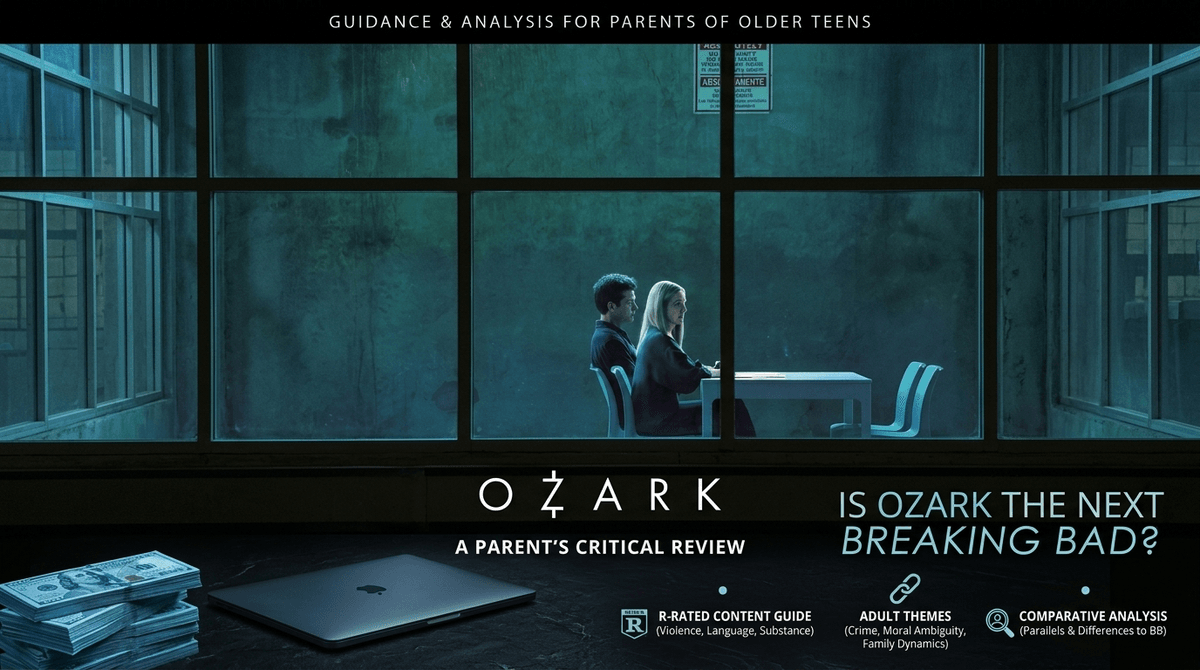
Ozark is rated TV-MA—and honestly, if it were any darker, you wouldn't be able to see the screen, both because of the literal blue-tinted cinematography and the pitch-black moral choices the Byrde family makes every single episode.
TL;DR: Ozark is a high-stakes crime thriller that earns its TV-MA rating through graphic violence, pervasive "F-bombs," and intense psychological stress. While it shares a "good man gone bad" DNA with Breaking Bad, it’s arguably bleaker and more cynical, making it appropriate only for older teens (16+) who can navigate complex themes of money laundering, cartel violence, and the erosion of family ethics. Screenwise gives it a high "intensity" score, so proceed only if your teen is ready for a show where nobody is truly the "good guy."
If you haven't been initiated into the stressful world of the Byrde family, here’s the setup: Marty Byrde (Jason Bateman) is a Chicago financial advisor who has been quietly laundering money for a Mexican drug cartel. When his partner gets caught skimming and is promptly executed, Marty fast-talks his way out of a bullet by promising to set up a massive laundering operation in the Lake of the Ozarks, Missouri.
He drags his wife, Wendy (Laura Linney), and their two kids, Charlotte and Jonah, to a drafty house on the lake. What follows is four seasons of the family trying to stay one step ahead of the FBI, local heroin kingpins, the Kansas City mob, and the cartel itself. It’s a pressure cooker that never lets up, exploring how a "normal" suburban family can justify horrific things in the name of survival.
The comparison is inevitable. Both shows feature a middle-aged man using his "boring" professional skills (chemistry vs. accounting) to serve the drug trade. But where Walter White’s journey is fueled by ego and a "kingpin" fantasy, Marty Byrde is fueled by a desperate, clinical need to survive.
In many ways, Ozark is more of a family ensemble. Wendy Byrde doesn't just "tolerate" the crime; she eventually becomes the driving force behind the family’s political and criminal expansion. For parents, this is the most interesting (and disturbing) part: watching how the kids, Jonah and Charlotte, are forced to grow up in a world where "cleaning" money is a family chore.
If your teen is asking to watch this because they finished Better Call Saul or The Wire, they are looking for that high-level prestige drama. Just know that Ozark lacks the occasional humor found in those shows; it’s a much grittier, more claustrophobic experience.
Even though the final season aired a few years ago, Ozark remains a staple in the "must-watch" canon for older teens. There are a few reasons why it sticks:
- The Stakes: In the world of TikTok and fast-paced media, Ozark delivers immediate, life-or-death consequences in every episode.
- Ruth Langmore: Julia Garner’s character, Ruth, is a fan favorite. She’s a brilliant, foul-mouthed, "trashy" local who is smarter than everyone else in the room. Teens often relate to her struggle to break out of her family's cycle of poverty and crime.
- The "Adult" Factor: It feels sophisticated. Watching Ozark feels like a rite of passage into "serious" television, moving away from YA tropes found in Stranger Things or Outer Banks.
At Screenwise, we don't just look at "bad words" (though there are plenty). We look at the psychological weight of the content. Here is the no-BS breakdown of what’s in the show:
1. Violence and Gore
It’s not constant, but when it happens, it’s brutal. We’re talking about people being dissolved in acid, electrocutions, point-blank executions, and torture. One of the most haunting elements is the "disposal" of bodies, which is handled with a clinical coldness that can be more disturbing than a typical slasher movie.
2. Language
The "F-word" is used as a noun, verb, and adjective in almost every scene. If your family has a strict "no profanity" rule, this show is going to be a non-starter within the first five minutes.
3. Sexual Content
There are several graphic sex scenes throughout the series, including some depictions of non-consensual situations and brief nudity. It’s not Game of Thrones level, but it’s definitely not "family viewing."
4. The Moral Vacuum
This is the big one. Marty and Wendy often involve their children in their crimes. Jonah, the son, eventually starts laundering money himself via cryptocurrency. For an intentional parent, the "danger" here isn't just the violence; it's the depiction of a family where loyalty is prioritized over morality, and where lying becomes a survival skill.

If you decide your 16 or 17-year-old is mature enough for Ozark, don't just let them disappear into their room for a 40-hour binge. This show is a goldmine for "what would you do?" conversations.
- The "Sunk Cost" Fallacy: Marty keeps thinking if he just does one more job, they’ll be safe. Talk about how easy it is to get trapped in bad decisions once you've made the first one.
- The Ethics of Money: The show does a great job (if you can call it that) of explaining how money laundering actually works. It’s a great jumping-off point to talk about the global financial system and why "victimless" white-collar crime actually hurts people.
- Family Loyalty vs. Integrity: At what point should Charlotte or Jonah have walked away? Is being "loyal" to your parents a good thing if your parents are actively hurting people?
If your 13 or 14-year-old is feeling left out of the Ozark conversation, there are ways to scratch that "thriller" itch without the trauma:
- Sherlock: High intelligence, high stakes, but much less "grimy."
- The Good Place: Hear me out—it deals with the same deep moral dilemmas about what it means to be a "good person," but it’s a comedy and much more appropriate for middle schoolers.
- Knives Out: A great entry point into the "crime and consequence" genre with a PG-13 rating.
Q: Is Ozark okay for a 14-year-old? Generally, no. Screenwise recommends waiting until at least 16 due to the graphic nature of the violence and the heavy psychological themes. Most 14-year-olds will find the slow-burn financial plot boring, while the sudden bursts of extreme violence can be genuinely upsetting.
Q: How much nudity is in Ozark? There is occasional graphic nudity and several explicit sex scenes. While it isn't the focus of every episode, it occurs frequently enough that it earns its TV-MA rating for "S" (Sexual Content) alongside violence and language.
Q: What are the main triggers in Ozark? The show features depictions of drug addiction, domestic abuse, terminal illness (cancer), suicide, and various forms of torture. It is a very "heavy" show that can be taxing for viewers sensitive to themes of hopelessness or family betrayal.
Q: Is Ozark better than Breaking Bad? That’s a matter of taste! Breaking Bad is often cited as having a more perfect "arc," while Ozark is praised for its intense atmosphere and the strong performance of its female lead, Wendy Byrde. Both are top-tier dramas, but Ozark feels more like a modern horror story about the American Dream.
Ozark is a brilliant, well-acted, and incredibly stressful piece of television. It’s the kind of show that makes you want to go for a long walk in the sunshine afterward just to remember that the world isn't entirely made of blue filters and cartel threats.
For parents of older teens, it can be a great way to engage with complex themes of morality and consequence. For parents of younger kids, keep this one behind the Netflix parental controls for a few more years. There’s plenty of time for them to learn about the dark side of the Ozarks later.