

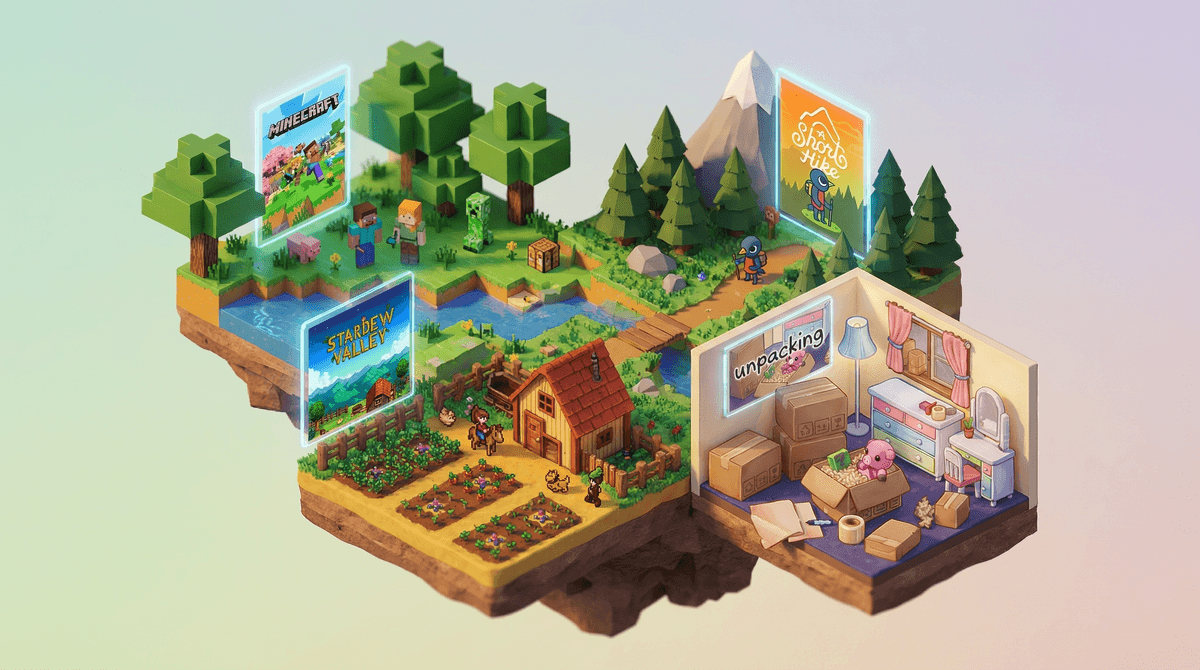
Look, I get it. You bought an Xbox (or your kid is begging for one), and suddenly you're drowning in a sea of first-person shooters, battle royales, and games where the main objective seems to be "eliminate everything that moves." But here's the good news: the Xbox library is actually packed with incredible games that skip the violence entirely and focus on creativity, exploration, puzzle-solving, and yes, even learning.
Nonviolent games aren't just "kid versions" of the real thing—many of them are legitimately some of the best games on the platform, period. We're talking about titles that engage problem-solving skills, encourage creativity, and provide hours of entertainment without a single health bar or respawn screen.
The research on kids and violent video games is... complicated. But here's what's not complicated: you get to decide what feels right for your family. Maybe you're not ready for your 8-year-old to be playing games centered around combat. Maybe your kid just genuinely isn't interested in shooting things and wants something different. Maybe you're looking for games you can actually enjoy playing together without cringing.
Whatever your reason, nonviolent games offer something really valuable: they prove that gaming can be engaging, challenging, and fun without relying on combat as the core mechanic. Plus, these games often emphasize skills like spatial reasoning, resource management, and creative problem-solving—which is a nice bonus when you're trying to justify that screen time.
Building and Creativity
Minecraft (Ages 6+)
Yeah, yeah, everyone knows about Minecraft. But there's a reason it's the best-selling game of all time. In Creative Mode or on Peaceful difficulty, it's pure building and exploration—no zombies, no stress, just infinite LEGO-like possibilities. The Xbox version has great split-screen co-op too, which means family building sessions on the couch.
LEGO Builder's Journey (Ages 5+)
This is basically a zen meditation with LEGO bricks. Beautiful, calming, and focused entirely on building creative solutions to environmental puzzles. It's short (2-3 hours), but it's gorgeous and perfect for younger kids who are just getting into gaming.
Exploration and Adventure
Slime Rancher (Ages 7+)
You're a rancher on an alien planet collecting adorable slimes, feeding them, and building your farm. It's like if Pokémon and Stardew Valley had a baby. There's light resource management, exploration, and zero violence—just bouncy, happy slimes. Kids absolutely love this one.
A Short Hike (Ages 6+)
You're a bird on a hiking trip trying to reach the summit of a mountain. That's it. That's the game. And it's absolutely delightful. The vibe is pure cozy exploration with charming characters and no pressure. Perfect for kids who need a break from high-stakes gaming.
Spiritfarer (Ages 10+)
This one's a bit more emotionally mature—you're a ferry master helping spirits move on to the afterlife. But it's all about building relationships, crafting, farming, and exploring. It deals with themes of death and loss in a beautiful, gentle way. Not for everyone, but for families who can handle those conversations, it's stunning.
Puzzle and Problem-Solving
Unpacking (Ages 6+)
You unpack boxes and arrange items in rooms. That's literally the entire game. And somehow it's completely mesmerizing and tells a whole life story through objects. It's like Marie Kondo meets narrative gaming. Surprisingly emotional, totally nonviolent, and oddly satisfying.
Portal 2 (Ages 10+)
Okay, technically there are turrets that shoot at you, but there's zero blood or gore—it's all about solving mind-bending physics puzzles with portals. The co-op mode is brilliant for parent-kid teamwork. The humor is sharp and clever (maybe a bit sarcastic for younger kids, but nothing inappropriate).
Human Fall Flat (Ages 7+)
Physics-based puzzle platformer where you control a wobbly human trying to navigate obstacle courses. It's hilarious, especially in co-op mode, and the only "violence" is your character flopping around like a ragdoll. Pure silly fun.
Cozy and Relaxing
Stardew Valley (Ages 10+)
The gold standard of cozy gaming. You inherit a farm, plant crops, raise animals, make friends with townspeople, and slowly build your agricultural empire. There's technically a combat element in the mines, but it's completely optional and cartoonish. The real game is about routine, growth, and making your farm exactly how you want it.
PowerWash Simulator (Ages 6+)
You power wash dirty things until they're clean. That's it. And it's weirdly, incredibly satisfying. Kids love seeing the grime disappear, and it's basically a zen experience. Plus, there's co-op so you can clean together—which is probably the only time your kids will voluntarily participate in cleaning anything.
Sports and Racing
Rocket League (Ages 7+)
Soccer with rocket-powered cars. Fast-paced, competitive, and requires genuine skill, but zero violence. The online community can be toxic (turn off chat), but the core game is pure sports competition.
Forza Horizon 5 (Ages 8+)
Open-world racing through gorgeous Mexican landscapes. You can just cruise around, explore, and drive cool cars without ever racing if you want. The game is stunning visually and offers a ton of freedom. Yes, you crash cars, but it's all arcade-style with no consequences.
Real talk: if you have an Xbox, you need Game Pass. It's like Netflix for games, and a huge percentage of the games I just mentioned are included. For $10-15/month, your kid can try tons of games without you dropping $60 each time they want something new. Games like Minecraft, Slime Rancher, Unpacking, PowerWash Simulator, and Human Fall Flat are all on there.
Learn more about whether Xbox Game Pass is worth it for your family
Ages 5-7: Stick with LEGO Builder's Journey, Minecraft (Creative Mode), PowerWash Simulator, and A Short Hike. These have simple controls and no reading requirements.
Ages 8-10: Add Slime Rancher, Human Fall Flat, Rocket League, and Forza Horizon 5. These require a bit more coordination but are still very accessible.
Ages 10+: Everything's on the table. Stardew Valley, Portal 2, and Spiritfarer offer more complex mechanics and deeper narratives that older kids will appreciate.
Co-op is king. Many of these games (Minecraft, Portal 2, Human Fall Flat, PowerWash Simulator) have split-screen or online co-op. Playing together is not only more fun, but it's also a great way to actually see what your kid is experiencing and have real conversations about problem-solving and strategy.
"Nonviolent" doesn't mean "easy." Some parents assume these games are somehow less challenging or engaging. Nope. Portal 2 will make your brain hurt. Stardew Valley is legitimately complex. These games respect players' intelligence.
Watch out for online interactions. Even in nonviolent games like Rocket League or Minecraft, online multiplayer can expose kids to toxic chat and behavior. Use parental controls to limit or disable chat, and stick to playing with friends when possible. Here's how to set up Xbox parental controls.
Some kids will still want combat games. And that's okay too. This isn't about demonizing all games with fighting—it's about knowing you have options. Some kids genuinely love action games, and that's a separate conversation about age-appropriateness and content.
The Xbox isn't just a violence machine—it's home to some of the most creative, thoughtful, and engaging games out there. Whether your kid wants to build, explore, solve puzzles, or just power wash a virtual playground, there are genuinely excellent options that skip the combat entirely.
The key is knowing these games exist and being willing to guide your kid toward them. Because left to their own devices (literally), kids will gravitate toward whatever's most heavily marketed—which is usually the latest shooter. But give them Slime Rancher or Stardew Valley, and you might be surprised how quickly they forget about the explosions.
✅ Check out Xbox Game Pass to try multiple games without committing to full purchases
✅ Set up parental controls to manage online interactions and screen time limits
✅ Try co-op gaming together—it's a totally different experience than watching them play
✅ Ask your kid what they're interested in—building? exploring? puzzles?—and match games to their interests
Want more recommendations? Explore alternatives to popular violent games or Find nonviolent games for your kid.