

TL;DR: The Quick Guide to News Without the Nightmare
If you’re short on time (because, let’s be honest, you’re probably reading this in the carpool lane), here is the high-level strategy for keeping your kids informed without destroying their mental health:
- Ditch the Feed: Stop letting TikTok or Instagram be their primary news source. The algorithm optimizes for outrage, not accuracy.
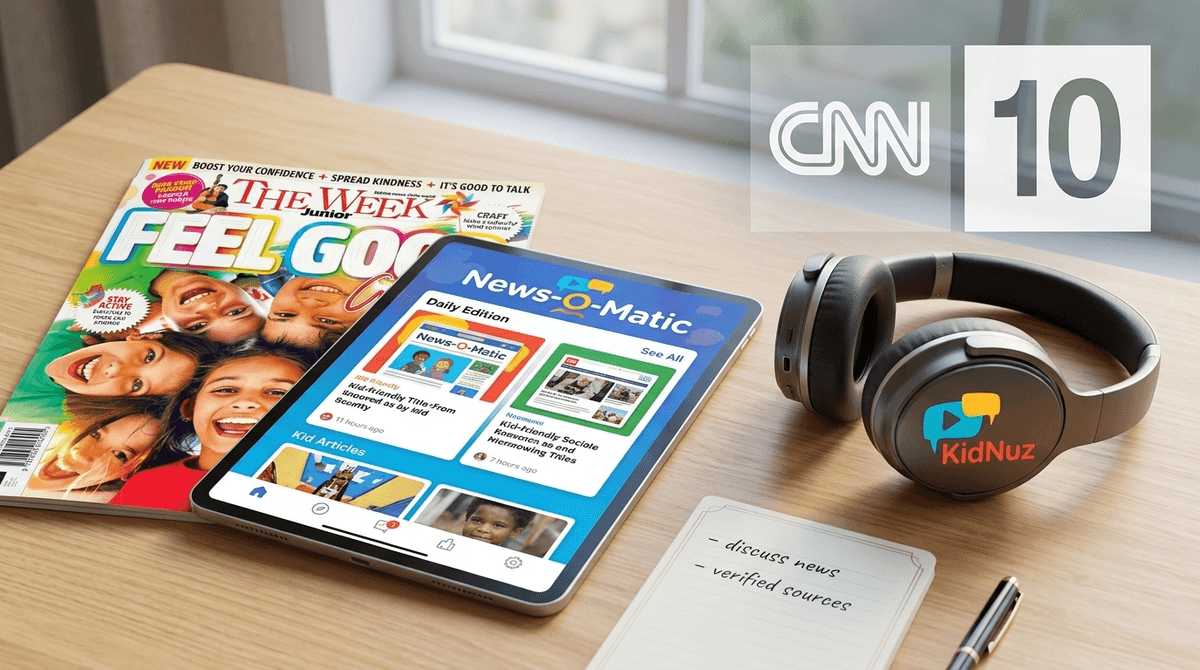
- Use Purpose-Built News: Switch to curated, age-appropriate platforms like Newsela, The Week Junior, or News-O-Matic.
- Spot the "Slop": Teach them that if a video looks weirdly shiny, has six fingers on a hand, or sounds like a robot reading a script, it’s AI "slop"—low-effort content designed to farm engagement or spread "slopaganda."
- Audio is Better: Podcasts like Wow in the World or KidNuz provide context without the scary visuals.
Check out our guide on the best news sources for kids
We used to worry about our kids seeing a stray "adult" scene in a movie. Now, we’re worried about them being radicalized by a 15-second clip of a guy in a truck screaming about the economy, or worse, a completely fabricated AI video of a world leader saying something they never said.
Our kids are growing up in an era of "slop." If you haven't heard the term, "slop" is the digital equivalent of industrial runoff. It’s the AI-generated images of "Jesus made of shrimp" or fake political protests that flood Facebook and X/Twitter. When that slop is used to push a political agenda, we call it slopaganda.
For a kid, the line between a real news report and a high-budget AI fabrication is razor-thin. They don't have the decades of "pre-internet" context we have to realize when something feels "off." To them, if it’s on their "For You Page," it’s just... the world.
It’s not that kids are inherently political junkies. It’s that political content is designed to trigger the same dopamine loops as Roblox or Minecraft.
- The Drama: Politics is framed as a high-stakes sport. There are "villains," "heroes," and constant "breaking news" alerts that make them feel like they’re part of a global event.
- The Logic of "Ohio": You know how kids use "Ohio" to mean anything weird or chaotic? The current political landscape is, for lack of a better word, very Ohio. It’s weird, it’s loud, and it’s meme-able.
- Social Currency: Being "in the know" about a global conflict or a viral political gaffe gives them something to talk about on the bus.
Get advice on how to talk to kids about scary news
If you want your kids to be informed citizens without the 24/7 anxiety cycle, you have to be the curator. Here are the platforms actually doing it right.
This is a weekly print magazine (yes, actual paper!) that covers current events, science, and culture. It is arguably the best resource for kids ages 8-14. It explains complex topics (like inflation or elections) without being condescending or terrifying.
Newsela takes real-world news stories from major outlets and rewrites them at five different reading levels. It’s a fantastic way to let a 3rd grader and a 7th grader read the same story in a way that makes sense for their respective brain developments.
Formerly "CNN Student News," this is a 10-minute daily digital news show. It’s fast-paced, visual, and non-partisan. It’s a staple in many middle school classrooms for a reason.
If you’re looking for a morning routine upgrade, KidNuz is a 5-minute daily podcast created by journalists who are also moms. It’s punchy, factual, and completely kid-appropriate.
This is a daily news app designed specifically for elementary and middle schoolers. Every article is reviewed by a child psychologist to ensure the tone is right. It also features interactive maps and games to keep them engaged.
Elementary (Ages 6-10)
At this age, kids don't need "the news." They need context. If they hear about a war or a protest, they need to know they are safe.
- The Strategy: Focus on "Helper News." Focus on stories about people solving problems. Use Wow in the World to show them that the world is full of wonder and discovery, not just conflict.
- The Boundry: Keep YouTube and TikTok off-limits for news. The "Up Next" feature is a one-way ticket to some very dark places.
Middle School (Ages 11-13)
This is the danger zone for "slopaganda." They are starting to explore social media, and their peers are sharing memes that are often politically charged.
- The Strategy: Start teaching "Digital Forensics." When they show you a wild video, ask: "Who made this? What do they want us to feel? Is this a real person or AI?"
- The Tool: Introduce them to The Week Junior or CNN 10.
High School (Ages 14-18)
They are likely getting their news from X/Twitter or Reddit. You can't stop it, so you have to lean into it.
- The Strategy: Talk about bias. Show them the AllSides media bias chart. Encourage them to follow creators with different viewpoints so their algorithm doesn't become a total echo chamber.
- The Tool: Suggest more long-form content like The Daily podcast or Up First to give them depth beyond the headlines.
Learn more about teaching media literacy to teens
The most important thing you can teach your kid right now is skepticism.
AI content is getting so good that "seeing is believing" is officially dead. Here are three quick red flags to teach your kids:
- The "Uncanny Valley" Glow: AI images often have a weird, airbrushed, hyper-vibrant look. If the lighting looks too perfect or "dreamlike," it’s probably AI.
- The Source Check: If a "breaking news" story is only being reported by an account called "@TruthBomb9928" and not by The Associated Press or BBC News, it’s fake.
- The Emotional Tug: If a post is designed to make you feel instant rage or extreme fear, it is likely "engagement bait" or propaganda. Real news is often kind of... boring.
Check out our guide on identifying AI-generated content
Politics is personal, and in many households, it’s a minefield. But your kids are going to form opinions whether you’re involved or not.
Instead of telling them what to think, focus on how to think.
- Ask "Where did you see that?": Don't judge the source immediately. Just get them talking about their discovery process.
- Acknowledge the Anxiety: If they’re worried about the climate or a war, don't dismiss it. Say, "Yeah, that is a big, heavy thing. Here is what people are doing to try and fix it."
- Model Healthy Habits: If you’re constantly screaming at the TV or doomscrolling Facebook at dinner, they’re going to mirror that behavior. Show them what it looks like to consume news intentionally and then put the phone down.
Find conversation starters for kids about current events
The goal isn't to raise a kid who knows every detail of the latest Congressional bill. The goal is to raise a kid who isn't a victim of the algorithm.
In 2026, being "screenwise" means knowing that the digital world is currently flooded with "slop" and "slopaganda." By steering them toward high-quality, curated sources like The Week Junior or Newsela, you’re giving them the tools to understand the world without being overwhelmed by it.