

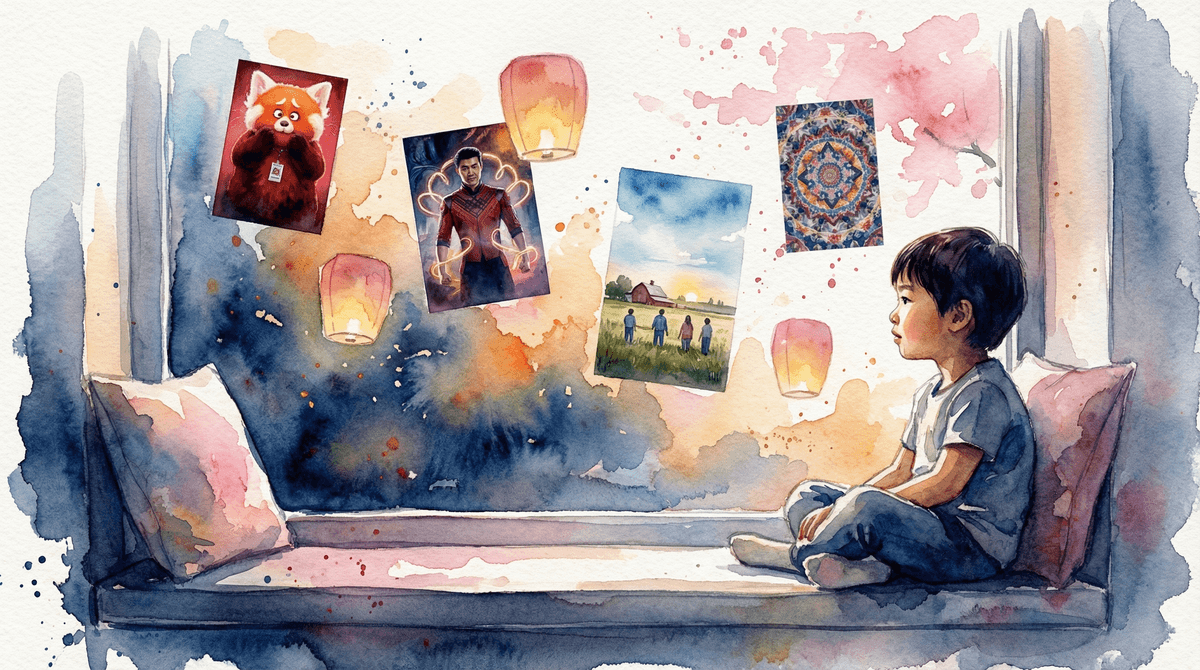
Let's be honest: for too long, Asian American kids have grown up watching movies where people who look like them are either nowhere to be found, or they're the nerdy sidekick, the martial arts expert, or the butt of an accent joke. And that matters more than we might think.
When kids see themselves reflected authentically on screen—not as stereotypes, but as full, complex humans—it changes something. It tells them their stories matter. It gives them language for their experiences. And for kids who aren't Asian American? It builds empathy and understanding in ways that no lecture about "being nice to everyone" ever could.
The good news: we're living through a genuine shift. From Everything Everywhere All at Once sweeping the Oscars to Turning Red capturing the specific chaos of being a Chinese Canadian tween, there's finally a growing library of films that get it right.
Here's what the research tells us: kids who see positive representations of their own identity have higher self-esteem and better academic outcomes. Kids who see diverse representations of other identities develop more empathy and less prejudice. This isn't soft skills stuff—this is foundational.
For Asian American kids specifically, representation combats the "perpetual foreigner" stereotype, the model minority myth, and the casual racism that still shows up everywhere from playgrounds to TikTok comments. When your kid watches Raya and the Last Dragon and sees a Southeast Asian-inspired hero saving the world, or watches Shang-Chi and sees a Marvel superhero who speaks Mandarin with his dad—that's not just entertainment. That's identity formation.
And let's talk about what happens when representation is missing. Asian American kids internalize the message that they're supporting characters in someone else's story. They learn to laugh at jokes about their food, their names, their parents' accents. They might start to feel ashamed of the very things that make them who they are.
Ages 3-7: Building the Foundation
Start young. Raya and the Last Dragon is a solid Disney adventure with Southeast Asian influences (though yes, it's a mashup of cultures, not a documentary). Abominable features a Chinese American girl in a sweet story about a magical yeti. Over the Moon tackles grief and blended families through Chinese mythology.
The key at this age: just normalizing Asian faces as protagonists. You don't need to make a big deal about it—just let it be part of their media diet.
Ages 8-12: Getting More Complex
This is when kids start noticing identity stuff more consciously. Turning Red is chef's kiss for this age—it's about a Chinese Canadian girl dealing with puberty, family expectations, and literally turning into a giant red panda when she gets emotional. Some parents clutched their pearls about the period references, but come on, it's 2025.
The Karate Kid (2010) with Jaden Smith features Jackie Chan in a mentor role that subverts some stereotypes while leaning into others—worth a watch and a conversation. Big Hero 6 has a mixed-race Asian American protagonist in a futuristic San Fransokyo.
Ages 13+: Real Talk Territory
Now we can get into the good stuff. Everything Everywhere All at Once is rated R for language and some violence, but for mature teens, it's a masterpiece about immigrant parents, generational trauma, and existential chaos. The Farewell explores Chinese vs. American values around death and family—deeply moving and conversation-worthy.
Crazy Rich Asians is PG-13 and fun, though it's specifically about wealthy Singaporeans, not the broader Asian American experience. Minari (PG-13) tells a beautiful, quiet story about a Korean immigrant family in 1980s Arkansas—it's slow but powerful.
For teens interested in history, The Terror: Infamy covers Japanese American incarceration during WWII (though it's a horror show, so know what you're getting into).
Don't just hit play and zone out. These movies are conversation starters:
Ask open-ended questions:
- "Have you ever felt like the character when they [specific scene]?"
- "What do you think about how the family handled that situation?"
- "Did anything in this movie surprise you?"
Point out the nuances:
- "Notice how this movie shows different kinds of Asian American families—not just one stereotype"
- "See how the character code-switches between English and [language]? Have you noticed people doing that in real life?"
Connect to their world:
- "Do you think kids at your school ever feel like this character?"
- "What would you do differently if you were in this situation?"
Not every movie with Asian characters is worth your time. Some things to watch out for:
Cultural mashup confusion: Some movies throw together pan-Asian aesthetics without care (looking at you, Raya—it's pretty but it's Southeast Asian soup).
White savior narratives: If the Asian characters are just there to teach the white protagonist about honor or wisdom or whatever, skip it.
Accent jokes: If the humor relies on mocking how someone speaks English, that's lazy writing and casual racism. Don't normalize it.
Model minority perfection: If every Asian character is a straight-A student with tiger parents and no other personality traits, that's a stereotype, not representation.
Representation isn't about checking boxes or being politically correct—it's about giving kids mirrors and windows. Mirrors to see themselves, windows to see others. Asian American kids deserve to see their experiences reflected authentically. And all kids benefit from understanding that there's no single "Asian" or "American" experience—there are millions of stories worth telling.
Start building this into your family's media rotation now. Make it normal. And when something feels off—a joke that doesn't land right, a stereotype that makes you uncomfortable—pause and talk about it. That's where the real learning happens.
Want more specific recommendations? Check out our guides on family movies about identity or shows that celebrate diverse cultures.
Looking for other types of representation? We've got guides on movies with Black protagonists, LGBTQ+ inclusive family content, and Latino representation in kids' media.
Want to dig deeper into a specific film? Search our media database—we've got detailed breakdowns, parent reviews, and age ratings for hundreds of titles.