

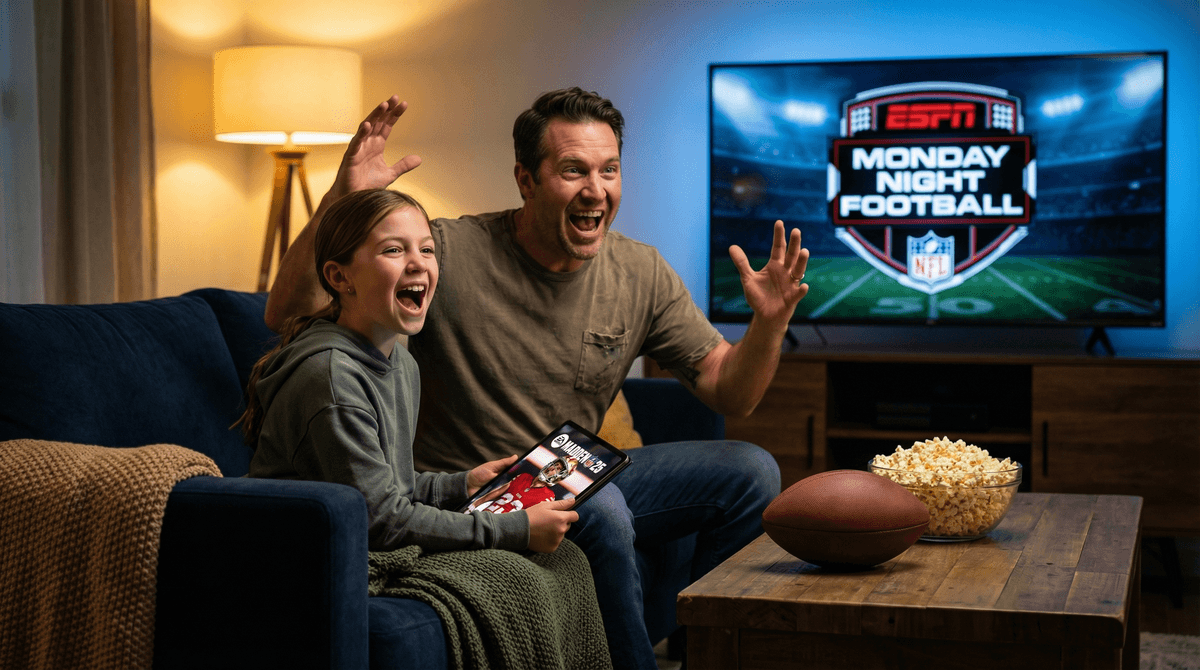
Monday Night Football (MNF) is the NFL's primetime television broadcast that airs weekly during football season, typically from September through early January.
It's been a cultural institution since 1970, making it one of the longest-running sports programs in television history.
For many families, it's more than just a game—it's a tradition. Kids grow up watching with parents, learning team loyalties, and experiencing the excitement of live sports.
But here's what's changed: Today's kids aren't just passively watching on TV. They're streaming on tablets, following players on social media, playing fantasy football on their phones, and watching game highlights on YouTube and TikTok.
The experience has become multi-screen, interactive, and significantly more time-consuming than the traditional three-hour broadcast.
The excitement is real. Live sports create genuine suspense that scripted content can't match. Kids experience authentic emotions—the thrill of a last-minute touchdown, the disappointment of a fumble.
It's social currency. Especially for kids ages 8-14, being able to discuss last night's game at school matters. They want to participate in conversations about amazing plays, controversial calls, and team standings.
Connection with parents. Many kids genuinely cherish watching games with their parents or grandparents. It's shared time with built-in conversation topics and emotional moments you experience together.
Fantasy football integration. For tweens and teens, fantasy leagues add a layer of engagement. They're not just watching a game—they're tracking "their" players' stats, which makes every play feel personally relevant.
The athlete culture. Kids follow their favorite players across social media, seeing their personalities beyond the field. These athletes become role models (for better or worse).
It feels grown-up. Staying up late on a school night to watch a game makes kids feel included in adult activities and family rituals.
The Time Commitment Reality
A typical Monday Night Football game runs 3 to 3.5 hours, often ending between 11 PM and midnight Eastern time (8-9 PM Pacific).
For school-age kids, this creates a real dilemma. The game doesn't end until well past recommended bedtimes for elementary and middle schoolers.
Many parents face the weekly decision: let kids stay up late or deal with disappointment when they have to go to bed before the game ends.
What research shows: Sleep-deprived kids struggle with attention, emotional regulation, and academic performance. The American Academy of Pediatrics recommends 9-12 hours for ages 6-12, and 8-10 hours for ages 13-18.
One late night won't derail everything, but making it a weekly habit can create cumulative sleep debt that affects the entire school week.
Content Considerations
Violence on the field. Football is a contact sport. Kids will see hard hits, injuries, and occasionally players being carted off the field. This can be distressing, especially for younger or sensitive children.
Commercials matter. NFL broadcasts include ads for alcohol, sports betting, erectile dysfunction medications, and violent movie trailers. You can't control what pops up during commercial breaks.
Sports betting normalization. The integration of betting odds, point spreads, and gambling advertising has exploded. Kids are being exposed to gambling culture as a normal part of sports consumption.
Controversial moments. Games can include fights between players, angry outbursts, and unsportsmanlike conduct. These become teaching moments—or modeling of poor behavior.
The Multi-Screen Reality
Kids today rarely watch "just" the game. They're simultaneously:
- Texting friends about plays
- Checking fantasy football scores
- Watching TikTok highlights
- Following player social media
- Playing Madden NFL during commercials
What looks like "watching football together" might actually be fragmented attention across multiple devices.
This matters because the benefit of watching together—connection, conversation, shared experience—gets diluted when everyone's on their phones.
Ages 5-8: Selective Viewing
What works: Watching the first half or specific quarters, focusing on the experience rather than the outcome.
Set them up for success: Let them stay up for the first quarter as a special treat, then stick to normal bedtime. They get the excitement without the sleep deprivation.
Make it educational: Count downs, learn team colors, understand basic rules. Football can teach math, geography, and teamwork concepts.
Watch for: Fear responses to injuries or aggressive play. Some kids this age aren't ready for the physical nature of the sport.
Ages 9-12: Building Traditions with Boundaries
What works: Designated "football nights" with clear expectations about bedtime, perhaps allowing slightly later sleep on non-school nights or when their team plays.
The sweet spot: This age group can understand strategy, appreciate skill, and engage in meaningful conversations about the game.
Introduce critical thinking: Talk about commercials, discuss sportsmanship, and address what they see. "What do you think about how that player reacted?"
Set device boundaries: Consider a "no phones during the game" rule for everyone, making it genuinely shared time.
Fantasy football caution: If they're participating, monitor time spent on fantasy apps. It can become obsessive, with kids checking scores constantly.
Ages 13+: Independence with Guardrails
What works: Letting them make some decisions about staying up, while maintaining consequences for sleep-deprived behavior the next day.
Natural consequences: If they stay up until midnight and are miserable Tuesday morning, that's valuable learning. Don't rescue them from their choice.
The betting conversation: By this age, they're seeing sports betting normalized everywhere. Have explicit conversations about gambling risks, especially for developing brains.
Social pressure: Teens may feel they have to watch to participate in social conversations. Help them understand they can catch highlights and still engage with friends.
Watch parties: If they're watching with friends, set expectations about supervision, devices, and pickup times.
For the Sports Betting Conversation
"You're seeing a lot of ads about betting on games. Here's what you should know: gambling companies spend billions on advertising because they make money when people lose. The odds are always in the house's favor, and for young people especially, gambling can become addictive really quickly."
For the Sleep Discussion
"I know you want to watch the whole game, and I get it—it's exciting. Here's my concern: you need about 9 hours of sleep, and if the game ends at 11:30, you won't get that. What if we record it and you can watch the second half before school, or we pick specific games that matter most to you?"
For the Violence/Injury Moments
"That looked scary, didn't it? Football is a sport where injuries happen because of how physical it is. Players know the risks and train to be as safe as possible, but it's still dangerous. How are you feeling about what we just saw?"
For the Multi-Screen Issue
"I've noticed we're all watching the game but also on our phones. I'd like to try something—let's put phones away during the game and actually watch together. We can check them during halftime and commercials. I want us to really share this time."
Sleep Hygiene
If kids do stay up late for games:
- Avoid making it every single Monday
- Consider allowing slightly later wake-up times Tuesday morning when possible
- Watch for cumulative effects (irritability, difficulty focusing, mood changes)
- Make Tuesday nights early-to-bed nights to recover
Screen Time Balance
A three-hour game is significant screen time. Consider:
- What else they've watched that day
- Whether this replaces homework or other responsibilities
- If football watching is becoming daily (highlights, commentary shows, fantasy management)
Emotional Regulation
Some kids get intensely emotionally invested in outcomes. Watch for:
- Genuine distress when their team loses
- Aggressive behavior mimicking what they see
- Difficulty transitioning away from the game afterward
- Obsessive focus on stats, scores, and standings
These can indicate they need help developing perspective about sports as entertainment rather than identity.
Monday Night Football can be a wonderful family tradition that teaches kids about teamwork, strategy, geography, and provides genuine connection time.
But it requires intentional parenting.
The default—letting kids watch every week until games end—often doesn't serve their sleep needs, especially for younger children.
The best approach is selective: choosing games that matter most, setting clear boundaries about bedtime, and making the time you do watch together genuinely screen-free and connected.
Football fandom isn't all-or-nothing. Kids can be fans, participate in school conversations, and enjoy the sport without watching every game start to finish.
What matters most is that you're making conscious decisions based on your child's age, sleep needs, and your family values—not just defaulting to what everyone else seems to be doing.
Have a family conversation. Before the next Monday night game, discuss expectations: Which games will you watch together? What's the bedtime plan? What are the device rules?
Try a compromise. Record games and watch the second half before school, or commit to watching only games featuring your family's team.
Create a ritual. Make Monday night football special with specific snacks, seating arrangements, or traditions that make the limited time you do watch feel meaningful.
Check in about content. After games with injuries or controversial moments, ask: "How did you feel about what we saw tonight?" Use it as a conversation starter.
Monitor the expansion. If football watching is extending to Thursday Night Football, Sunday games, and constant highlight watching, it may be taking up too much space in your family's life.
Model healthy fandom. Show kids what balanced sports enthusiasm looks like—passion without aggression, disappointment without devastation, enjoyment without obsession.
Revisit regularly. What works for a 9-year-old won't work for a 13-year-old. Keep adjusting as your kids grow and their needs change.